

Size and Shape Selective Metal Oxide Nanomaterials …
91
MONMs itself with polymeric materials (MONMs/polymer) and the other one is the
(MONMs/polymer) with biomolecules.
The prominent forces that reign NMs, in general, are electrostatic (double layer),
polymeric (steric) and van der Waals interaction. In colloidal state, the NMs should
exhibit small attractive forces to prevent thermal motion breaking process thus it can
exhibit good stabilization. It is achieved by creating an electric double layer at the
interface (solid-liquid) by the addition of ions or changing pH of the solution. If it
is not sufficient then through by an addition/functionalization of polymer or surfactant stabilization, it is done. When polymers are introduced, its segments or chains
enlarge and forms a protective adsorbed layer on the NMs. This is called polymer
induced steric stabilization. The van der Waals force refers to (MONMs/polymer)
with biomolecule interaction. This force arises due to the fluctuating or permanent
diploe moments between biomolecule and MONMs in close interaction. This value
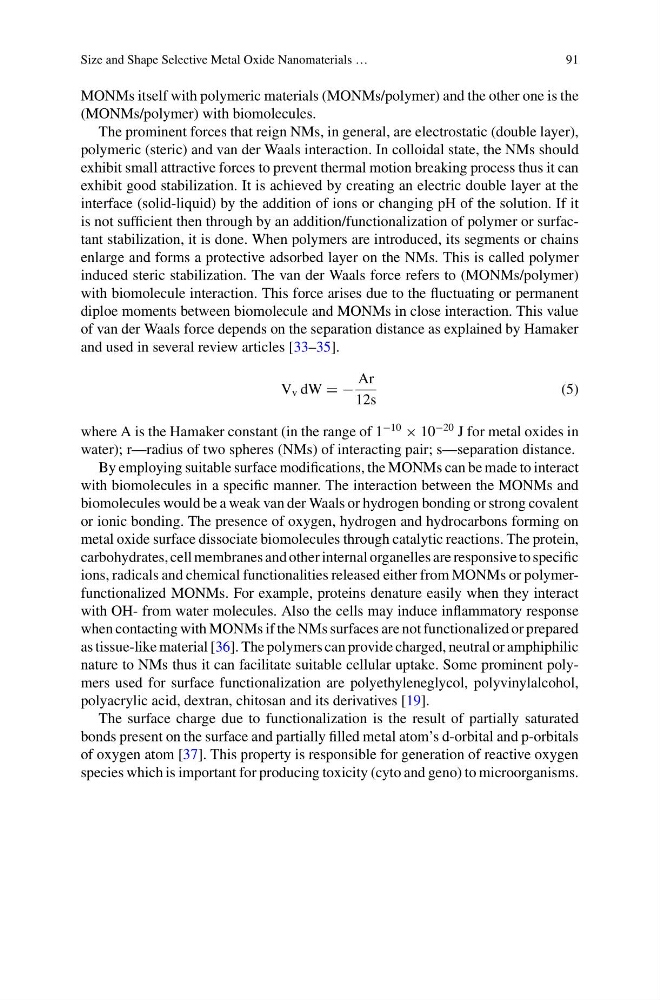
of van der Waals force depends on the separation distance as explained by Hamaker
and used in several review articles [33–35].
V v dW = −
Ar
12s
(5)
where A is the Hamaker constant (in the range of 1
−10
× 10
−20 J for metal oxides in
water); r—radius of two spheres (NMs) of interacting pair; s—separation distance.
By employing suitable surface modifications, the MONMs can be made to interact
with biomolecules in a specific manner. The interaction between the MONMs and
biomolecules would be a weak van der Waals or hydrogen bonding or strong covalent
or ionic bonding. The presence of oxygen, hydrogen and hydrocarbons forming on
metal oxide surface dissociate biomolecules through catalytic reactions. The protein,
carbohydrates, cell membranes and other internal organelles are responsive to specific
ions, radicals and chemical functionalities released either from MONMs or polymerfunctionalized MONMs. For example, proteins denature easily when they interact
with OH- from water molecules. Also the cells may induce inflammatory response
when contacting with MONMs if the NMs surfaces are not functionalized or prepared
as tissue-like material [36]. The polymers can provide charged, neutral or amphiphilic
nature to NMs thus it can facilitate suitable cellular uptake. Some prominent polymers used for surface functionalization are polyethyleneglycol, polyvinylalcohol,
polyacrylic acid, dextran, chitosan and its derivatives [19].
The surface charge due to functionalization is the result of partially saturated
bonds present on the surface and partially filled metal atom’s d-orbital and p-orbitals
of oxygen atom [37]. This property is responsible for generation of reactive oxygen
species which is important for producing toxicity (cyto and geno) to microorganisms.
91
MONMs itself with polymeric materials (MONMs/polymer) and the other one is the
(MONMs/polymer) with biomolecules.
The prominent forces that reign NMs, in general, are electrostatic (double layer),
polymeric (steric) and van der Waals interaction. In colloidal state, the NMs should
exhibit small attractive forces to prevent thermal motion breaking process thus it can
exhibit good stabilization. It is achieved by creating an electric double layer at the
interface (solid-liquid) by the addition of ions or changing pH of the solution. If it
is not sufficient then through by an addition/functionalization of polymer or surfactant stabilization, it is done. When polymers are introduced, its segments or chains
enlarge and forms a protective adsorbed layer on the NMs. This is called polymer
induced steric stabilization. The van der Waals force refers to (MONMs/polymer)
with biomolecule interaction. This force arises due to the fluctuating or permanent
diploe moments between biomolecule and MONMs in close interaction. This value
of van der Waals force depends on the separation distance as explained by Hamaker
and used in several review articles [33–35].
V v dW = −
Ar
12s
(5)
where A is the Hamaker constant (in the range of 1
−10
× 10
−20 J for metal oxides in
water); r—radius of two spheres (NMs) of interacting pair; s—separation distance.
By employing suitable surface modifications, the MONMs can be made to interact
with biomolecules in a specific manner. The interaction between the MONMs and
biomolecules would be a weak van der Waals or hydrogen bonding or strong covalent
or ionic bonding. The presence of oxygen, hydrogen and hydrocarbons forming on
metal oxide surface dissociate biomolecules through catalytic reactions. The protein,
carbohydrates, cell membranes and other internal organelles are responsive to specific
ions, radicals and chemical functionalities released either from MONMs or polymerfunctionalized MONMs. For example, proteins denature easily when they interact
with OH- from water molecules. Also the cells may induce inflammatory response
when contacting with MONMs if the NMs surfaces are not functionalized or prepared
as tissue-like material [36]. The polymers can provide charged, neutral or amphiphilic
nature to NMs thus it can facilitate suitable cellular uptake. Some prominent polymers used for surface functionalization are polyethyleneglycol, polyvinylalcohol,
polyacrylic acid, dextran, chitosan and its derivatives [19].
The surface charge due to functionalization is the result of partially saturated
bonds present on the surface and partially filled metal atom’s d-orbital and p-orbitals
of oxygen atom [37]. This property is responsible for generation of reactive oxygen
species which is important for producing toxicity (cyto and geno) to microorganisms.