

Size and Shape Selective Metal Oxide Nanomaterials …
87
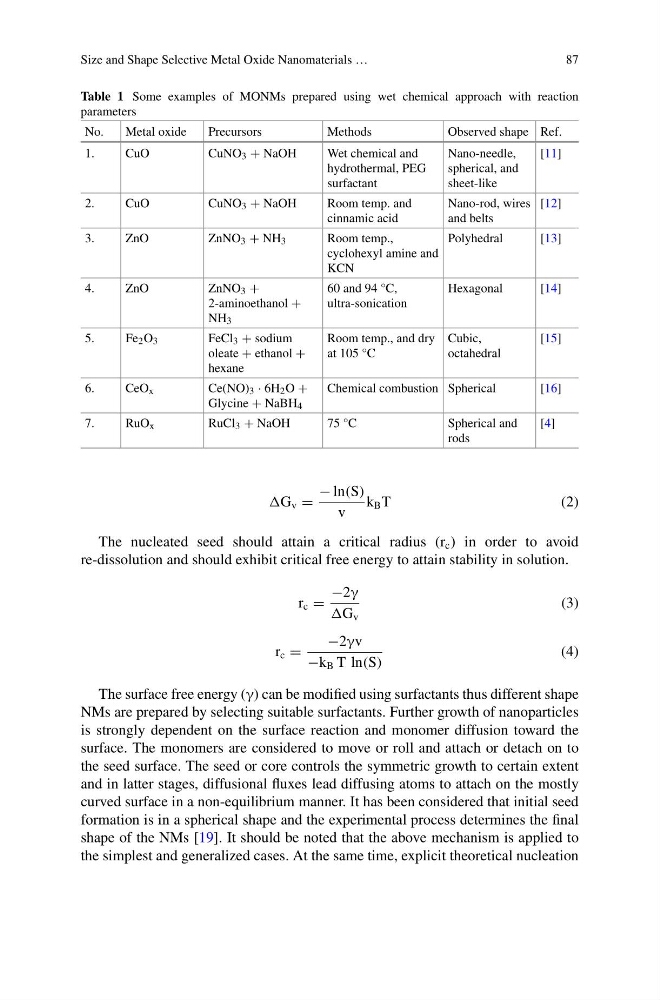
Table 1 Some examples of MONMs prepared using wet chemical approach with reaction
parameters
No.
Metal oxide
Precursors
Methods
Observed shape Ref.
1.
CuO
CuNO 3 + NaOH
Wet chemical and
hydrothermal, PEG
surfactant
Nano-needle,
spherical, and
sheet-like
[11]
2.
CuO
CuNO 3 + NaOH
Room temp. and
cinnamic acid
Nano-rod, wires
and belts
[12]
3.
ZnO
ZnNO 3 + NH 3
Room temp.,
cyclohexyl amine and
KCN
Polyhedral
[13]
4.
ZnO
ZnNO 3 +
2-aminoethanol +
NH 3
60 and 94 °C,
ultra-sonication
Hexagonal
[14]
5.
Fe 2 O 3
FeCl 3 + sodium
oleate + ethanol +
hexane
Room temp., and dry
at 105 °C
Cubic,
octahedral
[15]
6.
CeO x
Ce(NO) 3 · 6H 2 O +
Glycine + NaBH 4
Chemical combustion Spherical
[16]
7.
RuO x
RuCl 3 + NaOH
75 °C
Spherical and
rods
[4]
G v =
− ln(S)
v
k B T
( 2 )
The nucleated seed should attain a critical radius (r c ) in order to avoid
re-dissolution and should exhibit critical free energy to attain stability in solution.
r c =
−2γ
G v
(3)
r c =
−2γv
−k B T ln(S)
(4)
The surface free energy (γ) can be modified using surfactants thus different shape
NMs are prepared by selecting suitable surfactants. Further growth of nanoparticles
is strongly dependent on the surface reaction and monomer diffusion toward the
surface. The monomers are considered to move or roll and attach or detach on to
the seed surface. The seed or core controls the symmetric growth to certain extent
and in latter stages, diffusional fluxes lead diffusing atoms to attach on the mostly
curved surface in a non-equilibrium manner. It has been considered that initial seed
formation is in a spherical shape and the experimental process determines the final
shape of the NMs [19]. It should be noted that the above mechanism is applied to
the simplest and generalized cases. At the same time, explicit theoretical nucleation
87
Table 1 Some examples of MONMs prepared using wet chemical approach with reaction
parameters
No.
Metal oxide
Precursors
Methods
Observed shape Ref.
1.
CuO
CuNO 3 + NaOH
Wet chemical and
hydrothermal, PEG
surfactant
Nano-needle,
spherical, and
sheet-like
[11]
2.
CuO
CuNO 3 + NaOH
Room temp. and
cinnamic acid
Nano-rod, wires
and belts
[12]
3.
ZnO
ZnNO 3 + NH 3
Room temp.,
cyclohexyl amine and
KCN
Polyhedral
[13]
4.
ZnO
ZnNO 3 +
2-aminoethanol +
NH 3
60 and 94 °C,
ultra-sonication
Hexagonal
[14]
5.
Fe 2 O 3
FeCl 3 + sodium
oleate + ethanol +
hexane
Room temp., and dry
at 105 °C
Cubic,
octahedral
[15]
6.
CeO x
Ce(NO) 3 · 6H 2 O +
Glycine + NaBH 4
Chemical combustion Spherical
[16]
7.
RuO x
RuCl 3 + NaOH
75 °C
Spherical and
rods
[4]
G v =
− ln(S)
v
k B T
( 2 )
The nucleated seed should attain a critical radius (r c ) in order to avoid
re-dissolution and should exhibit critical free energy to attain stability in solution.
r c =
−2γ
G v
(3)
r c =
−2γv
−k B T ln(S)
(4)
The surface free energy (γ) can be modified using surfactants thus different shape
NMs are prepared by selecting suitable surfactants. Further growth of nanoparticles
is strongly dependent on the surface reaction and monomer diffusion toward the
surface. The monomers are considered to move or roll and attach or detach on to
the seed surface. The seed or core controls the symmetric growth to certain extent
and in latter stages, diffusional fluxes lead diffusing atoms to attach on the mostly
curved surface in a non-equilibrium manner. It has been considered that initial seed
formation is in a spherical shape and the experimental process determines the final
shape of the NMs [19]. It should be noted that the above mechanism is applied to
the simplest and generalized cases. At the same time, explicit theoretical nucleation