

86
A. Antony and J.-H. Boo
and plasma-assisted methods with possible growth mechanisms are detailed in the
next section. Every method shows its advantages and limitations based on bulk preparation, morphology tailoring, chemical purity and so on. For example, wet chemical
and hydrothermal methods are convenient both in laboratory and industrial scales.
Ease of handling, controlling reaction parameters and proposing the growth mechanisms are possible. The limitations of these methods can be related to the long time
synthesis. Green methods (plant and micro-organisms based) rely mainly on the
corresponding extracts for NMs synthesis thus it is environmentally benign. But lack
of opportunity to tune size and morphology, surface chemistry and finding out the
mechanism of NMs formation limits its widespread usage. Plasma assisted methods
are excellent means to control surface morphology [by alternations in the plasma
species or by electrical forces (power)] for the NMs which are not easily controlled
structurally by other methods. At the same time bulk preparation is the limitation.
This shortcoming can be addressed by using many arrays of plasma sources.
4.1 Wet Chemical Approach
Wet chemical method is a widely used and simple laboratory route to prepare NMs.
The target NMs precursor solutions and an alkali solution such as NaOH, KOH,
NH 3 OH, etc. are prepared and reacted at room or higher temperature. The stirring
speed, concentration of reactants, temperature and duration of reaction are considered
as important parameters. Wet chemical approaches come under bottom-up approach
in nanotechnology which enables good control over size, composition, and growth
by tuning the kinetic and thermodynamic parameters. Nucleation and growth kinetics
decides the size and shape of the NMs. In such cases, application of surfactants or
stabilizer molecules (such as polymers or mild acids) are used to induce specific
shapes (see Table 1 for some examples).
4.1.1 General Theory in Wet Chemistry
The theory of nucleation and growth was previously described by several models in
colloidal synthesis. Those are LaMer burst nucleation, Ostwald ripening, LifshitzSlyozov-Wagner (LSW), and Watzky and Finke. Taken from the above models, a
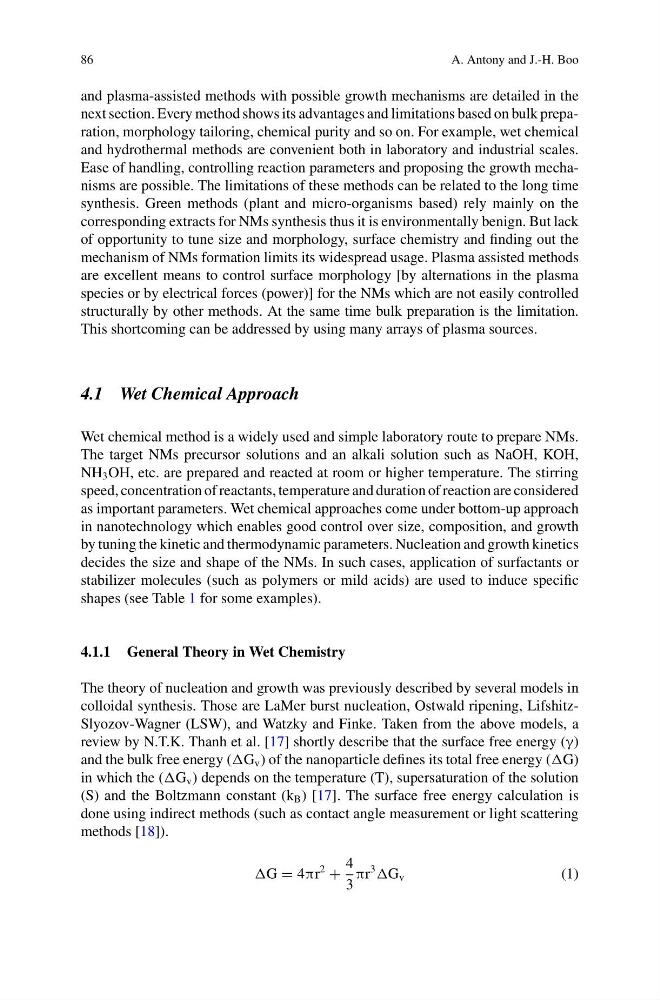
review by N.T.K. Thanh et al. [17] shortly describe that the surface free energy (γ)
and the bulk free energy (G v ) of the nanoparticle defines its total free energy (G)
in which the (G v ) depends on the temperature (T), supersaturation of the solution
(S) and the Boltzmann constant (k B ) [17]. The surface free energy calculation is
done using indirect methods (such as contact angle measurement or light scattering
methods [18]).
G = 4πr
2
+
4
3
πr
3
G v
(1)
A. Antony and J.-H. Boo
and plasma-assisted methods with possible growth mechanisms are detailed in the
next section. Every method shows its advantages and limitations based on bulk preparation, morphology tailoring, chemical purity and so on. For example, wet chemical
and hydrothermal methods are convenient both in laboratory and industrial scales.
Ease of handling, controlling reaction parameters and proposing the growth mechanisms are possible. The limitations of these methods can be related to the long time
synthesis. Green methods (plant and micro-organisms based) rely mainly on the
corresponding extracts for NMs synthesis thus it is environmentally benign. But lack
of opportunity to tune size and morphology, surface chemistry and finding out the
mechanism of NMs formation limits its widespread usage. Plasma assisted methods
are excellent means to control surface morphology [by alternations in the plasma
species or by electrical forces (power)] for the NMs which are not easily controlled
structurally by other methods. At the same time bulk preparation is the limitation.
This shortcoming can be addressed by using many arrays of plasma sources.
4.1 Wet Chemical Approach
Wet chemical method is a widely used and simple laboratory route to prepare NMs.
The target NMs precursor solutions and an alkali solution such as NaOH, KOH,
NH 3 OH, etc. are prepared and reacted at room or higher temperature. The stirring
speed, concentration of reactants, temperature and duration of reaction are considered
as important parameters. Wet chemical approaches come under bottom-up approach
in nanotechnology which enables good control over size, composition, and growth
by tuning the kinetic and thermodynamic parameters. Nucleation and growth kinetics
decides the size and shape of the NMs. In such cases, application of surfactants or
stabilizer molecules (such as polymers or mild acids) are used to induce specific
shapes (see Table 1 for some examples).
4.1.1 General Theory in Wet Chemistry
The theory of nucleation and growth was previously described by several models in
colloidal synthesis. Those are LaMer burst nucleation, Ostwald ripening, LifshitzSlyozov-Wagner (LSW), and Watzky and Finke. Taken from the above models, a
review by N.T.K. Thanh et al. [17] shortly describe that the surface free energy (γ)
and the bulk free energy (G v ) of the nanoparticle defines its total free energy (G)
in which the (G v ) depends on the temperature (T), supersaturation of the solution
(S) and the Boltzmann constant (k B ) [17]. The surface free energy calculation is
done using indirect methods (such as contact angle measurement or light scattering
methods [18]).
G = 4πr
2
+
4
3
πr
3
G v
(1)