

Metallic Nanoparticles for Biomedical Applications
67
NPs can be further purified by performing centrifuge at higher speed and washed with
distilled water. Lonicera japonica flower extract has been utilized to synthesize Au
NPs. Extracts contain alkane, amide, alcohols, and amino, which helps in reducing
HAuCl 4 solution as well as act as a stabilizing agent. Escherichia coli K12 cells have
been used to synthesize Au NPs with a mean diameter of 50 nm at room temperature
[99, 100].
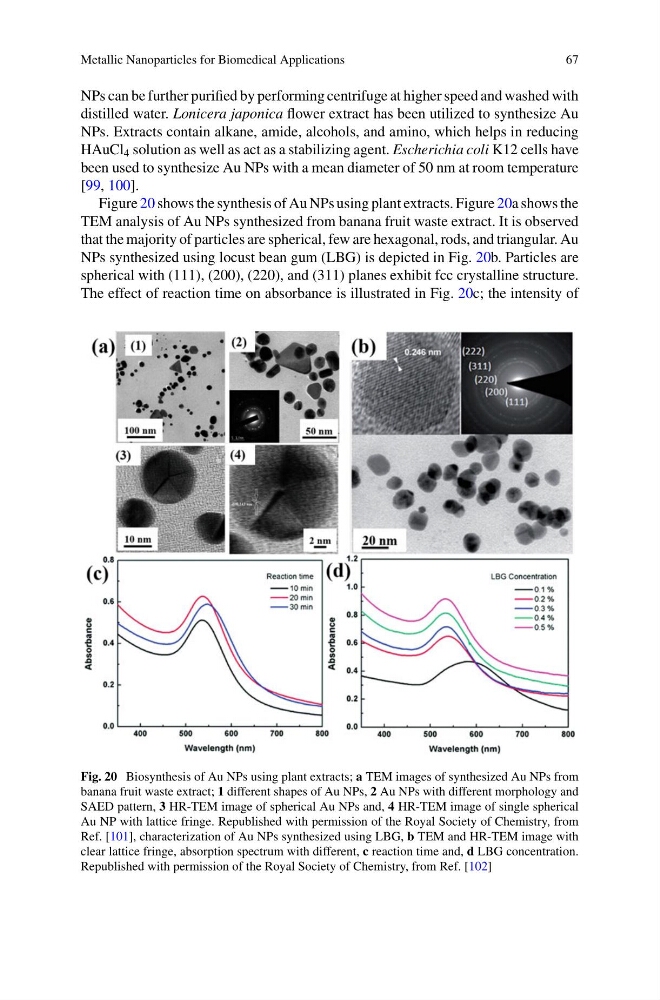
Figure 20 shows the synthesis of Au NPs using plant extracts. Figure 20a shows the
TEM analysis of Au NPs synthesized from banana fruit waste extract. It is observed
that the majority of particles are spherical, few are hexagonal, rods, and triangular. Au
NPs synthesized using locust bean gum (LBG) is depicted in Fig. 20b. Particles are
spherical with (111), (200), (220), and (311) planes exhibit fcc crystalline structure.
The effect of reaction time on absorbance is illustrated in Fig. 20c; the intensity of
Fig. 20 Biosynthesis of Au NPs using plant extracts; a TEM images of synthesized Au NPs from
banana fruit waste extract; 1 different shapes of Au NPs, 2 Au NPs with different morphology and
SAED pattern, 3 HR-TEM image of spherical Au NPs and, 4 HR-TEM image of single spherical
Au NP with lattice fringe. Republished with permission of the Royal Society of Chemistry, from
Ref. [101], characterization of Au NPs synthesized using LBG, b TEM and HR-TEM image with
clear lattice fringe, absorption spectrum with different, c reaction time and, d LBG concentration.
Republished with permission of the Royal Society of Chemistry, from Ref. [102]
67
NPs can be further purified by performing centrifuge at higher speed and washed with
distilled water. Lonicera japonica flower extract has been utilized to synthesize Au
NPs. Extracts contain alkane, amide, alcohols, and amino, which helps in reducing
HAuCl 4 solution as well as act as a stabilizing agent. Escherichia coli K12 cells have
been used to synthesize Au NPs with a mean diameter of 50 nm at room temperature
[99, 100].
Figure 20 shows the synthesis of Au NPs using plant extracts. Figure 20a shows the
TEM analysis of Au NPs synthesized from banana fruit waste extract. It is observed
that the majority of particles are spherical, few are hexagonal, rods, and triangular. Au
NPs synthesized using locust bean gum (LBG) is depicted in Fig. 20b. Particles are
spherical with (111), (200), (220), and (311) planes exhibit fcc crystalline structure.
The effect of reaction time on absorbance is illustrated in Fig. 20c; the intensity of
Fig. 20 Biosynthesis of Au NPs using plant extracts; a TEM images of synthesized Au NPs from
banana fruit waste extract; 1 different shapes of Au NPs, 2 Au NPs with different morphology and
SAED pattern, 3 HR-TEM image of spherical Au NPs and, 4 HR-TEM image of single spherical
Au NP with lattice fringe. Republished with permission of the Royal Society of Chemistry, from
Ref. [101], characterization of Au NPs synthesized using LBG, b TEM and HR-TEM image with
clear lattice fringe, absorption spectrum with different, c reaction time and, d LBG concentration.
Republished with permission of the Royal Society of Chemistry, from Ref. [102]