

66
K. Illath et al.
synthesis of NPs. It has been found that plant extracts are a source of secondary
metabolites like phenolic acid, flavonoids, alkaloid, and terpenoid, which can selectively reduce metallic ions and leads to the formation of NPs, or can act as stabilizing
or capping agent during the synthesis. Photoremediation of heavy metal is possible
with some plants such as Brassica juncea (brown mustard), Clethra barbinervis
(Japanese clethra), Sesbania drummondi (rattlebox) and Acanthopanax scidophylloides. After extracting the bio-reducing agents (bioreductant), it is mixed with an
aqueous solution of metal precursor appropriately. Various spontaneous reactions
occur at room temperature and lead to the formation of nanostructures. Sometimes,
to hasten the synthesis process, Cd is added with stirring and heating. Plant-based
synthesis is preferred over other biological methods due to its ease of availability,
bulk production, and the products formed are not harmful to the environment [34, 97].
Plant parts like fruit, leaf extract, herb extract, tuber extract, dried leaves, and crusts
can be used to synthesize Pt NPs of various shapes and sizes. Commonly employed
plants are date palm (Phoenix dactylifera), pomegranate (Punica granatum), tulsi
(Ocimum sanctum), vjradanti (Barleria prionitis), etc. Biofunctional groups involved
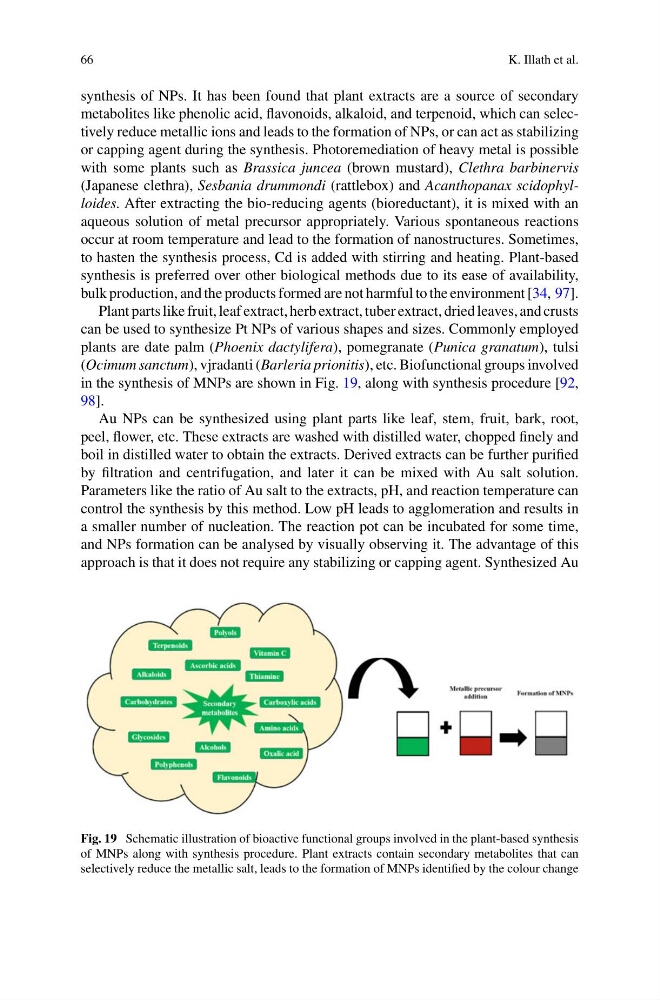
in the synthesis of MNPs are shown in Fig. 19, along with synthesis procedure [92,
98].
Au NPs can be synthesized using plant parts like leaf, stem, fruit, bark, root,
peel, flower, etc. These extracts are washed with distilled water, chopped finely and
boil in distilled water to obtain the extracts. Derived extracts can be further purified
by filtration and centrifugation, and later it can be mixed with Au salt solution.
Parameters like the ratio of Au salt to the extracts, pH, and reaction temperature can
control the synthesis by this method. Low pH leads to agglomeration and results in
a smaller number of nucleation. The reaction pot can be incubated for some time,
and NPs formation can be analysed by visually observing it. The advantage of this
approach is that it does not require any stabilizing or capping agent. Synthesized Au
Fig. 19 Schematic illustration of bioactive functional groups involved in the plant-based synthesis
of MNPs along with synthesis procedure. Plant extracts contain secondary metabolites that can
selectively reduce the metallic salt, leads to the formation of MNPs identified by the colour change
K. Illath et al.
synthesis of NPs. It has been found that plant extracts are a source of secondary
metabolites like phenolic acid, flavonoids, alkaloid, and terpenoid, which can selectively reduce metallic ions and leads to the formation of NPs, or can act as stabilizing
or capping agent during the synthesis. Photoremediation of heavy metal is possible
with some plants such as Brassica juncea (brown mustard), Clethra barbinervis
(Japanese clethra), Sesbania drummondi (rattlebox) and Acanthopanax scidophylloides. After extracting the bio-reducing agents (bioreductant), it is mixed with an
aqueous solution of metal precursor appropriately. Various spontaneous reactions
occur at room temperature and lead to the formation of nanostructures. Sometimes,
to hasten the synthesis process, Cd is added with stirring and heating. Plant-based
synthesis is preferred over other biological methods due to its ease of availability,
bulk production, and the products formed are not harmful to the environment [34, 97].
Plant parts like fruit, leaf extract, herb extract, tuber extract, dried leaves, and crusts
can be used to synthesize Pt NPs of various shapes and sizes. Commonly employed
plants are date palm (Phoenix dactylifera), pomegranate (Punica granatum), tulsi
(Ocimum sanctum), vjradanti (Barleria prionitis), etc. Biofunctional groups involved
in the synthesis of MNPs are shown in Fig. 19, along with synthesis procedure [92,
98].
Au NPs can be synthesized using plant parts like leaf, stem, fruit, bark, root,
peel, flower, etc. These extracts are washed with distilled water, chopped finely and
boil in distilled water to obtain the extracts. Derived extracts can be further purified
by filtration and centrifugation, and later it can be mixed with Au salt solution.
Parameters like the ratio of Au salt to the extracts, pH, and reaction temperature can
control the synthesis by this method. Low pH leads to agglomeration and results in
a smaller number of nucleation. The reaction pot can be incubated for some time,
and NPs formation can be analysed by visually observing it. The advantage of this
approach is that it does not require any stabilizing or capping agent. Synthesized Au
Fig. 19 Schematic illustration of bioactive functional groups involved in the plant-based synthesis
of MNPs along with synthesis procedure. Plant extracts contain secondary metabolites that can
selectively reduce the metallic salt, leads to the formation of MNPs identified by the colour change