

52
K. Illath et al.
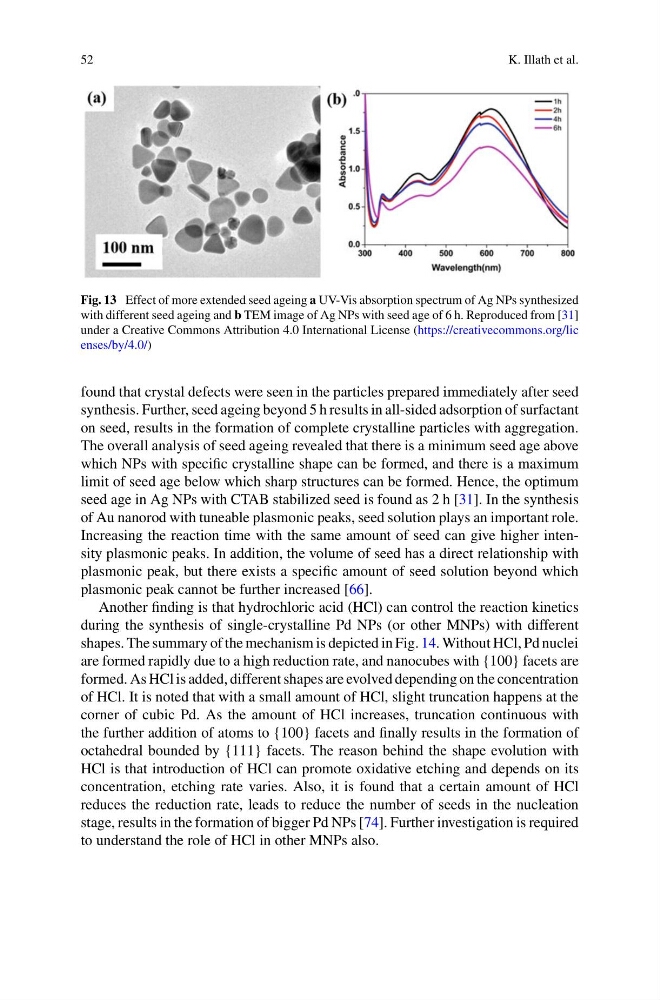
Fig. 13 Effect of more extended seed ageing a UV-Vis absorption spectrum of Ag NPs synthesized
with different seed ageing and b TEM image of Ag NPs with seed age of 6 h. Reproduced from [31]
under a Creative Commons Attribution 4.0 International License (https://creativecommons.org/lic
enses/by/4.0/)
found that crystal defects were seen in the particles prepared immediately after seed
synthesis. Further, seed ageing beyond 5 h results in all-sided adsorption of surfactant
on seed, results in the formation of complete crystalline particles with aggregation.
The overall analysis of seed ageing revealed that there is a minimum seed age above
which NPs with specific crystalline shape can be formed, and there is a maximum
limit of seed age below which sharp structures can be formed. Hence, the optimum
seed age in Ag NPs with CTAB stabilized seed is found as 2 h [31]. In the synthesis
of Au nanorod with tuneable plasmonic peaks, seed solution plays an important role.
Increasing the reaction time with the same amount of seed can give higher intensity plasmonic peaks. In addition, the volume of seed has a direct relationship with
plasmonic peak, but there exists a specific amount of seed solution beyond which
plasmonic peak cannot be further increased [66].
Another finding is that hydrochloric acid (HCl) can control the reaction kinetics
during the synthesis of single-crystalline Pd NPs (or other MNPs) with different
shapes. The summary of the mechanism is depicted in Fig. 14. Without HCl, Pd nuclei
are formed rapidly due to a high reduction rate, and nanocubes with {100} facets are
formed. As HCl is added, different shapes are evolved depending on the concentration
of HCl. It is noted that with a small amount of HCl, slight truncation happens at the
corner of cubic Pd. As the amount of HCl increases, truncation continuous with
the further addition of atoms to {100} facets and finally results in the formation of
octahedral bounded by {111} facets. The reason behind the shape evolution with
HCl is that introduction of HCl can promote oxidative etching and depends on its
concentration, etching rate varies. Also, it is found that a certain amount of HCl
reduces the reduction rate, leads to reduce the number of seeds in the nucleation
stage, results in the formation of bigger Pd NPs [74]. Further investigation is required
to understand the role of HCl in other MNPs also.
K. Illath et al.
Fig. 13 Effect of more extended seed ageing a UV-Vis absorption spectrum of Ag NPs synthesized
with different seed ageing and b TEM image of Ag NPs with seed age of 6 h. Reproduced from [31]
under a Creative Commons Attribution 4.0 International License (https://creativecommons.org/lic
enses/by/4.0/)
found that crystal defects were seen in the particles prepared immediately after seed
synthesis. Further, seed ageing beyond 5 h results in all-sided adsorption of surfactant
on seed, results in the formation of complete crystalline particles with aggregation.
The overall analysis of seed ageing revealed that there is a minimum seed age above
which NPs with specific crystalline shape can be formed, and there is a maximum
limit of seed age below which sharp structures can be formed. Hence, the optimum
seed age in Ag NPs with CTAB stabilized seed is found as 2 h [31]. In the synthesis
of Au nanorod with tuneable plasmonic peaks, seed solution plays an important role.
Increasing the reaction time with the same amount of seed can give higher intensity plasmonic peaks. In addition, the volume of seed has a direct relationship with
plasmonic peak, but there exists a specific amount of seed solution beyond which
plasmonic peak cannot be further increased [66].
Another finding is that hydrochloric acid (HCl) can control the reaction kinetics
during the synthesis of single-crystalline Pd NPs (or other MNPs) with different
shapes. The summary of the mechanism is depicted in Fig. 14. Without HCl, Pd nuclei
are formed rapidly due to a high reduction rate, and nanocubes with {100} facets are
formed. As HCl is added, different shapes are evolved depending on the concentration
of HCl. It is noted that with a small amount of HCl, slight truncation happens at the
corner of cubic Pd. As the amount of HCl increases, truncation continuous with
the further addition of atoms to {100} facets and finally results in the formation of
octahedral bounded by {111} facets. The reason behind the shape evolution with
HCl is that introduction of HCl can promote oxidative etching and depends on its
concentration, etching rate varies. Also, it is found that a certain amount of HCl
reduces the reduction rate, leads to reduce the number of seeds in the nucleation
stage, results in the formation of bigger Pd NPs [74]. Further investigation is required
to understand the role of HCl in other MNPs also.