

Tailoring the Surface Functionalities of Titania …
537
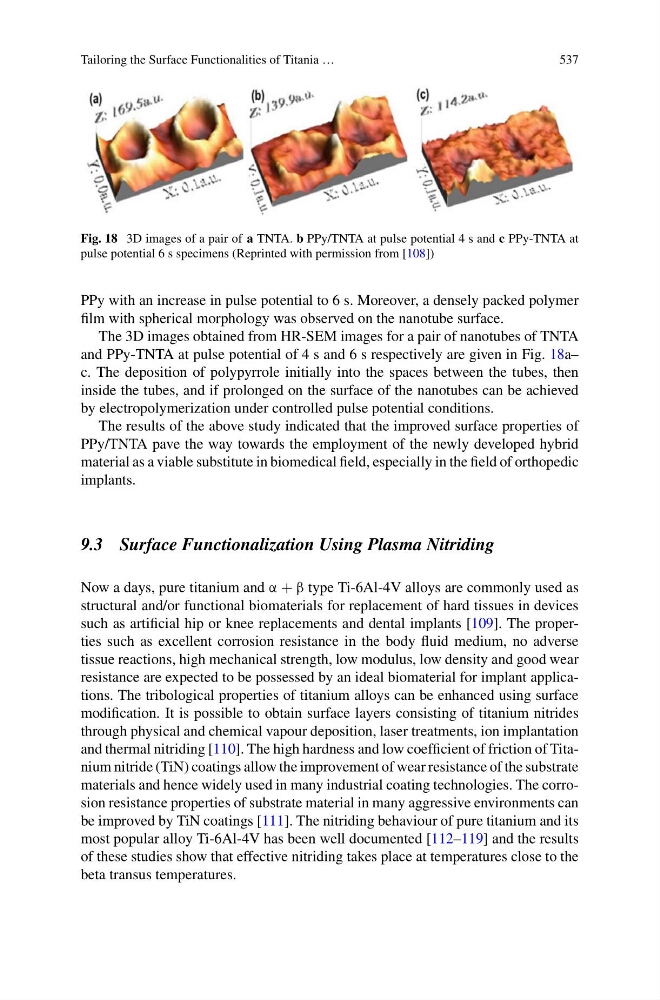
Fig. 18 3D images of a pair of a TNTA. b PPy/TNTA at pulse potential 4 s and c PPy-TNTA at
pulse potential 6 s specimens (Reprinted with permission from [108])
PPy with an increase in pulse potential to 6 s. Moreover, a densely packed polymer
film with spherical morphology was observed on the nanotube surface.
The 3D images obtained from HR-SEM images for a pair of nanotubes of TNTA
and PPy-TNTA at pulse potential of 4 s and 6 s respectively are given in Fig. 18a–
c. The deposition of polypyrrole initially into the spaces between the tubes, then
inside the tubes, and if prolonged on the surface of the nanotubes can be achieved
by electropolymerization under controlled pulse potential conditions.
The results of the above study indicated that the improved surface properties of
PPy/TNTA pave the way towards the employment of the newly developed hybrid
material as a viable substitute in biomedical field, especially in the field of orthopedic
implants.
9.3 Surface Functionalization Using Plasma Nitriding
Now a days, pure titanium and α + β type Ti-6Al-4V alloys are commonly used as
structural and/or functional biomaterials for replacement of hard tissues in devices
such as artificial hip or knee replacements and dental implants [109]. The properties such as excellent corrosion resistance in the body fluid medium, no adverse
tissue reactions, high mechanical strength, low modulus, low density and good wear
resistance are expected to be possessed by an ideal biomaterial for implant applications. The tribological properties of titanium alloys can be enhanced using surface
modification. It is possible to obtain surface layers consisting of titanium nitrides
through physical and chemical vapour deposition, laser treatments, ion implantation
and thermal nitriding [110]. The high hardness and low coefficient of friction of Titanium nitride (TiN) coatings allow the improvement of wear resistance of the substrate
materials and hence widely used in many industrial coating technologies. The corrosion resistance properties of substrate material in many aggressive environments can
be improved by TiN coatings [111]. The nitriding behaviour of pure titanium and its
most popular alloy Ti-6Al-4V has been well documented [112–119] and the results
of these studies show that effective nitriding takes place at temperatures close to the
beta transus temperatures.
537
Fig. 18 3D images of a pair of a TNTA. b PPy/TNTA at pulse potential 4 s and c PPy-TNTA at
pulse potential 6 s specimens (Reprinted with permission from [108])
PPy with an increase in pulse potential to 6 s. Moreover, a densely packed polymer
film with spherical morphology was observed on the nanotube surface.
The 3D images obtained from HR-SEM images for a pair of nanotubes of TNTA
and PPy-TNTA at pulse potential of 4 s and 6 s respectively are given in Fig. 18a–
c. The deposition of polypyrrole initially into the spaces between the tubes, then
inside the tubes, and if prolonged on the surface of the nanotubes can be achieved
by electropolymerization under controlled pulse potential conditions.
The results of the above study indicated that the improved surface properties of
PPy/TNTA pave the way towards the employment of the newly developed hybrid
material as a viable substitute in biomedical field, especially in the field of orthopedic
implants.
9.3 Surface Functionalization Using Plasma Nitriding
Now a days, pure titanium and α + β type Ti-6Al-4V alloys are commonly used as
structural and/or functional biomaterials for replacement of hard tissues in devices
such as artificial hip or knee replacements and dental implants [109]. The properties such as excellent corrosion resistance in the body fluid medium, no adverse
tissue reactions, high mechanical strength, low modulus, low density and good wear
resistance are expected to be possessed by an ideal biomaterial for implant applications. The tribological properties of titanium alloys can be enhanced using surface
modification. It is possible to obtain surface layers consisting of titanium nitrides
through physical and chemical vapour deposition, laser treatments, ion implantation
and thermal nitriding [110]. The high hardness and low coefficient of friction of Titanium nitride (TiN) coatings allow the improvement of wear resistance of the substrate
materials and hence widely used in many industrial coating technologies. The corrosion resistance properties of substrate material in many aggressive environments can
be improved by TiN coatings [111]. The nitriding behaviour of pure titanium and its
most popular alloy Ti-6Al-4V has been well documented [112–119] and the results
of these studies show that effective nitriding takes place at temperatures close to the
beta transus temperatures.