

536
V. S. Simi et al.
observed on the TNTA surface at 1.5 M concentration (Fig. 16d) and it fully covered
the nanotube surface which was more clearly visualized in its corresponding higher
magnification image provided in Fig. 16h.
Among the various concentrations studied, homogenous deposition of zinc oxide
was observed at 0.5 M. Uniform deposition of zinc by retaining the tubular nature
of the titania nanotubes is more advantageous for implant applications.
9.2 Surface Functionalization Using Polypyrrole
To tailor the surface properties of TiO 2 nanotubes and to advance their surface properties applicable to a wide variety of biomedical applications, an attempt has been
made to synthesis Polypyrrole/Titania nanotube arrays (PPy-TNTA) hybrid on titanium surface [108]. PPy-TNTA hybrid was prepared by normal pulse voltammetry
electrodeposition process in an electrolyte solution containing 0.2 M LiClO 4 and
0.1 M pyrrole. To benefit pyrrole monomer deposition, the pulse width was adjusted
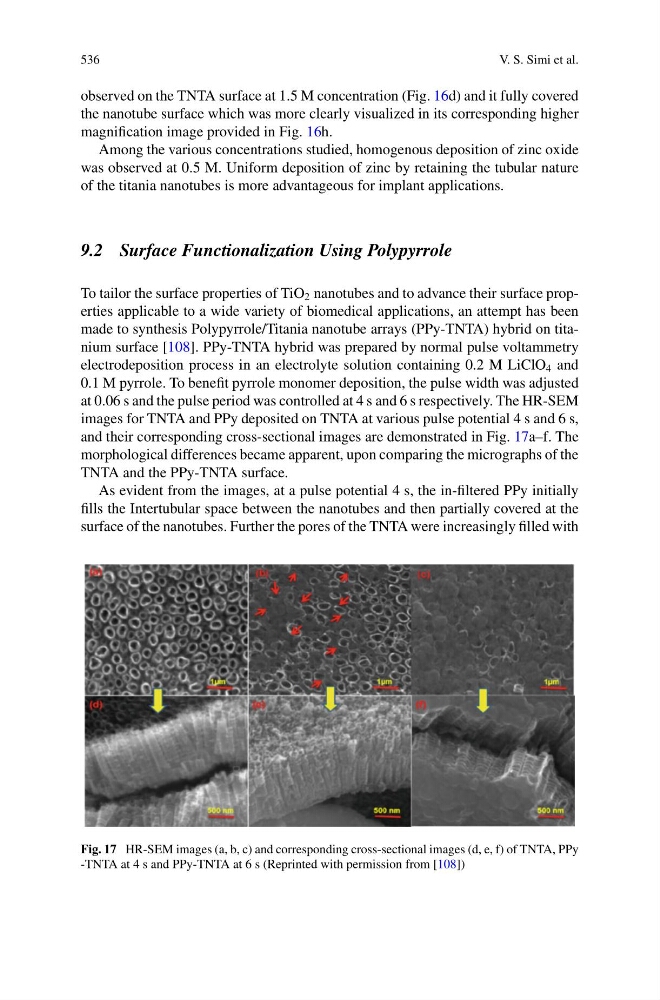
at 0.06 s and the pulse period was controlled at 4 s and 6 s respectively. The HR-SEM
images for TNTA and PPy deposited on TNTA at various pulse potential 4 s and 6 s,
and their corresponding cross-sectional images are demonstrated in Fig. 17a–f. The
morphological differences became apparent, upon comparing the micrographs of the
TNTA and the PPy-TNTA surface.
As evident from the images, at a pulse potential 4 s, the in-filtered PPy initially
fills the Intertubular space between the nanotubes and then partially covered at the
surface of the nanotubes. Further the pores of the TNTA were increasingly filled with
Fig. 17 HR-SEM images (a, b, c) and corresponding cross-sectional images (d, e, f) of TNTA, PPy
-TNTA at 4 s and PPy-TNTA at 6 s (Reprinted with permission from [108])
V. S. Simi et al.
observed on the TNTA surface at 1.5 M concentration (Fig. 16d) and it fully covered
the nanotube surface which was more clearly visualized in its corresponding higher
magnification image provided in Fig. 16h.
Among the various concentrations studied, homogenous deposition of zinc oxide
was observed at 0.5 M. Uniform deposition of zinc by retaining the tubular nature
of the titania nanotubes is more advantageous for implant applications.
9.2 Surface Functionalization Using Polypyrrole
To tailor the surface properties of TiO 2 nanotubes and to advance their surface properties applicable to a wide variety of biomedical applications, an attempt has been
made to synthesis Polypyrrole/Titania nanotube arrays (PPy-TNTA) hybrid on titanium surface [108]. PPy-TNTA hybrid was prepared by normal pulse voltammetry
electrodeposition process in an electrolyte solution containing 0.2 M LiClO 4 and
0.1 M pyrrole. To benefit pyrrole monomer deposition, the pulse width was adjusted
at 0.06 s and the pulse period was controlled at 4 s and 6 s respectively. The HR-SEM
images for TNTA and PPy deposited on TNTA at various pulse potential 4 s and 6 s,
and their corresponding cross-sectional images are demonstrated in Fig. 17a–f. The
morphological differences became apparent, upon comparing the micrographs of the
TNTA and the PPy-TNTA surface.
As evident from the images, at a pulse potential 4 s, the in-filtered PPy initially
fills the Intertubular space between the nanotubes and then partially covered at the
surface of the nanotubes. Further the pores of the TNTA were increasingly filled with
Fig. 17 HR-SEM images (a, b, c) and corresponding cross-sectional images (d, e, f) of TNTA, PPy
-TNTA at 4 s and PPy-TNTA at 6 s (Reprinted with permission from [108])