

Tailoring the Surface Functionalities of Titania …
525
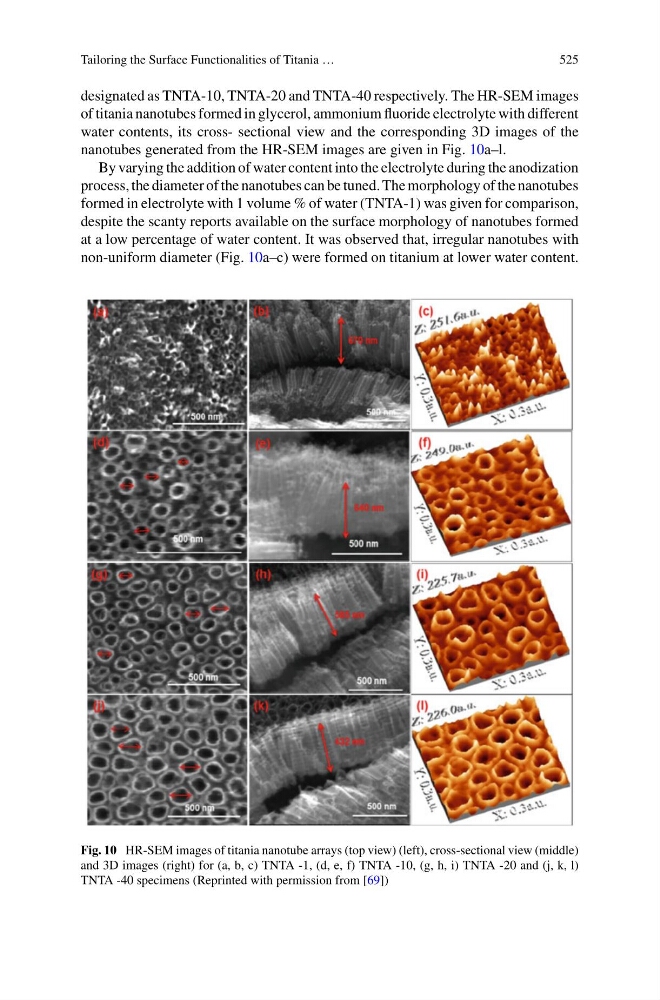
designated as TNTA-10, TNTA-20 and TNTA-40 respectively. The HR-SEM images
of titania nanotubes formed in glycerol, ammonium fluoride electrolyte with different
water contents, its cross- sectional view and the corresponding 3D images of the
nanotubes generated from the HR-SEM images are given in Fig. 10a–l.
By varying the addition of water content into the electrolyte during the anodization
process, the diameter of the nanotubes can be tuned. The morphology of the nanotubes
formed in electrolyte with 1 volume % of water (TNTA-1) was given for comparison,
despite the scanty reports available on the surface morphology of nanotubes formed
at a low percentage of water content. It was observed that, irregular nanotubes with
non-uniform diameter (Fig. 10a–c) were formed on titanium at lower water content.
Fig. 10 HR-SEM images of titania nanotube arrays (top view) (left), cross-sectional view (middle)
and 3D images (right) for (a, b, c) TNTA -1, (d, e, f) TNTA -10, (g, h, i) TNTA -20 and (j, k, l)
TNTA -40 specimens (Reprinted with permission from [69])
525
designated as TNTA-10, TNTA-20 and TNTA-40 respectively. The HR-SEM images
of titania nanotubes formed in glycerol, ammonium fluoride electrolyte with different
water contents, its cross- sectional view and the corresponding 3D images of the
nanotubes generated from the HR-SEM images are given in Fig. 10a–l.
By varying the addition of water content into the electrolyte during the anodization
process, the diameter of the nanotubes can be tuned. The morphology of the nanotubes
formed in electrolyte with 1 volume % of water (TNTA-1) was given for comparison,
despite the scanty reports available on the surface morphology of nanotubes formed
at a low percentage of water content. It was observed that, irregular nanotubes with
non-uniform diameter (Fig. 10a–c) were formed on titanium at lower water content.
Fig. 10 HR-SEM images of titania nanotube arrays (top view) (left), cross-sectional view (middle)
and 3D images (right) for (a, b, c) TNTA -1, (d, e, f) TNTA -10, (g, h, i) TNTA -20 and (j, k, l)
TNTA -40 specimens (Reprinted with permission from [69])