

Surface Nanostructuring of Metallic Materials …
481
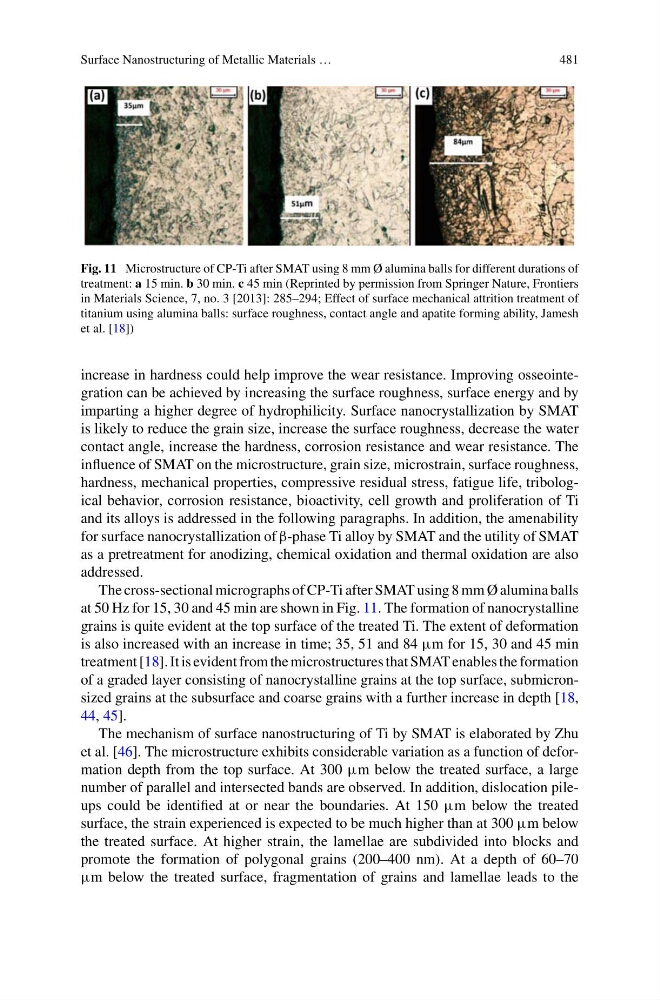
Fig. 11 Microstructure of CP-Ti after SMAT using 8 mm Ø alumina balls for different durations of
treatment: a 15 min. b 30 min. c 45 min (Reprinted by permission from Springer Nature, Frontiers
in Materials Science, 7, no. 3 [2013]: 285–294; Effect of surface mechanical attrition treatment of
titanium using alumina balls: surface roughness, contact angle and apatite forming ability, Jamesh
et al. [18])
increase in hardness could help improve the wear resistance. Improving osseointegration can be achieved by increasing the surface roughness, surface energy and by
imparting a higher degree of hydrophilicity. Surface nanocrystallization by SMAT
is likely to reduce the grain size, increase the surface roughness, decrease the water
contact angle, increase the hardness, corrosion resistance and wear resistance. The
influence of SMAT on the microstructure, grain size, microstrain, surface roughness,
hardness, mechanical properties, compressive residual stress, fatigue life, tribological behavior, corrosion resistance, bioactivity, cell growth and proliferation of Ti
and its alloys is addressed in the following paragraphs. In addition, the amenability
for surface nanocrystallization of β-phase Ti alloy by SMAT and the utility of SMAT
as a pretreatment for anodizing, chemical oxidation and thermal oxidation are also
addressed.
The cross-sectional micrographs of CP-Ti after SMAT using 8 mm Ø alumina balls
at 50 Hz for 15, 30 and 45 min are shown in Fig. 11. The formation of nanocrystalline
grains is quite evident at the top surface of the treated Ti. The extent of deformation
is also increased with an increase in time; 35, 51 and 84 μm for 15, 30 and 45 min
treatment [18]. It is evident from the microstructures that SMAT enables the formation
of a graded layer consisting of nanocrystalline grains at the top surface, submicronsized grains at the subsurface and coarse grains with a further increase in depth [18,
44, 45].
The mechanism of surface nanostructuring of Ti by SMAT is elaborated by Zhu
et al. [46]. The microstructure exhibits considerable variation as a function of deformation depth from the top surface. At 300 μm below the treated surface, a large
number of parallel and intersected bands are observed. In addition, dislocation pileups could be identified at or near the boundaries. At 150 μm below the treated
surface, the strain experienced is expected to be much higher than at 300 μm below
the treated surface. At higher strain, the lamellae are subdivided into blocks and
promote the formation of polygonal grains (200–400 nm). At a depth of 60–70
μm below the treated surface, fragmentation of grains and lamellae leads to the
481
Fig. 11 Microstructure of CP-Ti after SMAT using 8 mm Ø alumina balls for different durations of
treatment: a 15 min. b 30 min. c 45 min (Reprinted by permission from Springer Nature, Frontiers
in Materials Science, 7, no. 3 [2013]: 285–294; Effect of surface mechanical attrition treatment of
titanium using alumina balls: surface roughness, contact angle and apatite forming ability, Jamesh
et al. [18])
increase in hardness could help improve the wear resistance. Improving osseointegration can be achieved by increasing the surface roughness, surface energy and by
imparting a higher degree of hydrophilicity. Surface nanocrystallization by SMAT
is likely to reduce the grain size, increase the surface roughness, decrease the water
contact angle, increase the hardness, corrosion resistance and wear resistance. The
influence of SMAT on the microstructure, grain size, microstrain, surface roughness,
hardness, mechanical properties, compressive residual stress, fatigue life, tribological behavior, corrosion resistance, bioactivity, cell growth and proliferation of Ti
and its alloys is addressed in the following paragraphs. In addition, the amenability
for surface nanocrystallization of β-phase Ti alloy by SMAT and the utility of SMAT
as a pretreatment for anodizing, chemical oxidation and thermal oxidation are also
addressed.
The cross-sectional micrographs of CP-Ti after SMAT using 8 mm Ø alumina balls
at 50 Hz for 15, 30 and 45 min are shown in Fig. 11. The formation of nanocrystalline
grains is quite evident at the top surface of the treated Ti. The extent of deformation
is also increased with an increase in time; 35, 51 and 84 μm for 15, 30 and 45 min
treatment [18]. It is evident from the microstructures that SMAT enables the formation
of a graded layer consisting of nanocrystalline grains at the top surface, submicronsized grains at the subsurface and coarse grains with a further increase in depth [18,
44, 45].
The mechanism of surface nanostructuring of Ti by SMAT is elaborated by Zhu
et al. [46]. The microstructure exhibits considerable variation as a function of deformation depth from the top surface. At 300 μm below the treated surface, a large
number of parallel and intersected bands are observed. In addition, dislocation pileups could be identified at or near the boundaries. At 150 μm below the treated
surface, the strain experienced is expected to be much higher than at 300 μm below
the treated surface. At higher strain, the lamellae are subdivided into blocks and
promote the formation of polygonal grains (200–400 nm). At a depth of 60–70
μm below the treated surface, fragmentation of grains and lamellae leads to the