

480
T. Balusamy et al.
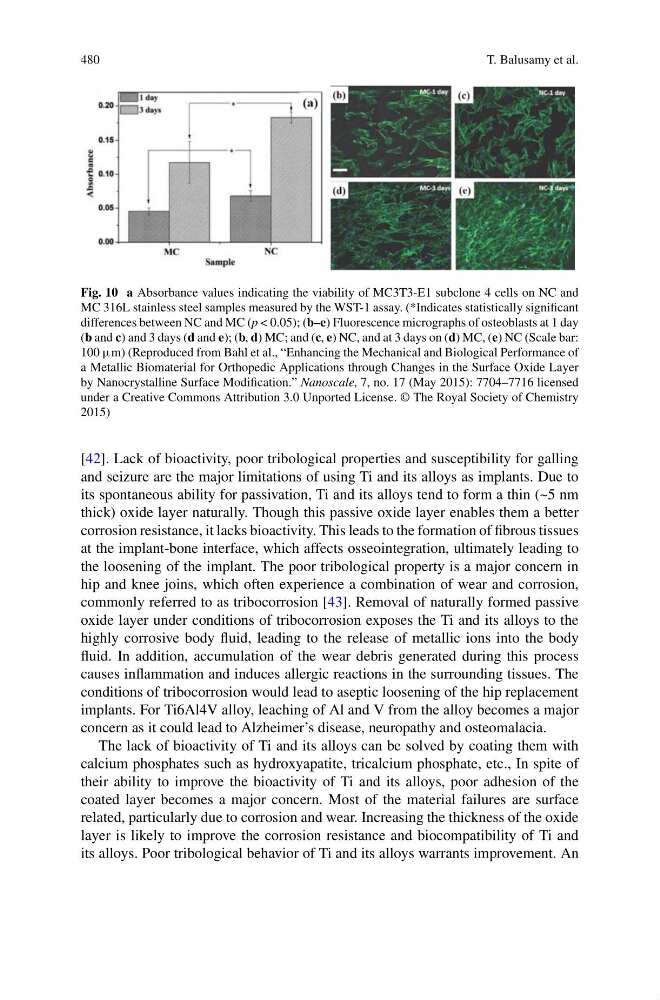
Fig. 10 a Absorbance values indicating the viability of MC3T3-E1 subclone 4 cells on NC and
MC 316L stainless steel samples measured by the WST-1 assay. (*Indicates statistically significant
differences between NC and MC (p < 0.05); (b–e) Fluorescence micrographs of osteoblasts at 1 day
(b and c) and 3 days (d and e); (b, d) MC; and (c, e) NC, and at 3 days on (d) MC, (e) NC (Scale bar:
100 μm) (Reproduced from Bahl et al., “Enhancing the Mechanical and Biological Performance of
a Metallic Biomaterial for Orthopedic Applications through Changes in the Surface Oxide Layer
by Nanocrystalline Surface Modification.” Nanoscale, 7, no. 17 (May 2015): 7704–7716 licensed
under a Creative Commons Attribution 3.0 Unported License. © The Royal Society of Chemistry
2015)
[42]. Lack of bioactivity, poor tribological properties and susceptibility for galling
and seizure are the major limitations of using Ti and its alloys as implants. Due to
its spontaneous ability for passivation, Ti and its alloys tend to form a thin (~5 nm
thick) oxide layer naturally. Though this passive oxide layer enables them a better
corrosion resistance, it lacks bioactivity. This leads to the formation of fibrous tissues
at the implant-bone interface, which affects osseointegration, ultimately leading to
the loosening of the implant. The poor tribological property is a major concern in
hip and knee joins, which often experience a combination of wear and corrosion,
commonly referred to as tribocorrosion [43]. Removal of naturally formed passive
oxide layer under conditions of tribocorrosion exposes the Ti and its alloys to the
highly corrosive body fluid, leading to the release of metallic ions into the body
fluid. In addition, accumulation of the wear debris generated during this process
causes inflammation and induces allergic reactions in the surrounding tissues. The
conditions of tribocorrosion would lead to aseptic loosening of the hip replacement
implants. For Ti6Al4V alloy, leaching of Al and V from the alloy becomes a major
concern as it could lead to Alzheimer’s disease, neuropathy and osteomalacia.
The lack of bioactivity of Ti and its alloys can be solved by coating them with
calcium phosphates such as hydroxyapatite, tricalcium phosphate, etc., In spite of
their ability to improve the bioactivity of Ti and its alloys, poor adhesion of the
coated layer becomes a major concern. Most of the material failures are surface
related, particularly due to corrosion and wear. Increasing the thickness of the oxide
layer is likely to improve the corrosion resistance and biocompatibility of Ti and
its alloys. Poor tribological behavior of Ti and its alloys warrants improvement. An
T. Balusamy et al.
Fig. 10 a Absorbance values indicating the viability of MC3T3-E1 subclone 4 cells on NC and
MC 316L stainless steel samples measured by the WST-1 assay. (*Indicates statistically significant
differences between NC and MC (p < 0.05); (b–e) Fluorescence micrographs of osteoblasts at 1 day
(b and c) and 3 days (d and e); (b, d) MC; and (c, e) NC, and at 3 days on (d) MC, (e) NC (Scale bar:
100 μm) (Reproduced from Bahl et al., “Enhancing the Mechanical and Biological Performance of
a Metallic Biomaterial for Orthopedic Applications through Changes in the Surface Oxide Layer
by Nanocrystalline Surface Modification.” Nanoscale, 7, no. 17 (May 2015): 7704–7716 licensed
under a Creative Commons Attribution 3.0 Unported License. © The Royal Society of Chemistry
2015)
[42]. Lack of bioactivity, poor tribological properties and susceptibility for galling
and seizure are the major limitations of using Ti and its alloys as implants. Due to
its spontaneous ability for passivation, Ti and its alloys tend to form a thin (~5 nm
thick) oxide layer naturally. Though this passive oxide layer enables them a better
corrosion resistance, it lacks bioactivity. This leads to the formation of fibrous tissues
at the implant-bone interface, which affects osseointegration, ultimately leading to
the loosening of the implant. The poor tribological property is a major concern in
hip and knee joins, which often experience a combination of wear and corrosion,
commonly referred to as tribocorrosion [43]. Removal of naturally formed passive
oxide layer under conditions of tribocorrosion exposes the Ti and its alloys to the
highly corrosive body fluid, leading to the release of metallic ions into the body
fluid. In addition, accumulation of the wear debris generated during this process
causes inflammation and induces allergic reactions in the surrounding tissues. The
conditions of tribocorrosion would lead to aseptic loosening of the hip replacement
implants. For Ti6Al4V alloy, leaching of Al and V from the alloy becomes a major
concern as it could lead to Alzheimer’s disease, neuropathy and osteomalacia.
The lack of bioactivity of Ti and its alloys can be solved by coating them with
calcium phosphates such as hydroxyapatite, tricalcium phosphate, etc., In spite of
their ability to improve the bioactivity of Ti and its alloys, poor adhesion of the
coated layer becomes a major concern. Most of the material failures are surface
related, particularly due to corrosion and wear. Increasing the thickness of the oxide
layer is likely to improve the corrosion resistance and biocompatibility of Ti and
its alloys. Poor tribological behavior of Ti and its alloys warrants improvement. An