

476
T. Balusamy et al.
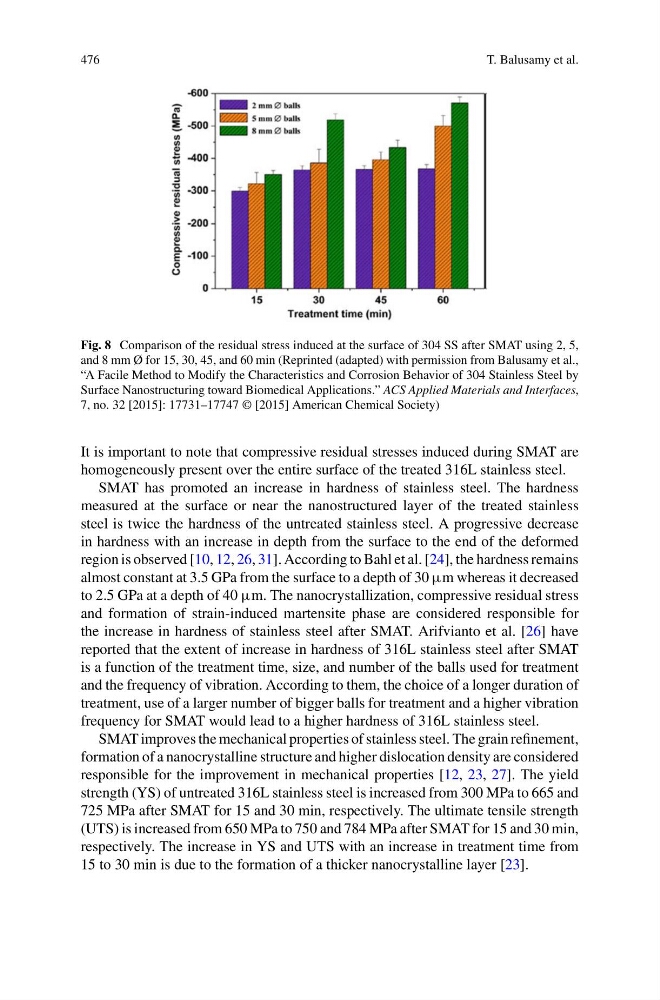
Fig. 8 Comparison of the residual stress induced at the surface of 304 SS after SMAT using 2, 5,
and 8 mm Ø for 15, 30, 45, and 60 min (Reprinted (adapted) with permission from Balusamy et al.,
“A Facile Method to Modify the Characteristics and Corrosion Behavior of 304 Stainless Steel by
Surface Nanostructuring toward Biomedical Applications.” ACS Applied Materials and Interfaces,
7, no. 32 [2015]: 17731–17747 © [2015] American Chemical Society)
It is important to note that compressive residual stresses induced during SMAT are
homogeneously present over the entire surface of the treated 316L stainless steel.
SMAT has promoted an increase in hardness of stainless steel. The hardness
measured at the surface or near the nanostructured layer of the treated stainless
steel is twice the hardness of the untreated stainless steel. A progressive decrease
in hardness with an increase in depth from the surface to the end of the deformed
region is observed [10, 12, 26, 31]. According to Bahl et al. [24], the hardness remains
almost constant at 3.5 GPa from the surface to a depth of 30 μm whereas it decreased
to 2.5 GPa at a depth of 40 μm. The nanocrystallization, compressive residual stress
and formation of strain-induced martensite phase are considered responsible for
the increase in hardness of stainless steel after SMAT. Arifvianto et al. [26] have
reported that the extent of increase in hardness of 316L stainless steel after SMAT
is a function of the treatment time, size, and number of the balls used for treatment
and the frequency of vibration. According to them, the choice of a longer duration of
treatment, use of a larger number of bigger balls for treatment and a higher vibration
frequency for SMAT would lead to a higher hardness of 316L stainless steel.
SMAT improves the mechanical properties of stainless steel. The grain refinement,
formation of a nanocrystalline structure and higher dislocation density are considered
responsible for the improvement in mechanical properties [12, 23, 27]. The yield
strength (YS) of untreated 316L stainless steel is increased from 300 MPa to 665 and
725 MPa after SMAT for 15 and 30 min, respectively. The ultimate tensile strength
(UTS) is increased from 650 MPa to 750 and 784 MPa after SMAT for 15 and 30 min,
respectively. The increase in YS and UTS with an increase in treatment time from
15 to 30 min is due to the formation of a thicker nanocrystalline layer [23].
T. Balusamy et al.
Fig. 8 Comparison of the residual stress induced at the surface of 304 SS after SMAT using 2, 5,
and 8 mm Ø for 15, 30, 45, and 60 min (Reprinted (adapted) with permission from Balusamy et al.,
“A Facile Method to Modify the Characteristics and Corrosion Behavior of 304 Stainless Steel by
Surface Nanostructuring toward Biomedical Applications.” ACS Applied Materials and Interfaces,
7, no. 32 [2015]: 17731–17747 © [2015] American Chemical Society)
It is important to note that compressive residual stresses induced during SMAT are
homogeneously present over the entire surface of the treated 316L stainless steel.
SMAT has promoted an increase in hardness of stainless steel. The hardness
measured at the surface or near the nanostructured layer of the treated stainless
steel is twice the hardness of the untreated stainless steel. A progressive decrease
in hardness with an increase in depth from the surface to the end of the deformed
region is observed [10, 12, 26, 31]. According to Bahl et al. [24], the hardness remains
almost constant at 3.5 GPa from the surface to a depth of 30 μm whereas it decreased
to 2.5 GPa at a depth of 40 μm. The nanocrystallization, compressive residual stress
and formation of strain-induced martensite phase are considered responsible for
the increase in hardness of stainless steel after SMAT. Arifvianto et al. [26] have
reported that the extent of increase in hardness of 316L stainless steel after SMAT
is a function of the treatment time, size, and number of the balls used for treatment
and the frequency of vibration. According to them, the choice of a longer duration of
treatment, use of a larger number of bigger balls for treatment and a higher vibration
frequency for SMAT would lead to a higher hardness of 316L stainless steel.
SMAT improves the mechanical properties of stainless steel. The grain refinement,
formation of a nanocrystalline structure and higher dislocation density are considered
responsible for the improvement in mechanical properties [12, 23, 27]. The yield
strength (YS) of untreated 316L stainless steel is increased from 300 MPa to 665 and
725 MPa after SMAT for 15 and 30 min, respectively. The ultimate tensile strength
(UTS) is increased from 650 MPa to 750 and 784 MPa after SMAT for 15 and 30 min,
respectively. The increase in YS and UTS with an increase in treatment time from
15 to 30 min is due to the formation of a thicker nanocrystalline layer [23].