

470
T. Balusamy et al.
with medium or high stacking fault energy (SFE), slip is the predominant mechanism
while for metals having a low SFE, twinning is favorable, particularly at high strain
rates and/or at low deformation temperatures [3]. In general, austenitic stainless
steels (304 and 316L) are low SFE materials. Hence, nanostructuring is expected to
occur by twinning mechanism [4]. The formation of planar dislocation arrays and
mechanical twins is considered to be the first stage, which is followed by twin-twin
interactions leading to refinement of grains down to nanometer level. SMAT induces
extremely high strain and the strain rate of the order of 10
2 to 10
3 s
−1 at the sample
surface. Austenitic stainless steels undergo extensive twinning and with an increase
in the extent of deformation, the twinning becomes multidirectional. Further, the
intersection of the multidirectional twins leads to grain subdivision and formation of
strain-induced martensite (SIM). The twin-twin interactions are considered to be the
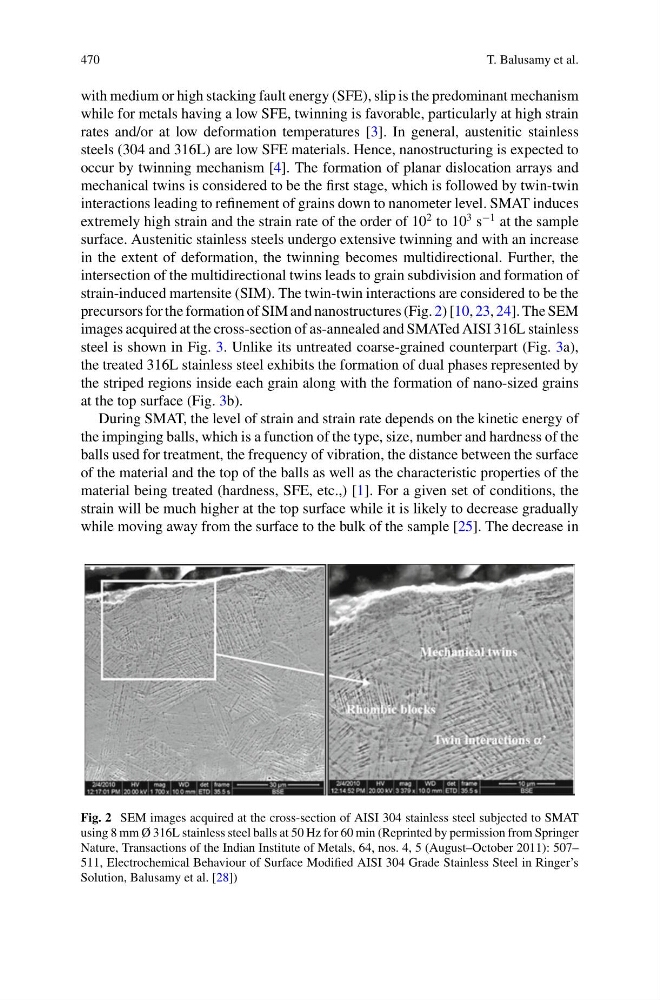
precursors for the formation of SIM and nanostructures (Fig. 2) [10, 23, 24]. The SEM
images acquired at the cross-section of as-annealed and SMATed AISI 316L stainless
steel is shown in Fig. 3. Unlike its untreated coarse-grained counterpart (Fig. 3a),
the treated 316L stainless steel exhibits the formation of dual phases represented by
the striped regions inside each grain along with the formation of nano-sized grains
at the top surface (Fig. 3b).
During SMAT, the level of strain and strain rate depends on the kinetic energy of
the impinging balls, which is a function of the type, size, number and hardness of the
balls used for treatment, the frequency of vibration, the distance between the surface
of the material and the top of the balls as well as the characteristic properties of the
material being treated (hardness, SFE, etc.,) [1]. For a given set of conditions, the
strain will be much higher at the top surface while it is likely to decrease gradually
while moving away from the surface to the bulk of the sample [25]. The decrease in
Fig. 2 SEM images acquired at the cross-section of AISI 304 stainless steel subjected to SMAT
using 8 mm Ø 316L stainless steel balls at 50 Hz for 60 min (Reprinted by permission from Springer
Nature, Transactions of the Indian Institute of Metals, 64, nos. 4, 5 (August–October 2011): 507–
511, Electrochemical Behaviour of Surface Modified AISI 304 Grade Stainless Steel in Ringer’s
Solution, Balusamy et al. [28])
T. Balusamy et al.
with medium or high stacking fault energy (SFE), slip is the predominant mechanism
while for metals having a low SFE, twinning is favorable, particularly at high strain
rates and/or at low deformation temperatures [3]. In general, austenitic stainless
steels (304 and 316L) are low SFE materials. Hence, nanostructuring is expected to
occur by twinning mechanism [4]. The formation of planar dislocation arrays and
mechanical twins is considered to be the first stage, which is followed by twin-twin
interactions leading to refinement of grains down to nanometer level. SMAT induces
extremely high strain and the strain rate of the order of 10
2 to 10
3 s
−1 at the sample
surface. Austenitic stainless steels undergo extensive twinning and with an increase
in the extent of deformation, the twinning becomes multidirectional. Further, the
intersection of the multidirectional twins leads to grain subdivision and formation of
strain-induced martensite (SIM). The twin-twin interactions are considered to be the
precursors for the formation of SIM and nanostructures (Fig. 2) [10, 23, 24]. The SEM
images acquired at the cross-section of as-annealed and SMATed AISI 316L stainless
steel is shown in Fig. 3. Unlike its untreated coarse-grained counterpart (Fig. 3a),
the treated 316L stainless steel exhibits the formation of dual phases represented by
the striped regions inside each grain along with the formation of nano-sized grains
at the top surface (Fig. 3b).
During SMAT, the level of strain and strain rate depends on the kinetic energy of
the impinging balls, which is a function of the type, size, number and hardness of the
balls used for treatment, the frequency of vibration, the distance between the surface
of the material and the top of the balls as well as the characteristic properties of the
material being treated (hardness, SFE, etc.,) [1]. For a given set of conditions, the
strain will be much higher at the top surface while it is likely to decrease gradually
while moving away from the surface to the bulk of the sample [25]. The decrease in
Fig. 2 SEM images acquired at the cross-section of AISI 304 stainless steel subjected to SMAT
using 8 mm Ø 316L stainless steel balls at 50 Hz for 60 min (Reprinted by permission from Springer
Nature, Transactions of the Indian Institute of Metals, 64, nos. 4, 5 (August–October 2011): 507–
511, Electrochemical Behaviour of Surface Modified AISI 304 Grade Stainless Steel in Ringer’s
Solution, Balusamy et al. [28])