

Surface Nanostructuring of Metallic Materials …
467
The principle of SMAT is quite similar to shot peening (SP). Both of them involve
repeated impingement of shots on the surface, causing plastic deformation of the
surface, impart compressive residual stress, induce work hardening, and increase
the surface roughness. However, notable differences exist between them. The main
difference is the size, shape, and impact velocities of the shots. SMAT is capable of
imparting surface nanocrystallization, which is always not true with SP. The thickness of the nanocrystalline layer is much higher and the depth of the compressive
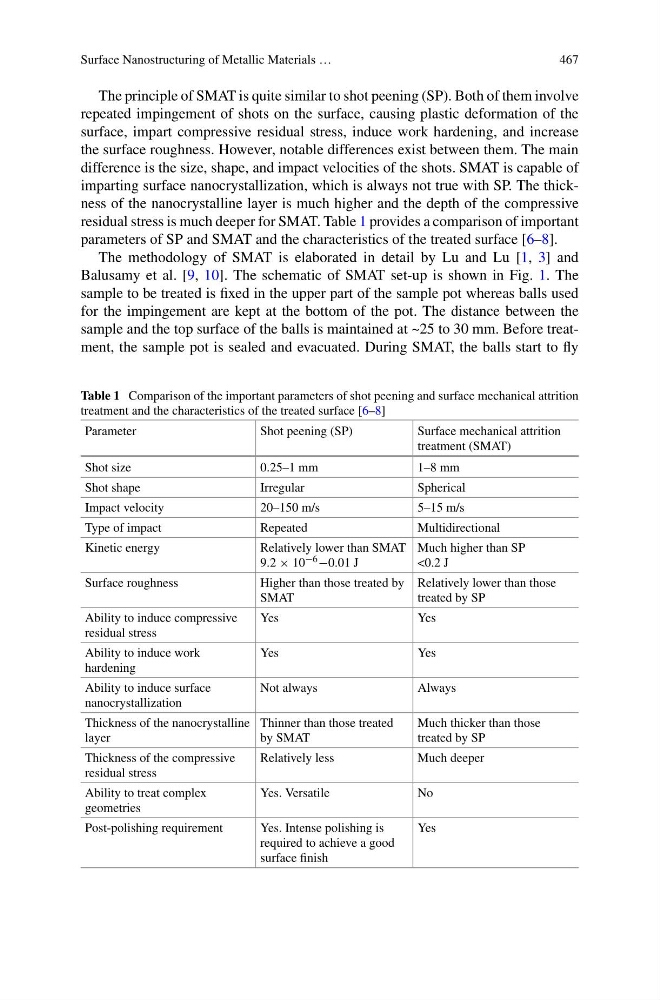
residual stress is much deeper for SMAT. Table 1 provides a comparison of important
parameters of SP and SMAT and the characteristics of the treated surface [6–8].
The methodology of SMAT is elaborated in detail by Lu and Lu [1, 3] and
Balusamy et al. [9, 10]. The schematic of SMAT set-up is shown in Fig. 1. The
sample to be treated is fixed in the upper part of the sample pot whereas balls used
for the impingement are kept at the bottom of the pot. The distance between the
sample and the top surface of the balls is maintained at ~25 to 30 mm. Before treatment, the sample pot is sealed and evacuated. During SMAT, the balls start to fly
Table 1 Comparison of the important parameters of shot peening and surface mechanical attrition
treatment and the characteristics of the treated surface [6–8]
Parameter
Shot peening (SP)
Surface mechanical attrition
treatment (SMAT)
Shot size
0.25–1 mm
1–8 mm
Shot shape
Irregular
Spherical
Impact velocity
20–150 m/s
5–15 m/s
Type of impact
Repeated
Multidirectional
Kinetic energy
Relatively lower than SMAT
9.2 × 10 −6 −0.01 J
Much higher than SP
<0.2 J
Surface roughness
Higher than those treated by
SMAT
Relatively lower than those
treated by SP
Ability to induce compressive
residual stress
Yes
Yes
Ability to induce work
hardening
Yes
Yes
Ability to induce surface
nanocrystallization
Not always
Always
Thickness of the nanocrystalline
layer
Thinner than those treated
by SMAT
Much thicker than those
treated by SP
Thickness of the compressive
residual stress
Relatively less
Much deeper
Ability to treat complex
geometries
Yes. Versatile
No
Post-polishing requirement
Yes. Intense polishing is
required to achieve a good
surface finish
Yes
467
The principle of SMAT is quite similar to shot peening (SP). Both of them involve
repeated impingement of shots on the surface, causing plastic deformation of the
surface, impart compressive residual stress, induce work hardening, and increase
the surface roughness. However, notable differences exist between them. The main
difference is the size, shape, and impact velocities of the shots. SMAT is capable of
imparting surface nanocrystallization, which is always not true with SP. The thickness of the nanocrystalline layer is much higher and the depth of the compressive
residual stress is much deeper for SMAT. Table 1 provides a comparison of important
parameters of SP and SMAT and the characteristics of the treated surface [6–8].
The methodology of SMAT is elaborated in detail by Lu and Lu [1, 3] and
Balusamy et al. [9, 10]. The schematic of SMAT set-up is shown in Fig. 1. The
sample to be treated is fixed in the upper part of the sample pot whereas balls used
for the impingement are kept at the bottom of the pot. The distance between the
sample and the top surface of the balls is maintained at ~25 to 30 mm. Before treatment, the sample pot is sealed and evacuated. During SMAT, the balls start to fly
Table 1 Comparison of the important parameters of shot peening and surface mechanical attrition
treatment and the characteristics of the treated surface [6–8]
Parameter
Shot peening (SP)
Surface mechanical attrition
treatment (SMAT)
Shot size
0.25–1 mm
1–8 mm
Shot shape
Irregular
Spherical
Impact velocity
20–150 m/s
5–15 m/s
Type of impact
Repeated
Multidirectional
Kinetic energy
Relatively lower than SMAT
9.2 × 10 −6 −0.01 J
Much higher than SP
<0.2 J
Surface roughness
Higher than those treated by
SMAT
Relatively lower than those
treated by SP
Ability to induce compressive
residual stress
Yes
Yes
Ability to induce work
hardening
Yes
Yes
Ability to induce surface
nanocrystallization
Not always
Always
Thickness of the nanocrystalline
layer
Thinner than those treated
by SMAT
Much thicker than those
treated by SP
Thickness of the compressive
residual stress
Relatively less
Much deeper
Ability to treat complex
geometries
Yes. Versatile
No
Post-polishing requirement
Yes. Intense polishing is
required to achieve a good
surface finish
Yes