

428
A. Kumar et al.
and the pharmaceutical pollutants, electrostatic interactions, hydrophobic interactions, and hydrogen bonding between Chitosan and the drugs, the adsorption efficiency of the Chitosan spheres nanocomposite were enhanced for the antibiotic and
chemotherapy drug. Carbon nanomaterials can be modified with other biopolymers,
including gum, polyacrylamide, polyvinyl alcohol, L-cysteine, cellulose, polyaniline,
and polydopamine which is utilized for purification of water [78]. The “polyaniline (PANI)” functionalized “GO-SrTiO3” nanomaterial has assisted in the effective
absorption of cationic and anionic dyes at the same time.
4.8 Modification of Graphene Quantum Dots (GQDs)-Based
Nanomaterials in Cancer Treatment
GQDs can be doped with heteroatoms to modify their and optical characteristics
and density of electrons effectively for specific properties [79]. N doping of GQDs
is an efficient method to expand the light absorption and improving the PL lifetime
[80]. Kuo and colleagues [81] prepared N-GQDs by modified them with amino acid
molecules (amino-N-GQDs). The modification improved the electronic properties of
N-GQDs. Du and co-workers (“Photodynamic Graphene Quantum Dot: Reduction
Condition Regulated Photo-Activity and Size-Dependent Efficacy” 82) functionalized GQDs-based nanocomposites by incorporating Ce6 using disulfide bond onto
GQDs. Also, Pluronic F- 127 coated on the GQD-SS-Ce6 acts as a stabilizer. GSH
in the tumor cells initiates disulfide bond cleavage when GQD-SS- Ce6 reaches
local tumor tissue. The GQDs nanoplatform then can release Ce6 and its phototoxicity is restored. [83] fabricated HA-GQD, a nanocomposite, where HA and GQDs
have p-p stacking, which has PDT and imaging characteristics as well. After that,
to prepare HA-GQD-SiO2, HA-GQD is encapsulated by porous silica nanoparticles. This helps during drug delivery to avoid the refining of the nanocomposites.
This again enhanced the intensity of the fluorescence signal and HA-GQD production capability. Besides, specific PDT property can be exhibited by functionalized
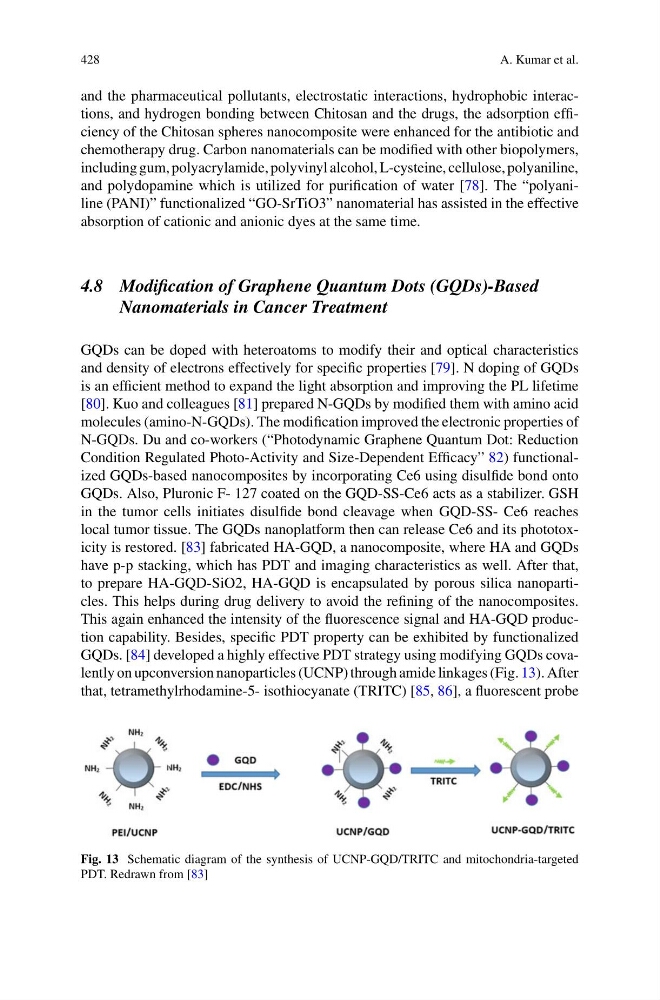
GQDs. [84] developed a highly effective PDT strategy using modifying GQDs covalently on upconversion nanoparticles (UCNP) through amide linkages (Fig. 13). After
that, tetramethylrhodamine-5- isothiocyanate (TRITC) [85, 86], a fluorescent probe
Fig. 13 Schematic diagram of the synthesis of UCNP-GQD/TRITC and mitochondria-targeted
PDT. Redrawn from [83]
A. Kumar et al.
and the pharmaceutical pollutants, electrostatic interactions, hydrophobic interactions, and hydrogen bonding between Chitosan and the drugs, the adsorption efficiency of the Chitosan spheres nanocomposite were enhanced for the antibiotic and
chemotherapy drug. Carbon nanomaterials can be modified with other biopolymers,
including gum, polyacrylamide, polyvinyl alcohol, L-cysteine, cellulose, polyaniline,
and polydopamine which is utilized for purification of water [78]. The “polyaniline (PANI)” functionalized “GO-SrTiO3” nanomaterial has assisted in the effective
absorption of cationic and anionic dyes at the same time.
4.8 Modification of Graphene Quantum Dots (GQDs)-Based
Nanomaterials in Cancer Treatment
GQDs can be doped with heteroatoms to modify their and optical characteristics
and density of electrons effectively for specific properties [79]. N doping of GQDs
is an efficient method to expand the light absorption and improving the PL lifetime
[80]. Kuo and colleagues [81] prepared N-GQDs by modified them with amino acid
molecules (amino-N-GQDs). The modification improved the electronic properties of
N-GQDs. Du and co-workers (“Photodynamic Graphene Quantum Dot: Reduction
Condition Regulated Photo-Activity and Size-Dependent Efficacy” 82) functionalized GQDs-based nanocomposites by incorporating Ce6 using disulfide bond onto
GQDs. Also, Pluronic F- 127 coated on the GQD-SS-Ce6 acts as a stabilizer. GSH
in the tumor cells initiates disulfide bond cleavage when GQD-SS- Ce6 reaches
local tumor tissue. The GQDs nanoplatform then can release Ce6 and its phototoxicity is restored. [83] fabricated HA-GQD, a nanocomposite, where HA and GQDs
have p-p stacking, which has PDT and imaging characteristics as well. After that,
to prepare HA-GQD-SiO2, HA-GQD is encapsulated by porous silica nanoparticles. This helps during drug delivery to avoid the refining of the nanocomposites.
This again enhanced the intensity of the fluorescence signal and HA-GQD production capability. Besides, specific PDT property can be exhibited by functionalized
GQDs. [84] developed a highly effective PDT strategy using modifying GQDs covalently on upconversion nanoparticles (UCNP) through amide linkages (Fig. 13). After
that, tetramethylrhodamine-5- isothiocyanate (TRITC) [85, 86], a fluorescent probe
Fig. 13 Schematic diagram of the synthesis of UCNP-GQD/TRITC and mitochondria-targeted
PDT. Redrawn from [83]