

34
K. Illath et al.
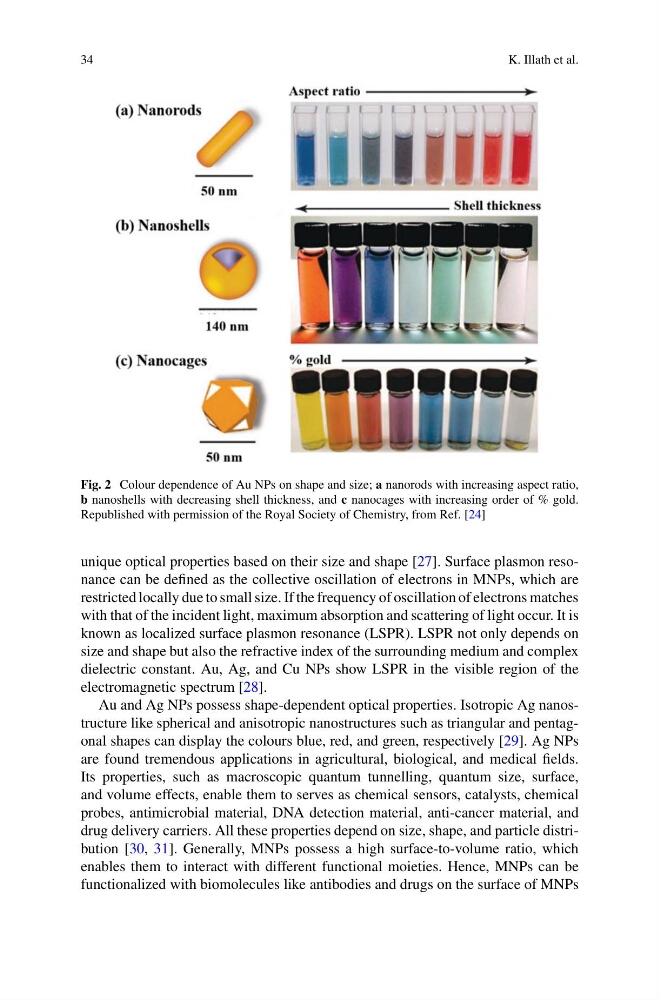
Fig. 2 Colour dependence of Au NPs on shape and size; a nanorods with increasing aspect ratio,
b nanoshells with decreasing shell thickness, and c nanocages with increasing order of % gold.
Republished with permission of the Royal Society of Chemistry, from Ref. [24]
unique optical properties based on their size and shape [27]. Surface plasmon resonance can be defined as the collective oscillation of electrons in MNPs, which are
restricted locally due to small size. If the frequency of oscillation of electrons matches
with that of the incident light, maximum absorption and scattering of light occur. It is
known as localized surface plasmon resonance (LSPR). LSPR not only depends on
size and shape but also the refractive index of the surrounding medium and complex
dielectric constant. Au, Ag, and Cu NPs show LSPR in the visible region of the
electromagnetic spectrum [28].
Au and Ag NPs possess shape-dependent optical properties. Isotropic Ag nanostructure like spherical and anisotropic nanostructures such as triangular and pentagonal shapes can display the colours blue, red, and green, respectively [29]. Ag NPs
are found tremendous applications in agricultural, biological, and medical fields.
Its properties, such as macroscopic quantum tunnelling, quantum size, surface,
and volume effects, enable them to serves as chemical sensors, catalysts, chemical
probes, antimicrobial material, DNA detection material, anti-cancer material, and
drug delivery carriers. All these properties depend on size, shape, and particle distribution [30, 31]. Generally, MNPs possess a high surface-to-volume ratio, which
enables them to interact with different functional moieties. Hence, MNPs can be
functionalized with biomolecules like antibodies and drugs on the surface of MNPs
K. Illath et al.
Fig. 2 Colour dependence of Au NPs on shape and size; a nanorods with increasing aspect ratio,
b nanoshells with decreasing shell thickness, and c nanocages with increasing order of % gold.
Republished with permission of the Royal Society of Chemistry, from Ref. [24]
unique optical properties based on their size and shape [27]. Surface plasmon resonance can be defined as the collective oscillation of electrons in MNPs, which are
restricted locally due to small size. If the frequency of oscillation of electrons matches
with that of the incident light, maximum absorption and scattering of light occur. It is
known as localized surface plasmon resonance (LSPR). LSPR not only depends on
size and shape but also the refractive index of the surrounding medium and complex
dielectric constant. Au, Ag, and Cu NPs show LSPR in the visible region of the
electromagnetic spectrum [28].
Au and Ag NPs possess shape-dependent optical properties. Isotropic Ag nanostructure like spherical and anisotropic nanostructures such as triangular and pentagonal shapes can display the colours blue, red, and green, respectively [29]. Ag NPs
are found tremendous applications in agricultural, biological, and medical fields.
Its properties, such as macroscopic quantum tunnelling, quantum size, surface,
and volume effects, enable them to serves as chemical sensors, catalysts, chemical
probes, antimicrobial material, DNA detection material, anti-cancer material, and
drug delivery carriers. All these properties depend on size, shape, and particle distribution [30, 31]. Generally, MNPs possess a high surface-to-volume ratio, which
enables them to interact with different functional moieties. Hence, MNPs can be
functionalized with biomolecules like antibodies and drugs on the surface of MNPs