

422
A. Kumar et al.
and other derivatives for various applications. Graphene is less expensive, environmentally stable, available in plenty, and showcased exceptional physicochemical
properties utilized in adsorption applications.
4.2 Modifications of Carbon Nanotubes (CNTs)
[44] developed a nanohybrid aerogel made of graphene-CNT to deduct pollutants of
organic nature from wastewater. The surface area increased due to the attachment
of CNTs to graphene aerogel about 57% in the nanohybrid. The nanohybrid aerogel
was successful in adsorbing to cationic dyes, anionic dyes, CR and MO, and crystal
violet (CV) and MB, primarily through p–p and van der Waals forces. Therefore,
nanohybrid aerogels help in the adsorption of both negatively as well as positively
charged water pollutants.
CNTs, like graphene, can be modified availing magnetic nanoparticles to help
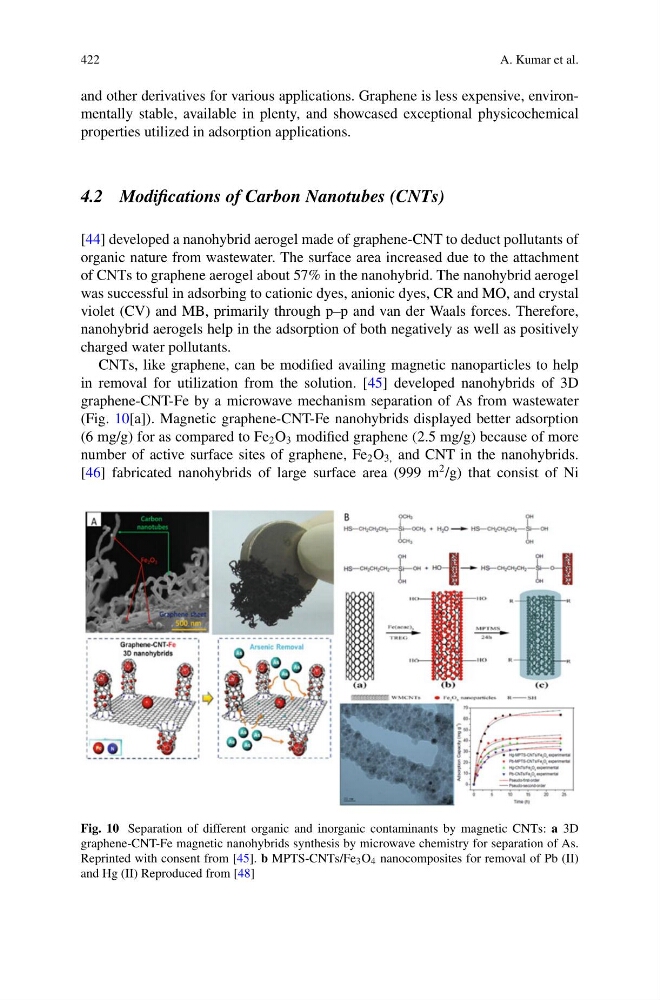
in removal for utilization from the solution. [45] developed nanohybrids of 3D
graphene-CNT-Fe by a microwave mechanism separation of As from wastewater
(Fig. 10[a]). Magnetic graphene-CNT-Fe nanohybrids displayed better adsorption
(6 mg/g) for as compared to Fe 2 O 3 modified graphene (2.5 mg/g) because of more
number of active surface sites of graphene, Fe 2 O 3, and CNT in the nanohybrids.
[46] fabricated nanohybrids of large surface area (999 m
2 /g) that consist of Ni
Fig. 10 Separation of different organic and inorganic contaminants by magnetic CNTs: a 3D
graphene-CNT-Fe magnetic nanohybrids synthesis by microwave chemistry for separation of As.
Reprinted with consent from [45]. b MPTS-CNTs/Fe 3 O 4 nanocomposites for removal of Pb (II)
and Hg (II) Reproduced from [48]
A. Kumar et al.
and other derivatives for various applications. Graphene is less expensive, environmentally stable, available in plenty, and showcased exceptional physicochemical
properties utilized in adsorption applications.
4.2 Modifications of Carbon Nanotubes (CNTs)
[44] developed a nanohybrid aerogel made of graphene-CNT to deduct pollutants of
organic nature from wastewater. The surface area increased due to the attachment
of CNTs to graphene aerogel about 57% in the nanohybrid. The nanohybrid aerogel
was successful in adsorbing to cationic dyes, anionic dyes, CR and MO, and crystal
violet (CV) and MB, primarily through p–p and van der Waals forces. Therefore,
nanohybrid aerogels help in the adsorption of both negatively as well as positively
charged water pollutants.
CNTs, like graphene, can be modified availing magnetic nanoparticles to help
in removal for utilization from the solution. [45] developed nanohybrids of 3D
graphene-CNT-Fe by a microwave mechanism separation of As from wastewater
(Fig. 10[a]). Magnetic graphene-CNT-Fe nanohybrids displayed better adsorption
(6 mg/g) for as compared to Fe 2 O 3 modified graphene (2.5 mg/g) because of more
number of active surface sites of graphene, Fe 2 O 3, and CNT in the nanohybrids.
[46] fabricated nanohybrids of large surface area (999 m
2 /g) that consist of Ni
Fig. 10 Separation of different organic and inorganic contaminants by magnetic CNTs: a 3D
graphene-CNT-Fe magnetic nanohybrids synthesis by microwave chemistry for separation of As.
Reprinted with consent from [45]. b MPTS-CNTs/Fe 3 O 4 nanocomposites for removal of Pb (II)
and Hg (II) Reproduced from [48]