

368
N. Ashwin Kumar et al.
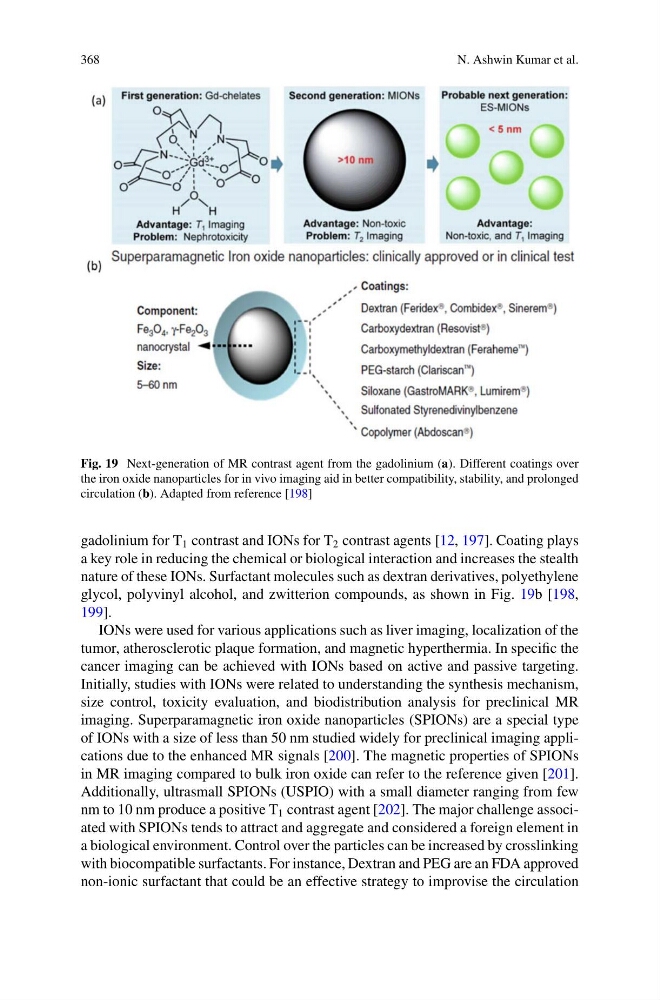
Fig. 19 Next-generation of MR contrast agent from the gadolinium (a). Different coatings over
the iron oxide nanoparticles for in vivo imaging aid in better compatibility, stability, and prolonged
circulation (b). Adapted from reference [198]
gadolinium for T 1 contrast and IONs for T 2 contrast agents [12, 197]. Coating plays
a key role in reducing the chemical or biological interaction and increases the stealth
nature of these IONs. Surfactant molecules such as dextran derivatives, polyethylene
glycol, polyvinyl alcohol, and zwitterion compounds, as shown in Fig. 19b [198,
199].
IONs were used for various applications such as liver imaging, localization of the
tumor, atherosclerotic plaque formation, and magnetic hyperthermia. In specific the
cancer imaging can be achieved with IONs based on active and passive targeting.
Initially, studies with IONs were related to understanding the synthesis mechanism,
size control, toxicity evaluation, and biodistribution analysis for preclinical MR
imaging. Superparamagnetic iron oxide nanoparticles (SPIONs) are a special type
of IONs with a size of less than 50 nm studied widely for preclinical imaging applications due to the enhanced MR signals [200]. The magnetic properties of SPIONs
in MR imaging compared to bulk iron oxide can refer to the reference given [201].
Additionally, ultrasmall SPIONs (USPIO) with a small diameter ranging from few
nm to 10 nm produce a positive T 1 contrast agent [202]. The major challenge associated with SPIONs tends to attract and aggregate and considered a foreign element in
a biological environment. Control over the particles can be increased by crosslinking
with biocompatible surfactants. For instance, Dextran and PEG are an FDA approved
non-ionic surfactant that could be an effective strategy to improvise the circulation
N. Ashwin Kumar et al.
Fig. 19 Next-generation of MR contrast agent from the gadolinium (a). Different coatings over
the iron oxide nanoparticles for in vivo imaging aid in better compatibility, stability, and prolonged
circulation (b). Adapted from reference [198]
gadolinium for T 1 contrast and IONs for T 2 contrast agents [12, 197]. Coating plays
a key role in reducing the chemical or biological interaction and increases the stealth
nature of these IONs. Surfactant molecules such as dextran derivatives, polyethylene
glycol, polyvinyl alcohol, and zwitterion compounds, as shown in Fig. 19b [198,
199].
IONs were used for various applications such as liver imaging, localization of the
tumor, atherosclerotic plaque formation, and magnetic hyperthermia. In specific the
cancer imaging can be achieved with IONs based on active and passive targeting.
Initially, studies with IONs were related to understanding the synthesis mechanism,
size control, toxicity evaluation, and biodistribution analysis for preclinical MR
imaging. Superparamagnetic iron oxide nanoparticles (SPIONs) are a special type
of IONs with a size of less than 50 nm studied widely for preclinical imaging applications due to the enhanced MR signals [200]. The magnetic properties of SPIONs
in MR imaging compared to bulk iron oxide can refer to the reference given [201].
Additionally, ultrasmall SPIONs (USPIO) with a small diameter ranging from few
nm to 10 nm produce a positive T 1 contrast agent [202]. The major challenge associated with SPIONs tends to attract and aggregate and considered a foreign element in
a biological environment. Control over the particles can be increased by crosslinking
with biocompatible surfactants. For instance, Dextran and PEG are an FDA approved
non-ionic surfactant that could be an effective strategy to improvise the circulation