

320
G. Perumal and M. Doble
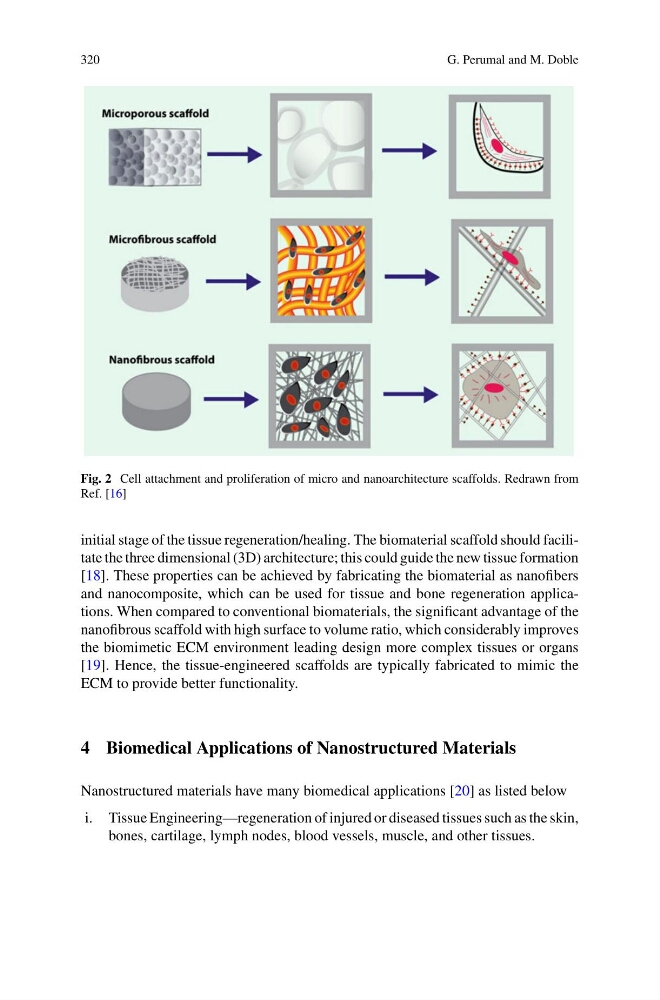
Fig. 2 Cell attachment and proliferation of micro and nanoarchitecture scaffolds. Redrawn from
Ref. [16]
initial stage of the tissue regeneration/healing. The biomaterial scaffold should facilitate the three dimensional (3D) architecture; this could guide the new tissue formation
[18]. These properties can be achieved by fabricating the biomaterial as nanofibers
and nanocomposite, which can be used for tissue and bone regeneration applications. When compared to conventional biomaterials, the significant advantage of the
nanofibrous scaffold with high surface to volume ratio, which considerably improves
the biomimetic ECM environment leading design more complex tissues or organs
[19]. Hence, the tissue-engineered scaffolds are typically fabricated to mimic the
ECM to provide better functionality.
4 Biomedical Applications of Nanostructured Materials
Nanostructured materials have many biomedical applications [20] as listed below
i. Tissue Engineering—regeneration of injured or diseased tissues such as the skin,
bones, cartilage, lymph nodes, blood vessels, muscle, and other tissues.
G. Perumal and M. Doble
Fig. 2 Cell attachment and proliferation of micro and nanoarchitecture scaffolds. Redrawn from
Ref. [16]
initial stage of the tissue regeneration/healing. The biomaterial scaffold should facilitate the three dimensional (3D) architecture; this could guide the new tissue formation
[18]. These properties can be achieved by fabricating the biomaterial as nanofibers
and nanocomposite, which can be used for tissue and bone regeneration applications. When compared to conventional biomaterials, the significant advantage of the
nanofibrous scaffold with high surface to volume ratio, which considerably improves
the biomimetic ECM environment leading design more complex tissues or organs
[19]. Hence, the tissue-engineered scaffolds are typically fabricated to mimic the
ECM to provide better functionality.
4 Biomedical Applications of Nanostructured Materials
Nanostructured materials have many biomedical applications [20] as listed below
i. Tissue Engineering—regeneration of injured or diseased tissues such as the skin,
bones, cartilage, lymph nodes, blood vessels, muscle, and other tissues.