

Hydrogels: Biomaterials for Sustained and Localized Drug Delivery
231
Table 6 Comparative analysis of various microfabrication methods
Technique
Resolution Description
Demerits
Bioprinting
~ 10 μm
Accurate deposition by the
printer.
Expensive; Limited to
specific hydrogel
Stereolithography ~ 1 μm
Photopolymerisable hydrogel
block formation layer by layer
with laser irradiation
Expensive; Limited to
photopolymerizable
polymers
Laser printing
~ 1 μm
Hydrogel block formation by
laser ablation
Expensive; Time consuming;
Non-homogeneous hydrogel
network formation
Bioprinting
~ 100 nm Hydrogel mold with master
structure from
microfabrication techniques
Highly sophisticated; trained
personnel; multiple steps
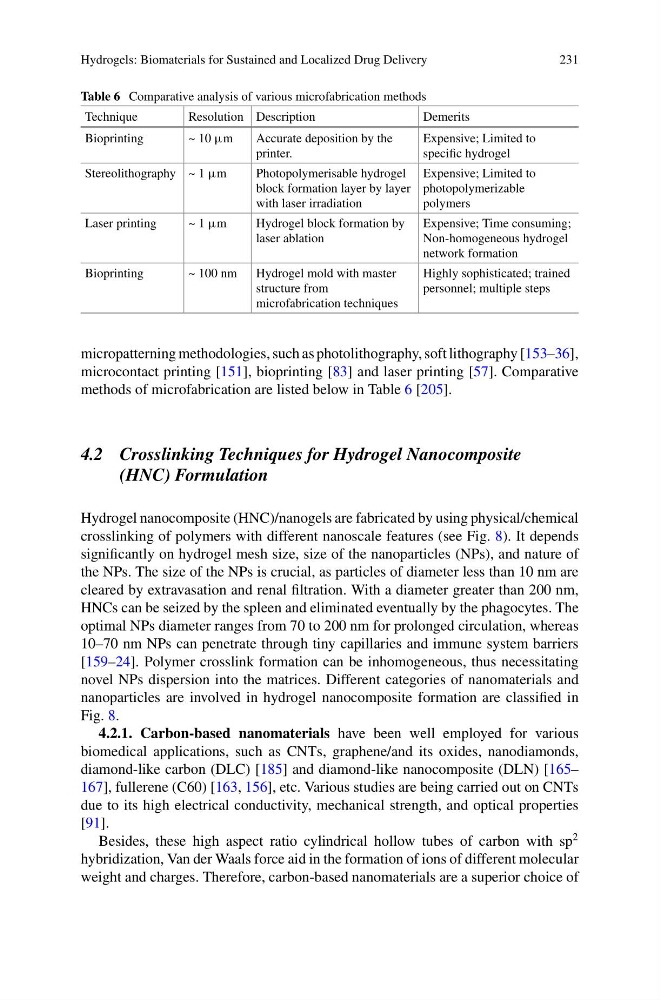
micropatterning methodologies, such as photolithography, soft lithography [153–36],
microcontact printing [151], bioprinting [83] and laser printing [57]. Comparative
methods of microfabrication are listed below in Table 6 [205].
4.2 Crosslinking Techniques for Hydrogel Nanocomposite
(HNC) Formulation
Hydrogel nanocomposite (HNC)/nanogels are fabricated by using physical/chemical
crosslinking of polymers with different nanoscale features (see Fig. 8). It depends
significantly on hydrogel mesh size, size of the nanoparticles (NPs), and nature of
the NPs. The size of the NPs is crucial, as particles of diameter less than 10 nm are
cleared by extravasation and renal filtration. With a diameter greater than 200 nm,
HNCs can be seized by the spleen and eliminated eventually by the phagocytes. The
optimal NPs diameter ranges from 70 to 200 nm for prolonged circulation, whereas
10–70 nm NPs can penetrate through tiny capillaries and immune system barriers
[159–24]. Polymer crosslink formation can be inhomogeneous, thus necessitating
novel NPs dispersion into the matrices. Different categories of nanomaterials and
nanoparticles are involved in hydrogel nanocomposite formation are classified in
Fig. 8.
4.2.1. Carbon-based nanomaterials have been well employed for various
biomedical applications, such as CNTs, graphene/and its oxides, nanodiamonds,
diamond-like carbon (DLC) [185] and diamond-like nanocomposite (DLN) [165–
167], fullerene (C60) [163, 156], etc. Various studies are being carried out on CNTs
due to its high electrical conductivity, mechanical strength, and optical properties
[91].
Besides, these high aspect ratio cylindrical hollow tubes of carbon with sp
2
hybridization, Van der Waals force aid in the formation of ions of different molecular
weight and charges. Therefore, carbon-based nanomaterials are a superior choice of
231
Table 6 Comparative analysis of various microfabrication methods
Technique
Resolution Description
Demerits
Bioprinting
~ 10 μm
Accurate deposition by the
printer.
Expensive; Limited to
specific hydrogel
Stereolithography ~ 1 μm
Photopolymerisable hydrogel
block formation layer by layer
with laser irradiation
Expensive; Limited to
photopolymerizable
polymers
Laser printing
~ 1 μm
Hydrogel block formation by
laser ablation
Expensive; Time consuming;
Non-homogeneous hydrogel
network formation
Bioprinting
~ 100 nm Hydrogel mold with master
structure from
microfabrication techniques
Highly sophisticated; trained
personnel; multiple steps
micropatterning methodologies, such as photolithography, soft lithography [153–36],
microcontact printing [151], bioprinting [83] and laser printing [57]. Comparative
methods of microfabrication are listed below in Table 6 [205].
4.2 Crosslinking Techniques for Hydrogel Nanocomposite
(HNC) Formulation
Hydrogel nanocomposite (HNC)/nanogels are fabricated by using physical/chemical
crosslinking of polymers with different nanoscale features (see Fig. 8). It depends
significantly on hydrogel mesh size, size of the nanoparticles (NPs), and nature of
the NPs. The size of the NPs is crucial, as particles of diameter less than 10 nm are
cleared by extravasation and renal filtration. With a diameter greater than 200 nm,
HNCs can be seized by the spleen and eliminated eventually by the phagocytes. The
optimal NPs diameter ranges from 70 to 200 nm for prolonged circulation, whereas
10–70 nm NPs can penetrate through tiny capillaries and immune system barriers
[159–24]. Polymer crosslink formation can be inhomogeneous, thus necessitating
novel NPs dispersion into the matrices. Different categories of nanomaterials and
nanoparticles are involved in hydrogel nanocomposite formation are classified in
Fig. 8.
4.2.1. Carbon-based nanomaterials have been well employed for various
biomedical applications, such as CNTs, graphene/and its oxides, nanodiamonds,
diamond-like carbon (DLC) [185] and diamond-like nanocomposite (DLN) [165–
167], fullerene (C60) [163, 156], etc. Various studies are being carried out on CNTs
due to its high electrical conductivity, mechanical strength, and optical properties
[91].
Besides, these high aspect ratio cylindrical hollow tubes of carbon with sp
2
hybridization, Van der Waals force aid in the formation of ions of different molecular
weight and charges. Therefore, carbon-based nanomaterials are a superior choice of