

218
G. Keerthiga et al.
hydrogel formulation [69]. For tissue engineering scaffold generation, positively
charged polymer scaffolds show a better attachment than the negatively charged
polymer [186]. Implantable hydrogels for drug delivery/tissue engineering frequently
face rejection due to the immune response of the host system. A thick collagenous of
matter around the implant is formed, that favorably thwarts the implant- body interactions preventing implant rejection. pHEMA does not favor non-specific protein
absorption, thus supporting its non-fouling property, which is highly desirable for
an implant. However, pHEMA can only partially prevent surface capsule formation,
thereby necessitates for modification of pHEMA formulations. Zwitterionic hydrogels of poly carboxy betaine methacrylate (PCBMA) has known to develop smaller
surface capsule formation, thus causing lesser inflammation, ultimately leading to a
lowered chance of implant rejection [223].
Polyacrylamide (PAAm) based hydrogels are synthesized from monomers of acrylamide. Different conditions of polymer synthesis, co-polymerization with other
different monomers, to achieve for tailored chemical properties of the hydrogel.
Hydrogels constructed with PAAm backbone are often exploited for stimuliresponsive drug delivery. Gastrointestinal systemic delivery with varied pH, ranging
from highly acidic to alkaline (pH 1.0–8.2), chronic wound treatment, and treatment
for cancer employed by using PAAm based hydrogels are reported in the literature.
These formulations contain weak acidic (carboxylic or sulfonic) or primary (ammonium) functional groups bonded to the main polymer configurations, that become
ionized in micro-environmental pH conditions either by accepting or donating
protons, thereby affecting the swelling pattern of the hydrogel [58–203].
In addition to pH sensitivity, temperature-responsive PAAm polymers are also
used for their distinct properties. Frequently used thermoresponsive modified PAAm
polymers are polyN-isopropylacrylamide (PNIPAAm), polyN, N-dimethyl acrylamide (PDEAAm) [100]. One another polymer is employed for similar thermoresponsive properties is PNIPPAm, and the additional functionality of the pendant
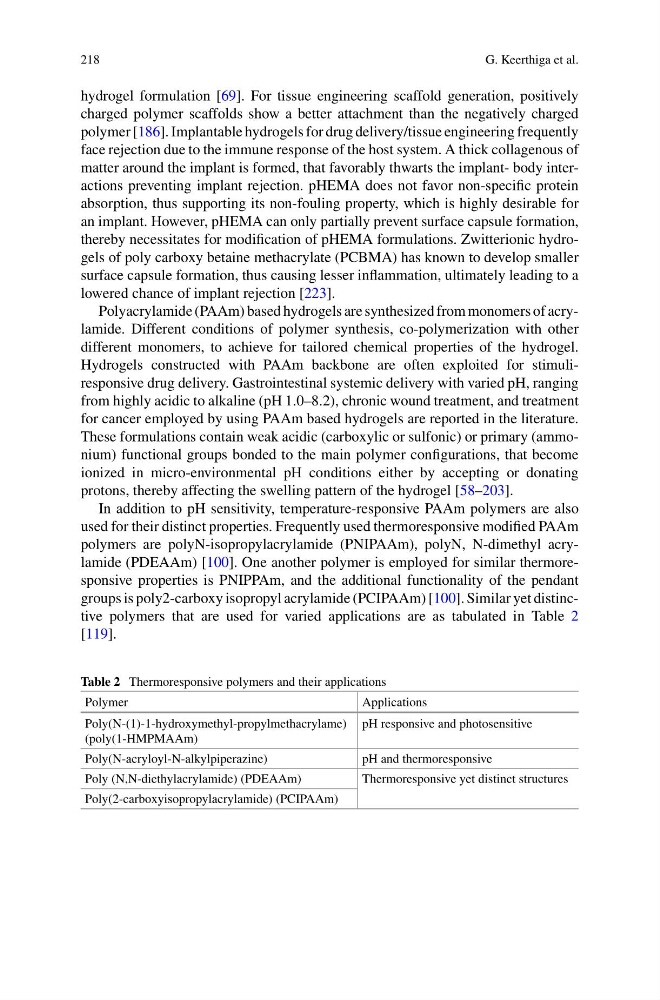
groups is poly2-carboxy isopropyl acrylamide (PCIPAAm) [100]. Similar yet distinctive polymers that are used for varied applications are as tabulated in Table 2
[119].
Table 2 Thermoresponsive polymers and their applications
Polymer
Applications
Poly(N-(1)-1-hydroxymethyl-propylmethacrylame)
(poly(1-HMPMAAm)
pH responsive and photosensitive
Poly(N-acryloyl-N-alkylpiperazine)
pH and thermoresponsive
Poly (N,N-diethylacrylamide) (PDEAAm)
Thermoresponsive yet distinct structures
Poly(2-carboxyisopropylacrylamide) (PCIPAAm)
G. Keerthiga et al.
hydrogel formulation [69]. For tissue engineering scaffold generation, positively
charged polymer scaffolds show a better attachment than the negatively charged
polymer [186]. Implantable hydrogels for drug delivery/tissue engineering frequently
face rejection due to the immune response of the host system. A thick collagenous of
matter around the implant is formed, that favorably thwarts the implant- body interactions preventing implant rejection. pHEMA does not favor non-specific protein
absorption, thus supporting its non-fouling property, which is highly desirable for
an implant. However, pHEMA can only partially prevent surface capsule formation,
thereby necessitates for modification of pHEMA formulations. Zwitterionic hydrogels of poly carboxy betaine methacrylate (PCBMA) has known to develop smaller
surface capsule formation, thus causing lesser inflammation, ultimately leading to a
lowered chance of implant rejection [223].
Polyacrylamide (PAAm) based hydrogels are synthesized from monomers of acrylamide. Different conditions of polymer synthesis, co-polymerization with other
different monomers, to achieve for tailored chemical properties of the hydrogel.
Hydrogels constructed with PAAm backbone are often exploited for stimuliresponsive drug delivery. Gastrointestinal systemic delivery with varied pH, ranging
from highly acidic to alkaline (pH 1.0–8.2), chronic wound treatment, and treatment
for cancer employed by using PAAm based hydrogels are reported in the literature.
These formulations contain weak acidic (carboxylic or sulfonic) or primary (ammonium) functional groups bonded to the main polymer configurations, that become
ionized in micro-environmental pH conditions either by accepting or donating
protons, thereby affecting the swelling pattern of the hydrogel [58–203].
In addition to pH sensitivity, temperature-responsive PAAm polymers are also
used for their distinct properties. Frequently used thermoresponsive modified PAAm
polymers are polyN-isopropylacrylamide (PNIPAAm), polyN, N-dimethyl acrylamide (PDEAAm) [100]. One another polymer is employed for similar thermoresponsive properties is PNIPPAm, and the additional functionality of the pendant
groups is poly2-carboxy isopropyl acrylamide (PCIPAAm) [100]. Similar yet distinctive polymers that are used for varied applications are as tabulated in Table 2
[119].
Table 2 Thermoresponsive polymers and their applications
Polymer
Applications
Poly(N-(1)-1-hydroxymethyl-propylmethacrylame)
(poly(1-HMPMAAm)
pH responsive and photosensitive
Poly(N-acryloyl-N-alkylpiperazine)
pH and thermoresponsive
Poly (N,N-diethylacrylamide) (PDEAAm)
Thermoresponsive yet distinct structures
Poly(2-carboxyisopropylacrylamide) (PCIPAAm)