

Hydrogels: Biomaterials for Sustained and Localized Drug Delivery
215
2.1 Polymeric Source
The polymeric source can range from natural to synthetic monomers for hydrogel
formulation depends upon the application intended.
2.1.1 Natural Polymers
Natural polymers are developing biomaterials that are the primary forms of renewable biomass. Extracted from a macromolecular matter of microbes, plants, and
animals, they offer a range of properties such as biodegradability, biocompatibility,
and non-toxicity. They are classified into cationic, anionic, neutral, and amphipathic,
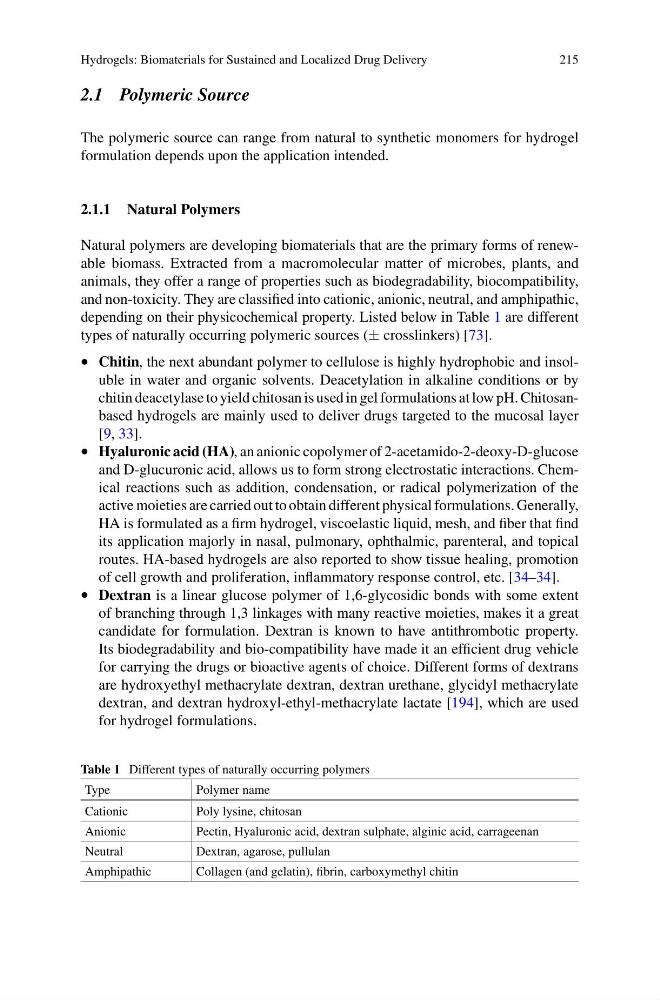
depending on their physicochemical property. Listed below in Table 1 are different
types of naturally occurring polymeric sources (± crosslinkers) [73].
• Chitin, the next abundant polymer to cellulose is highly hydrophobic and insoluble in water and organic solvents. Deacetylation in alkaline conditions or by
chitin deacetylase to yield chitosan is used in gel formulations at low pH. Chitosanbased hydrogels are mainly used to deliver drugs targeted to the mucosal layer
[9, 33].
• Hyaluronic acid (HA), an anionic copolymer of 2-acetamido-2-deoxy-D-glucose
and D-glucuronic acid, allows us to form strong electrostatic interactions. Chemical reactions such as addition, condensation, or radical polymerization of the
active moieties are carried out to obtain different physical formulations. Generally,
HA is formulated as a firm hydrogel, viscoelastic liquid, mesh, and fiber that find
its application majorly in nasal, pulmonary, ophthalmic, parenteral, and topical
routes. HA-based hydrogels are also reported to show tissue healing, promotion
of cell growth and proliferation, inflammatory response control, etc. [34–34].
• Dextran is a linear glucose polymer of 1,6-glycosidic bonds with some extent
of branching through 1,3 linkages with many reactive moieties, makes it a great
candidate for formulation. Dextran is known to have antithrombotic property.
Its biodegradability and bio-compatibility have made it an efficient drug vehicle
for carrying the drugs or bioactive agents of choice. Different forms of dextrans
are hydroxyethyl methacrylate dextran, dextran urethane, glycidyl methacrylate
dextran, and dextran hydroxyl-ethyl-methacrylate lactate [194], which are used
for hydrogel formulations.
Table 1 Different types of naturally occurring polymers
Type
Polymer name
Cationic
Poly lysine, chitosan
Anionic
Pectin, Hyaluronic acid, dextran sulphate, alginic acid, carrageenan
Neutral
Dextran, agarose, pullulan
Amphipathic
Collagen (and gelatin), fibrin, carboxymethyl chitin
215
2.1 Polymeric Source
The polymeric source can range from natural to synthetic monomers for hydrogel
formulation depends upon the application intended.
2.1.1 Natural Polymers
Natural polymers are developing biomaterials that are the primary forms of renewable biomass. Extracted from a macromolecular matter of microbes, plants, and
animals, they offer a range of properties such as biodegradability, biocompatibility,
and non-toxicity. They are classified into cationic, anionic, neutral, and amphipathic,
depending on their physicochemical property. Listed below in Table 1 are different
types of naturally occurring polymeric sources (± crosslinkers) [73].
• Chitin, the next abundant polymer to cellulose is highly hydrophobic and insoluble in water and organic solvents. Deacetylation in alkaline conditions or by
chitin deacetylase to yield chitosan is used in gel formulations at low pH. Chitosanbased hydrogels are mainly used to deliver drugs targeted to the mucosal layer
[9, 33].
• Hyaluronic acid (HA), an anionic copolymer of 2-acetamido-2-deoxy-D-glucose
and D-glucuronic acid, allows us to form strong electrostatic interactions. Chemical reactions such as addition, condensation, or radical polymerization of the
active moieties are carried out to obtain different physical formulations. Generally,
HA is formulated as a firm hydrogel, viscoelastic liquid, mesh, and fiber that find
its application majorly in nasal, pulmonary, ophthalmic, parenteral, and topical
routes. HA-based hydrogels are also reported to show tissue healing, promotion
of cell growth and proliferation, inflammatory response control, etc. [34–34].
• Dextran is a linear glucose polymer of 1,6-glycosidic bonds with some extent
of branching through 1,3 linkages with many reactive moieties, makes it a great
candidate for formulation. Dextran is known to have antithrombotic property.
Its biodegradability and bio-compatibility have made it an efficient drug vehicle
for carrying the drugs or bioactive agents of choice. Different forms of dextrans
are hydroxyethyl methacrylate dextran, dextran urethane, glycidyl methacrylate
dextran, and dextran hydroxyl-ethyl-methacrylate lactate [194], which are used
for hydrogel formulations.
Table 1 Different types of naturally occurring polymers
Type
Polymer name
Cationic
Poly lysine, chitosan
Anionic
Pectin, Hyaluronic acid, dextran sulphate, alginic acid, carrageenan
Neutral
Dextran, agarose, pullulan
Amphipathic
Collagen (and gelatin), fibrin, carboxymethyl chitin