

214
G. Keerthiga et al.
Injectable hydrogel formulation is currently overpowering the matrix hydrogel for
its capability to skip surgery for implantation [118]. Thus physical form significantly
decides the route of hydrogel introduction, depending on the physical structure of
the polymer, rigidity, covalent bonding and intermolecular interaction within the
polymeric chains [37, 25–58].
On the other hand, chemical characteristics involve matrix density, the mechanical
strength of the hydrogel formulation, biodegradability, and biocompatibility. These
properties are constricted to the individual and collective properties of monomers and
crosslinking agents used. Tailored hydrogel formulations are prepared by modifying
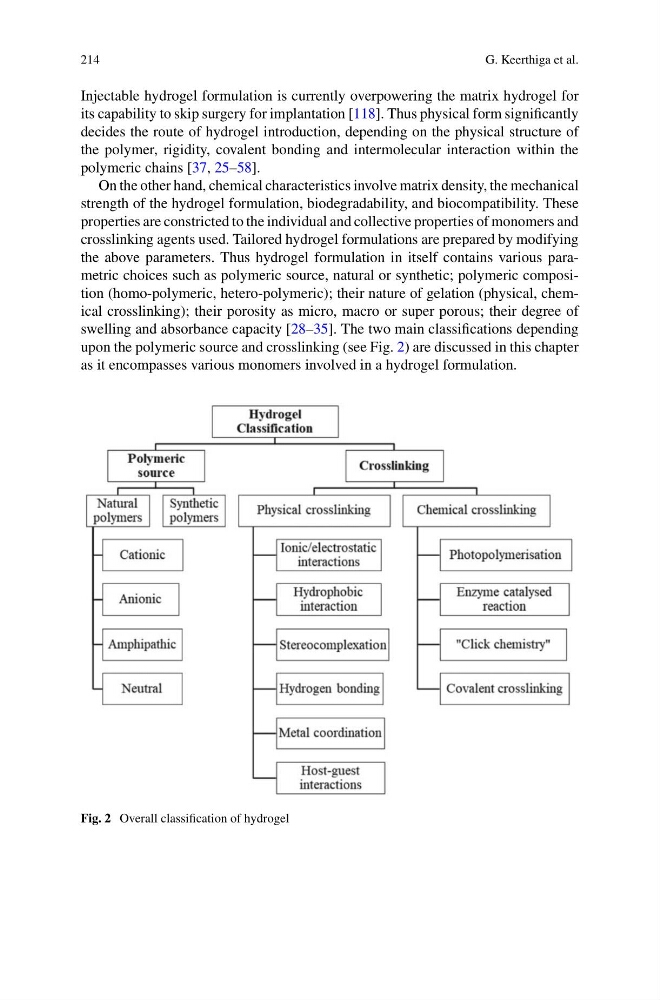
the above parameters. Thus hydrogel formulation in itself contains various parametric choices such as polymeric source, natural or synthetic; polymeric composition (homo-polymeric, hetero-polymeric); their nature of gelation (physical, chemical crosslinking); their porosity as micro, macro or super porous; their degree of
swelling and absorbance capacity [28–35]. The two main classifications depending
upon the polymeric source and crosslinking (see Fig. 2) are discussed in this chapter
as it encompasses various monomers involved in a hydrogel formulation.
Fig. 2 Overall classification of hydrogel
G. Keerthiga et al.
Injectable hydrogel formulation is currently overpowering the matrix hydrogel for
its capability to skip surgery for implantation [118]. Thus physical form significantly
decides the route of hydrogel introduction, depending on the physical structure of
the polymer, rigidity, covalent bonding and intermolecular interaction within the
polymeric chains [37, 25–58].
On the other hand, chemical characteristics involve matrix density, the mechanical
strength of the hydrogel formulation, biodegradability, and biocompatibility. These
properties are constricted to the individual and collective properties of monomers and
crosslinking agents used. Tailored hydrogel formulations are prepared by modifying
the above parameters. Thus hydrogel formulation in itself contains various parametric choices such as polymeric source, natural or synthetic; polymeric composition (homo-polymeric, hetero-polymeric); their nature of gelation (physical, chemical crosslinking); their porosity as micro, macro or super porous; their degree of
swelling and absorbance capacity [28–35]. The two main classifications depending
upon the polymeric source and crosslinking (see Fig. 2) are discussed in this chapter
as it encompasses various monomers involved in a hydrogel formulation.
Fig. 2 Overall classification of hydrogel