

186
S. T. Aruna and M. Shilpa
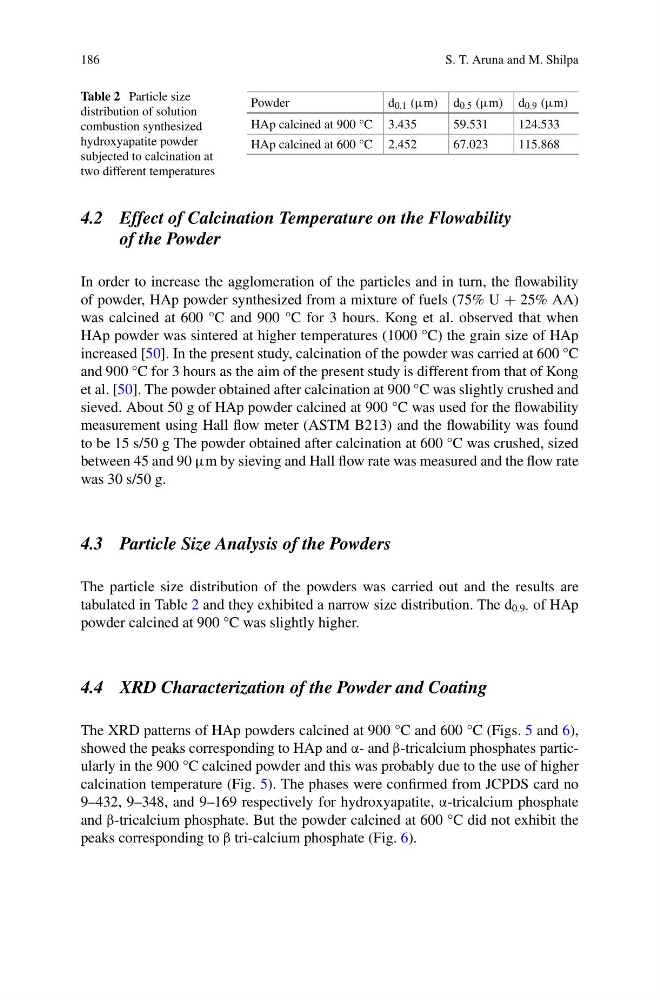
Table 2 Particle size
distribution of solution
combustion synthesized
hydroxyapatite powder
subjected to calcination at
two different temperatures
Powder
d 0.1 (μm) d 0.5 (μm) d 0.9 (μm)
HAp calcined at 900 °C 3.435
59.531
124.533
HAp calcined at 600 °C 2.452
67.023
115.868
4.2 Effect of Calcination Temperature on the Flowability
of the Powder
In order to increase the agglomeration of the particles and in turn, the flowability
of powder, HAp powder synthesized from a mixture of fuels (75% U + 25% AA)
was calcined at 600 °C and 900 °C for 3 hours. Kong et al. observed that when
HAp powder was sintered at higher temperatures (1000 °C) the grain size of HAp
increased [50]. In the present study, calcination of the powder was carried at 600 °C
and 900 °C for 3 hours as the aim of the present study is different from that of Kong
et al. [50]. The powder obtained after calcination at 900 °C was slightly crushed and
sieved. About 50 g of HAp powder calcined at 900 °C was used for the flowability
measurement using Hall flow meter (ASTM B213) and the flowability was found
to be 15 s/50 g The powder obtained after calcination at 600 °C was crushed, sized
between 45 and 90 μm by sieving and Hall flow rate was measured and the flow rate
was 30 s/50 g.
4.3 Particle Size Analysis of the Powders
The particle size distribution of the powders was carried out and the results are
tabulated in Table 2 and they exhibited a narrow size distribution. The d 0.9- of HAp
powder calcined at 900 °C was slightly higher.
4.4 XRD Characterization of the Powder and Coating
The XRD patterns of HAp powders calcined at 900 °C and 600 °C (Figs. 5 and 6),
showed the peaks corresponding to HAp and α- and β-tricalcium phosphates particularly in the 900 °C calcined powder and this was probably due to the use of higher
calcination temperature (Fig. 5). The phases were confirmed from JCPDS card no
9–432, 9–348, and 9–169 respectively for hydroxyapatite, α-tricalcium phosphate
and β-tricalcium phosphate. But the powder calcined at 600 °C did not exhibit the
peaks corresponding to β tri-calcium phosphate (Fig. 6).
S. T. Aruna and M. Shilpa
Table 2 Particle size
distribution of solution
combustion synthesized
hydroxyapatite powder
subjected to calcination at
two different temperatures
Powder
d 0.1 (μm) d 0.5 (μm) d 0.9 (μm)
HAp calcined at 900 °C 3.435
59.531
124.533
HAp calcined at 600 °C 2.452
67.023
115.868
4.2 Effect of Calcination Temperature on the Flowability
of the Powder
In order to increase the agglomeration of the particles and in turn, the flowability
of powder, HAp powder synthesized from a mixture of fuels (75% U + 25% AA)
was calcined at 600 °C and 900 °C for 3 hours. Kong et al. observed that when
HAp powder was sintered at higher temperatures (1000 °C) the grain size of HAp
increased [50]. In the present study, calcination of the powder was carried at 600 °C
and 900 °C for 3 hours as the aim of the present study is different from that of Kong
et al. [50]. The powder obtained after calcination at 900 °C was slightly crushed and
sieved. About 50 g of HAp powder calcined at 900 °C was used for the flowability
measurement using Hall flow meter (ASTM B213) and the flowability was found
to be 15 s/50 g The powder obtained after calcination at 600 °C was crushed, sized
between 45 and 90 μm by sieving and Hall flow rate was measured and the flow rate
was 30 s/50 g.
4.3 Particle Size Analysis of the Powders
The particle size distribution of the powders was carried out and the results are
tabulated in Table 2 and they exhibited a narrow size distribution. The d 0.9- of HAp
powder calcined at 900 °C was slightly higher.
4.4 XRD Characterization of the Powder and Coating
The XRD patterns of HAp powders calcined at 900 °C and 600 °C (Figs. 5 and 6),
showed the peaks corresponding to HAp and α- and β-tricalcium phosphates particularly in the 900 °C calcined powder and this was probably due to the use of higher
calcination temperature (Fig. 5). The phases were confirmed from JCPDS card no
9–432, 9–348, and 9–169 respectively for hydroxyapatite, α-tricalcium phosphate
and β-tricalcium phosphate. But the powder calcined at 600 °C did not exhibit the
peaks corresponding to β tri-calcium phosphate (Fig. 6).