

Biomedical Applications of Carbon-Based Nanomaterials
165
ovalbumin (OVA). This integration in the form of CpG-OVA improved OVA-specific
immune response both in vitro and in vivo [45].
3.5 Toxicity Related to CNTs
Although nanotechnology has emerged with enhanced properties and is being extensively used in various fields, its chemical reactivity and biological activity are much
more significant than larger particles. The mechanism behind CNTs toxicity is due to
the formation of reactive oxygen species causing oxidative stress. The toxicity level
is also influenced by impurities, shape, length, solubility, and routes of exposure
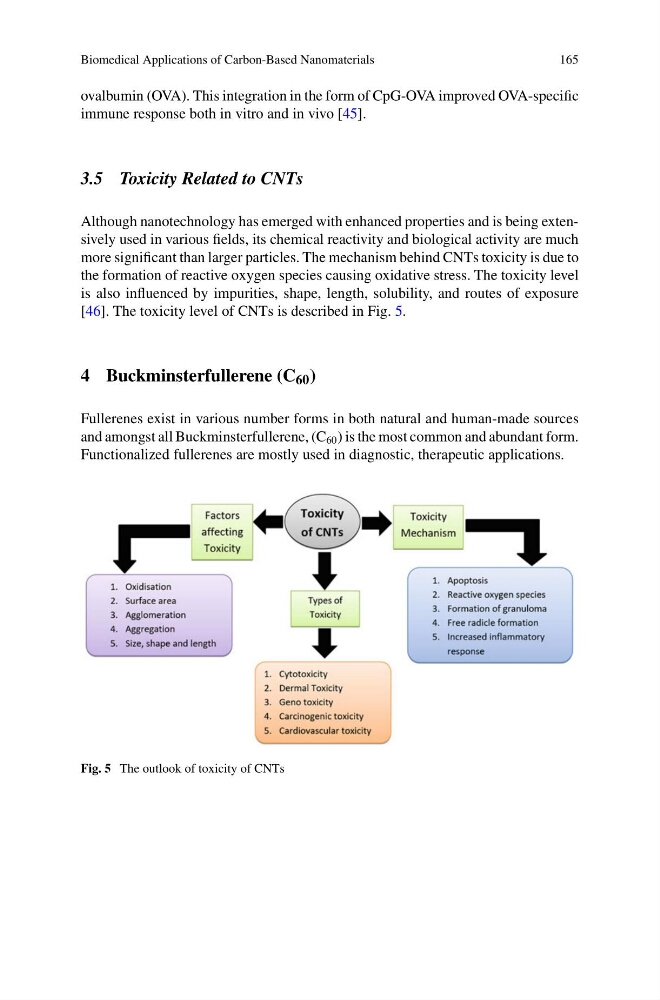
[46]. The toxicity level of CNTs is described in Fig. 5.
4 Buckminsterfullerene (C 60 )
Fullerenes exist in various number forms in both natural and human-made sources
and amongst all Buckminsterfullerene, (C 60 ) is the most common and abundant form.
Functionalized fullerenes are mostly used in diagnostic, therapeutic applications.
Fig. 5 The outlook of toxicity of CNTs
165
ovalbumin (OVA). This integration in the form of CpG-OVA improved OVA-specific
immune response both in vitro and in vivo [45].
3.5 Toxicity Related to CNTs
Although nanotechnology has emerged with enhanced properties and is being extensively used in various fields, its chemical reactivity and biological activity are much
more significant than larger particles. The mechanism behind CNTs toxicity is due to
the formation of reactive oxygen species causing oxidative stress. The toxicity level
is also influenced by impurities, shape, length, solubility, and routes of exposure
[46]. The toxicity level of CNTs is described in Fig. 5.
4 Buckminsterfullerene (C 60 )
Fullerenes exist in various number forms in both natural and human-made sources
and amongst all Buckminsterfullerene, (C 60 ) is the most common and abundant form.
Functionalized fullerenes are mostly used in diagnostic, therapeutic applications.
Fig. 5 The outlook of toxicity of CNTs