

94
A. Antony and J.-H. Boo
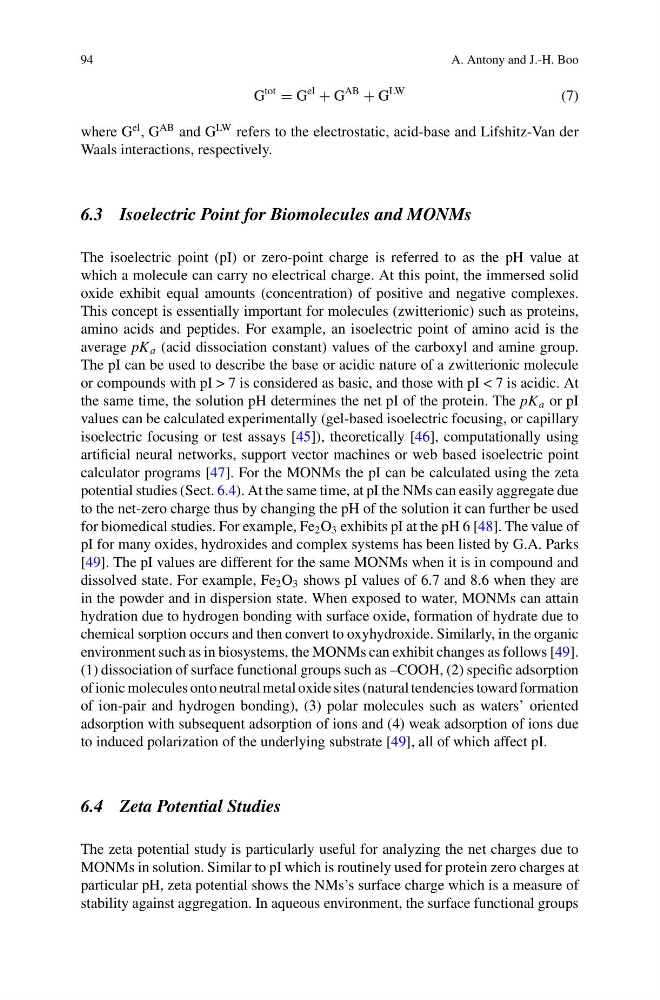
G
tot
= G
el
+ G
AB
+ G
LW
(7)
where G
el , G
AB and G
LW refers to the electrostatic, acid-base and Lifshitz-Van der
Waals interactions, respectively.
6.3 Isoelectric Point for Biomolecules and MONMs
The isoelectric point (pI) or zero-point charge is referred to as the pH value at
which a molecule can carry no electrical charge. At this point, the immersed solid
oxide exhibit equal amounts (concentration) of positive and negative complexes.
This concept is essentially important for molecules (zwitterionic) such as proteins,
amino acids and peptides. For example, an isoelectric point of amino acid is the
average pK a (acid dissociation constant) values of the carboxyl and amine group.
The pI can be used to describe the base or acidic nature of a zwitterionic molecule
or compounds with pI > 7 is considered as basic, and those with pI < 7 is acidic. At
the same time, the solution pH determines the net pI of the protein. The pK a or pI
values can be calculated experimentally (gel-based isoelectric focusing, or capillary
isoelectric focusing or test assays [45]), theoretically [46], computationally using
artificial neural networks, support vector machines or web based isoelectric point
calculator programs [47]. For the MONMs the pI can be calculated using the zeta
potential studies (Sect. 6.4). At the same time, at pI the NMs can easily aggregate due
to the net-zero charge thus by changing the pH of the solution it can further be used
for biomedical studies. For example, Fe 2 O 3 exhibits pI at the pH 6 [48]. The value of
pI for many oxides, hydroxides and complex systems has been listed by G.A. Parks
[49]. The pI values are different for the same MONMs when it is in compound and
dissolved state. For example, Fe 2 O 3 shows pI values of 6.7 and 8.6 when they are
in the powder and in dispersion state. When exposed to water, MONMs can attain
hydration due to hydrogen bonding with surface oxide, formation of hydrate due to
chemical sorption occurs and then convert to oxyhydroxide. Similarly, in the organic
environment such as in biosystems, the MONMs can exhibit changes as follows [49].
(1) dissociation of surface functional groups such as –COOH, (2) specific adsorption
of ionic molecules onto neutral metal oxide sites (natural tendencies toward formation
of ion-pair and hydrogen bonding), (3) polar molecules such as waters’ oriented
adsorption with subsequent adsorption of ions and (4) weak adsorption of ions due
to induced polarization of the underlying substrate [49], all of which affect pI.
6.4 Zeta Potential Studies
The zeta potential study is particularly useful for analyzing the net charges due to
MONMs in solution. Similar to pI which is routinely used for protein zero charges at
particular pH, zeta potential shows the NMs’s surface charge which is a measure of
stability against aggregation. In aqueous environment, the surface functional groups
A. Antony and J.-H. Boo
G
tot
= G
el
+ G
AB
+ G
LW
(7)
where G
el , G
AB and G
LW refers to the electrostatic, acid-base and Lifshitz-Van der
Waals interactions, respectively.
6.3 Isoelectric Point for Biomolecules and MONMs
The isoelectric point (pI) or zero-point charge is referred to as the pH value at
which a molecule can carry no electrical charge. At this point, the immersed solid
oxide exhibit equal amounts (concentration) of positive and negative complexes.
This concept is essentially important for molecules (zwitterionic) such as proteins,
amino acids and peptides. For example, an isoelectric point of amino acid is the
average pK a (acid dissociation constant) values of the carboxyl and amine group.
The pI can be used to describe the base or acidic nature of a zwitterionic molecule
or compounds with pI > 7 is considered as basic, and those with pI < 7 is acidic. At
the same time, the solution pH determines the net pI of the protein. The pK a or pI
values can be calculated experimentally (gel-based isoelectric focusing, or capillary
isoelectric focusing or test assays [45]), theoretically [46], computationally using
artificial neural networks, support vector machines or web based isoelectric point
calculator programs [47]. For the MONMs the pI can be calculated using the zeta
potential studies (Sect. 6.4). At the same time, at pI the NMs can easily aggregate due
to the net-zero charge thus by changing the pH of the solution it can further be used
for biomedical studies. For example, Fe 2 O 3 exhibits pI at the pH 6 [48]. The value of
pI for many oxides, hydroxides and complex systems has been listed by G.A. Parks
[49]. The pI values are different for the same MONMs when it is in compound and
dissolved state. For example, Fe 2 O 3 shows pI values of 6.7 and 8.6 when they are
in the powder and in dispersion state. When exposed to water, MONMs can attain
hydration due to hydrogen bonding with surface oxide, formation of hydrate due to
chemical sorption occurs and then convert to oxyhydroxide. Similarly, in the organic
environment such as in biosystems, the MONMs can exhibit changes as follows [49].
(1) dissociation of surface functional groups such as –COOH, (2) specific adsorption
of ionic molecules onto neutral metal oxide sites (natural tendencies toward formation
of ion-pair and hydrogen bonding), (3) polar molecules such as waters’ oriented
adsorption with subsequent adsorption of ions and (4) weak adsorption of ions due
to induced polarization of the underlying substrate [49], all of which affect pI.
6.4 Zeta Potential Studies
The zeta potential study is particularly useful for analyzing the net charges due to
MONMs in solution. Similar to pI which is routinely used for protein zero charges at
particular pH, zeta potential shows the NMs’s surface charge which is a measure of
stability against aggregation. In aqueous environment, the surface functional groups