

80
3 Area-Preserving Maps
bifurcation, p = p (k) . It will be a fixed point of the mapping, V 2 k , and will be
located at (y = 0, x = x (k) ). That is, the mapping, BV 2 k B −1 , where
B =
˜
β 0
0 ˜
α
,
in the neighborhood of the good and bad points looks the same as that for V 2 k−1 .
The scale of the bifurcation process after the kth bifurcation has shrunk by 1/ ˜
β in
the y direction and by 1/ ˜
α in the x direction. The bifurcation tree for the first four
bifurcations of the good point is shown in Fig. 3.19. The bifurcation points and the
stability are plotted as a function of parameter, p, and position, x, for the quadratic
de Vogelaere map.
3.7 Cantori
A KAM torus is destroyed when the resonance zones associated with neighboring
periodic orbits begin to squeeze holes in it. The periodic orbits that play the
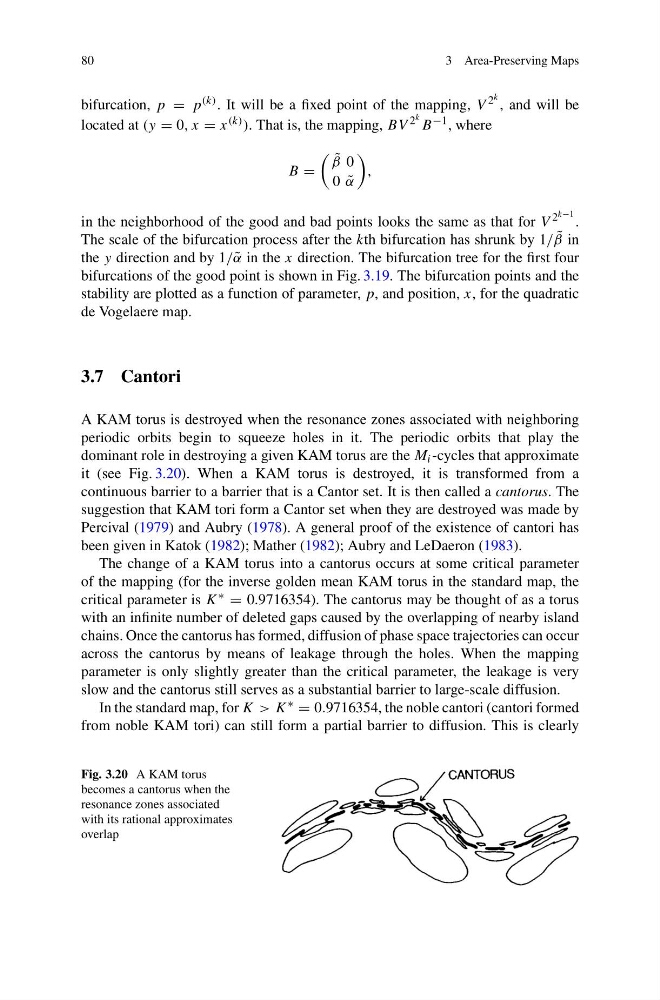
dominant role in destroying a given KAM torus are the M i -cycles that approximate
it (see Fig. 3.20). When a KAM torus is destroyed, it is transformed from a
continuous barrier to a barrier that is a Cantor set. It is then called a cantorus. The
suggestion that KAM tori form a Cantor set when they are destroyed was made by
Percival (1979) and Aubry (1978). A general proof of the existence of cantori has
been given in Katok (1982); Mather (1982); Aubry and LeDaeron (1983).
The change of a KAM torus into a cantorus occurs at some critical parameter
of the mapping (for the inverse golden mean KAM torus in the standard map, the
critical parameter is K ∗ = 0.9716354). The cantorus may be thought of as a torus
with an infinite number of deleted gaps caused by the overlapping of nearby island
chains. Once the cantorus has formed, diffusion of phase space trajectories can occur
across the cantorus by means of leakage through the holes. When the mapping
parameter is only slightly greater than the critical parameter, the leakage is very
slow and the cantorus still serves as a substantial barrier to large-scale diffusion.
In the standard map, for K > K ∗ = 0.9716354, the noble cantori (cantori formed
from noble KAM tori) can still form a partial barrier to diffusion. This is clearly
Fig. 3.20 A KAM torus
becomes a cantorus when the
resonance zones associated
with its rational approximates
overlap
3 Area-Preserving Maps
bifurcation, p = p (k) . It will be a fixed point of the mapping, V 2 k , and will be
located at (y = 0, x = x (k) ). That is, the mapping, BV 2 k B −1 , where
B =
˜
β 0
0 ˜
α
,
in the neighborhood of the good and bad points looks the same as that for V 2 k−1 .
The scale of the bifurcation process after the kth bifurcation has shrunk by 1/ ˜
β in
the y direction and by 1/ ˜
α in the x direction. The bifurcation tree for the first four
bifurcations of the good point is shown in Fig. 3.19. The bifurcation points and the
stability are plotted as a function of parameter, p, and position, x, for the quadratic
de Vogelaere map.
3.7 Cantori
A KAM torus is destroyed when the resonance zones associated with neighboring
periodic orbits begin to squeeze holes in it. The periodic orbits that play the
dominant role in destroying a given KAM torus are the M i -cycles that approximate
it (see Fig. 3.20). When a KAM torus is destroyed, it is transformed from a
continuous barrier to a barrier that is a Cantor set. It is then called a cantorus. The
suggestion that KAM tori form a Cantor set when they are destroyed was made by
Percival (1979) and Aubry (1978). A general proof of the existence of cantori has
been given in Katok (1982); Mather (1982); Aubry and LeDaeron (1983).
The change of a KAM torus into a cantorus occurs at some critical parameter
of the mapping (for the inverse golden mean KAM torus in the standard map, the
critical parameter is K ∗ = 0.9716354). The cantorus may be thought of as a torus
with an infinite number of deleted gaps caused by the overlapping of nearby island
chains. Once the cantorus has formed, diffusion of phase space trajectories can occur
across the cantorus by means of leakage through the holes. When the mapping
parameter is only slightly greater than the critical parameter, the leakage is very
slow and the cantorus still serves as a substantial barrier to large-scale diffusion.
In the standard map, for K > K ∗ = 0.9716354, the noble cantori (cantori formed
from noble KAM tori) can still form a partial barrier to diffusion. This is clearly
Fig. 3.20 A KAM torus
becomes a cantorus when the
resonance zones associated
with its rational approximates
overlap