

3.6 Bifurcation of M-Cycles
79
Table 3.1 Values of p (k) and
x (k) for k = 1 to k = 9
(MacKay 1982)
k 2 k
p (k)
x (k)
1
2 −1.000000000
0.000000000
2
4 −1.234067977 −0.276393202
3
8 −1.262841686 −0.224612022
4
16 −1.265913483 −0.238675841
5
32 −1.266265664 −0.235323100
6
64 −1.266306047 −0.236173934
7 128 −1.266310677 −0.235964076
8 256 −1.266311208 −0.236016521
9 512 −1.266311269 −0.236003494
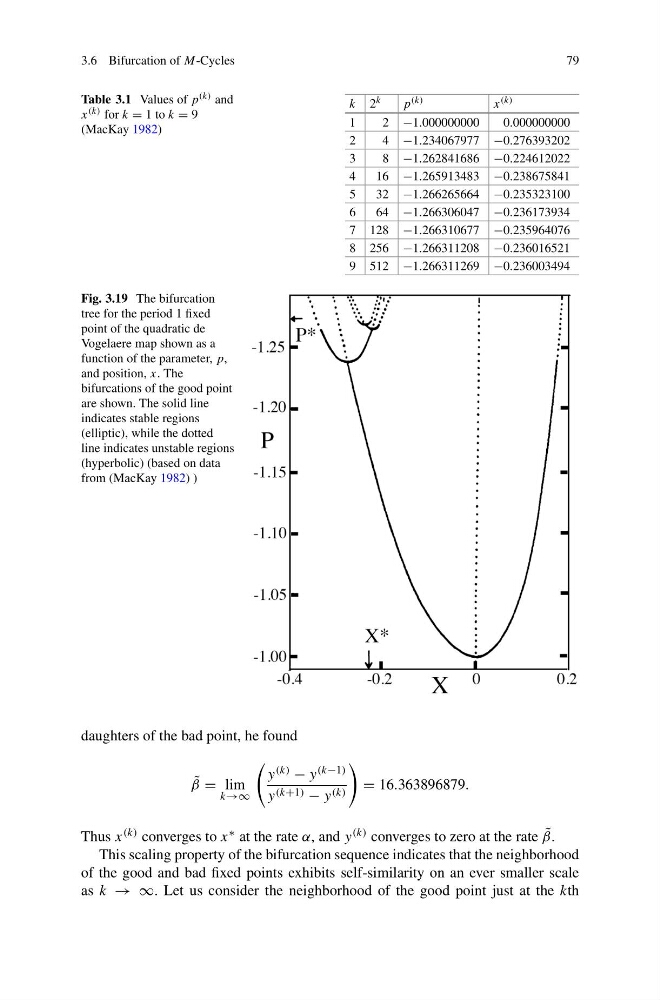
Fig. 3.19 The bifurcation
tree for the period 1 fixed
point of the quadratic de
Vogelaere map shown as a
function of the parameter, p,
and position, x. The
bifurcations of the good point
are shown. The solid line
indicates stable regions
(elliptic), while the dotted
line indicates unstable regions
(hyperbolic) (based on data
from (MacKay 1982) )
daughters of the bad point, he found
˜
β = lim
k→∞
y (k) − y (k−1)
y (k+1) − y (k)
= 16.363896879.
Thus x (k) converges to x ∗ at the rate α, and y (k) converges to zero at the rate ˜
β.
This scaling property of the bifurcation sequence indicates that the neighborhood
of the good and bad fixed points exhibits self-similarity on an ever smaller scale
as k → ∞. Let us consider the neighborhood of the good point just at the kth
79
Table 3.1 Values of p (k) and
x (k) for k = 1 to k = 9
(MacKay 1982)
k 2 k
p (k)
x (k)
1
2 −1.000000000
0.000000000
2
4 −1.234067977 −0.276393202
3
8 −1.262841686 −0.224612022
4
16 −1.265913483 −0.238675841
5
32 −1.266265664 −0.235323100
6
64 −1.266306047 −0.236173934
7 128 −1.266310677 −0.235964076
8 256 −1.266311208 −0.236016521
9 512 −1.266311269 −0.236003494
Fig. 3.19 The bifurcation
tree for the period 1 fixed
point of the quadratic de
Vogelaere map shown as a
function of the parameter, p,
and position, x. The
bifurcations of the good point
are shown. The solid line
indicates stable regions
(elliptic), while the dotted
line indicates unstable regions
(hyperbolic) (based on data
from (MacKay 1982) )
daughters of the bad point, he found
˜
β = lim
k→∞
y (k) − y (k−1)
y (k+1) − y (k)
= 16.363896879.
Thus x (k) converges to x ∗ at the rate α, and y (k) converges to zero at the rate ˜
β.
This scaling property of the bifurcation sequence indicates that the neighborhood
of the good and bad fixed points exhibits self-similarity on an ever smaller scale
as k → ∞. Let us consider the neighborhood of the good point just at the kth