

3.4 Scaling Behavior of Noble KAM Tori
63
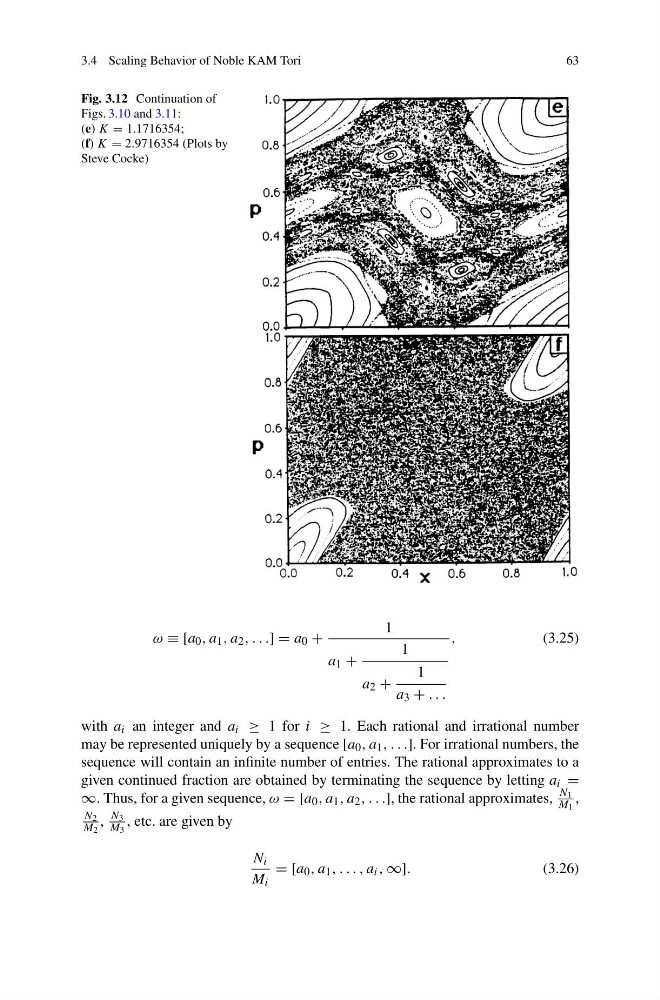
Fig. 3.12 Continuation of
Figs. 3.10 and 3.11:
(e) K = 1.1716354;
(f) K = 2.9716354 (Plots by
Steve Cocke)
ω ≡ [a 0 , a 1 , a 2 , . . .] = a 0 +
1
a 1 +
1
a 2 +
1
a 3 + . . .
,
(3.25)
with a i an integer and a i ≥ 1 for i ≥ 1. Each rational and irrational number
may be represented uniquely by a sequence [a 0 , a 1 , . . .]. For irrational numbers, the
sequence will contain an infinite number of entries. The rational approximates to a
given continued fraction are obtained by terminating the sequence by letting a i =
∞. Thus, for a given sequence, ω = [a 0 , a 1 , a 2 , . . .], the rational approximates,
N 1
M 1
,
N 2
M 2
,
N 3
M 3
, etc. are given by
N i
M i
= [a 0 , a 1 , . . . , a i , ∞].
(3.26)
63
Fig. 3.12 Continuation of
Figs. 3.10 and 3.11:
(e) K = 1.1716354;
(f) K = 2.9716354 (Plots by
Steve Cocke)
ω ≡ [a 0 , a 1 , a 2 , . . .] = a 0 +
1
a 1 +
1
a 2 +
1
a 3 + . . .
,
(3.25)
with a i an integer and a i ≥ 1 for i ≥ 1. Each rational and irrational number
may be represented uniquely by a sequence [a 0 , a 1 , . . .]. For irrational numbers, the
sequence will contain an infinite number of entries. The rational approximates to a
given continued fraction are obtained by terminating the sequence by letting a i =
∞. Thus, for a given sequence, ω = [a 0 , a 1 , a 2 , . . .], the rational approximates,
N 1
M 1
,
N 2
M 2
,
N 3
M 3
, etc. are given by
N i
M i
= [a 0 , a 1 , . . . , a i , ∞].
(3.26)