

62
3 Area-Preserving Maps
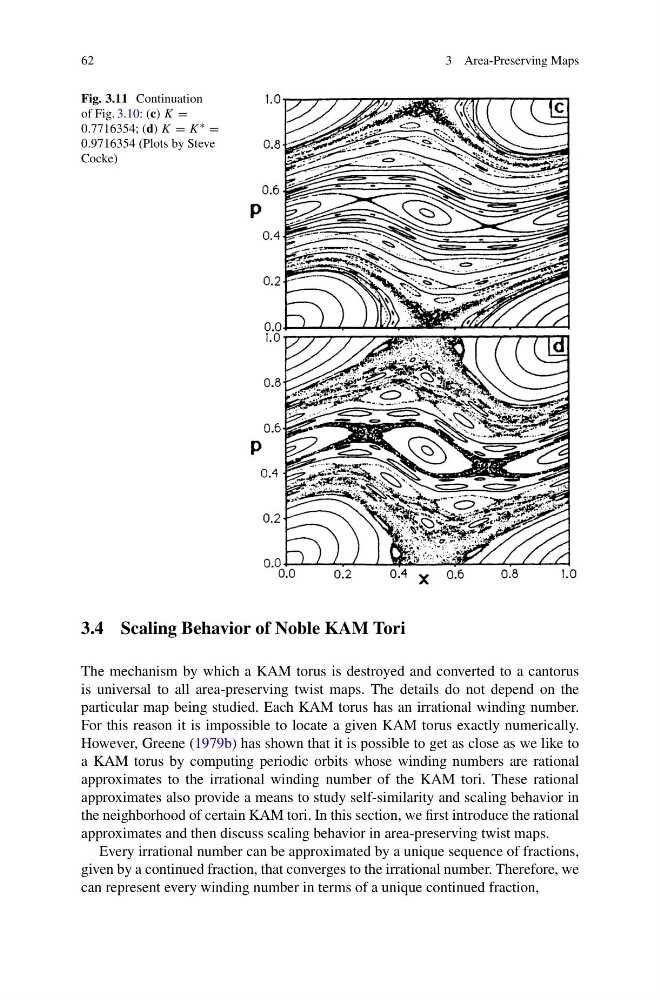
Fig. 3.11 Continuation
of Fig. 3.10: (c) K =
0.7716354; (d) K = K ∗ =
0.9716354 (Plots by Steve
Cocke)
3.4 Scaling Behavior of Noble KAM Tori
The mechanism by which a KAM torus is destroyed and converted to a cantorus
is universal to all area-preserving twist maps. The details do not depend on the
particular map being studied. Each KAM torus has an irrational winding number.
For this reason it is impossible to locate a given KAM torus exactly numerically.
However, Greene (1979b) has shown that it is possible to get as close as we like to
a KAM torus by computing periodic orbits whose winding numbers are rational
approximates to the irrational winding number of the KAM tori. These rational
approximates also provide a means to study self-similarity and scaling behavior in
the neighborhood of certain KAM tori. In this section, we first introduce the rational
approximates and then discuss scaling behavior in area-preserving twist maps.
Every irrational number can be approximated by a unique sequence of fractions,
given by a continued fraction, that converges to the irrational number. Therefore, we
can represent every winding number in terms of a unique continued fraction,
3 Area-Preserving Maps
Fig. 3.11 Continuation
of Fig. 3.10: (c) K =
0.7716354; (d) K = K ∗ =
0.9716354 (Plots by Steve
Cocke)
3.4 Scaling Behavior of Noble KAM Tori
The mechanism by which a KAM torus is destroyed and converted to a cantorus
is universal to all area-preserving twist maps. The details do not depend on the
particular map being studied. Each KAM torus has an irrational winding number.
For this reason it is impossible to locate a given KAM torus exactly numerically.
However, Greene (1979b) has shown that it is possible to get as close as we like to
a KAM torus by computing periodic orbits whose winding numbers are rational
approximates to the irrational winding number of the KAM tori. These rational
approximates also provide a means to study self-similarity and scaling behavior in
the neighborhood of certain KAM tori. In this section, we first introduce the rational
approximates and then discuss scaling behavior in area-preserving twist maps.
Every irrational number can be approximated by a unique sequence of fractions,
given by a continued fraction, that converges to the irrational number. Therefore, we
can represent every winding number in terms of a unique continued fraction,