

58
3 Area-Preserving Maps
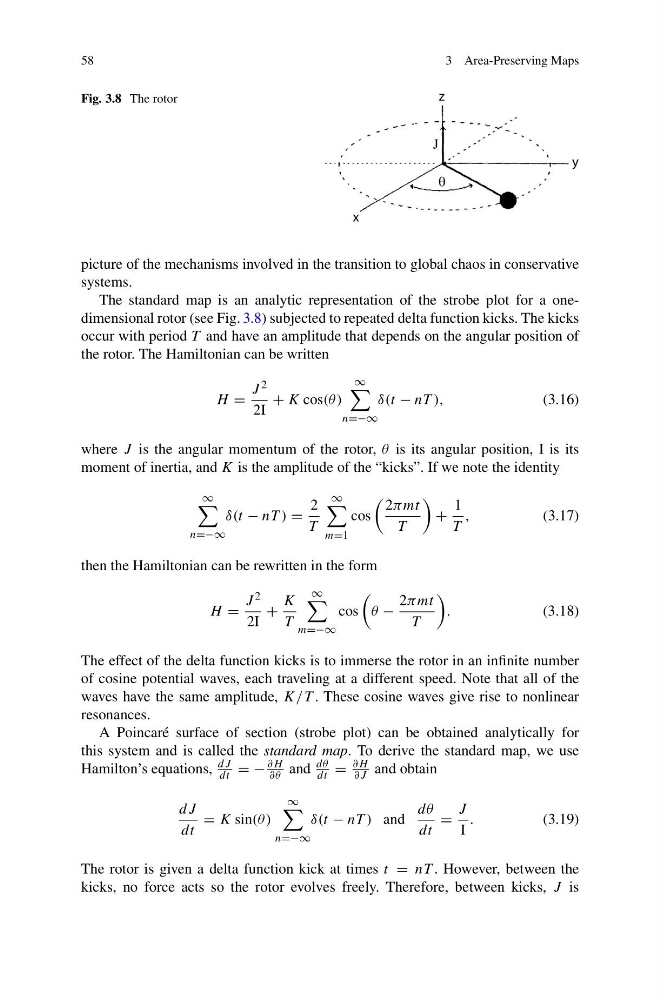
Fig. 3.8 The rotor
picture of the mechanisms involved in the transition to global chaos in conservative
systems.
The standard map is an analytic representation of the strobe plot for a onedimensional rotor (see Fig. 3.8) subjected to repeated delta function kicks. The kicks
occur with period T and have an amplitude that depends on the angular position of
the rotor. The Hamiltonian can be written
H =
J 2
2I
+ K cos(θ )
∞
n=−∞
δ(t − nT ),
(3.16)
where J is the angular momentum of the rotor, θ is its angular position, I is its
moment of inertia, and K is the amplitude of the “kicks”. If we note the identity
∞
n=−∞
δ(t − nT ) =
2
T
∞
m=1
cos
2πmt
T
+
1
T
,
(3.17)
then the Hamiltonian can be rewritten in the form
H =
J 2
2I
+
K
T
∞
m=−∞
cos
θ −
2πmt
T
.
(3.18)
The effect of the delta function kicks is to immerse the rotor in an infinite number
of cosine potential waves, each traveling at a different speed. Note that all of the
waves have the same amplitude, K/T . These cosine waves give rise to nonlinear
resonances.
A Poincaré surface of section (strobe plot) can be obtained analytically for
this system and is called the standard map. To derive the standard map, we use
Hamilton’s equations,
dJ
dt = −
∂H
∂θ and
dθ
dt =
∂H
∂J and obtain
dJ
dt
= K sin(θ )
∞
n=−∞
δ(t − nT ) and
dθ
dt
=
J
I
.
(3.19)
The rotor is given a delta function kick at times t = nT . However, between the
kicks, no force acts so the rotor evolves freely. Therefore, between kicks, J is
3 Area-Preserving Maps
Fig. 3.8 The rotor
picture of the mechanisms involved in the transition to global chaos in conservative
systems.
The standard map is an analytic representation of the strobe plot for a onedimensional rotor (see Fig. 3.8) subjected to repeated delta function kicks. The kicks
occur with period T and have an amplitude that depends on the angular position of
the rotor. The Hamiltonian can be written
H =
J 2
2I
+ K cos(θ )
∞
n=−∞
δ(t − nT ),
(3.16)
where J is the angular momentum of the rotor, θ is its angular position, I is its
moment of inertia, and K is the amplitude of the “kicks”. If we note the identity
∞
n=−∞
δ(t − nT ) =
2
T
∞
m=1
cos
2πmt
T
+
1
T
,
(3.17)
then the Hamiltonian can be rewritten in the form
H =
J 2
2I
+
K
T
∞
m=−∞
cos
θ −
2πmt
T
.
(3.18)
The effect of the delta function kicks is to immerse the rotor in an infinite number
of cosine potential waves, each traveling at a different speed. Note that all of the
waves have the same amplitude, K/T . These cosine waves give rise to nonlinear
resonances.
A Poincaré surface of section (strobe plot) can be obtained analytically for
this system and is called the standard map. To derive the standard map, we use
Hamilton’s equations,
dJ
dt = −
∂H
∂θ and
dθ
dt =
∂H
∂J and obtain
dJ
dt
= K sin(θ )
∞
n=−∞
δ(t − nT ) and
dθ
dt
=
J
I
.
(3.19)
The rotor is given a delta function kick at times t = nT . However, between the
kicks, no force acts so the rotor evolves freely. Therefore, between kicks, J is