

532
K Hydrogen in a Constant Electric Field
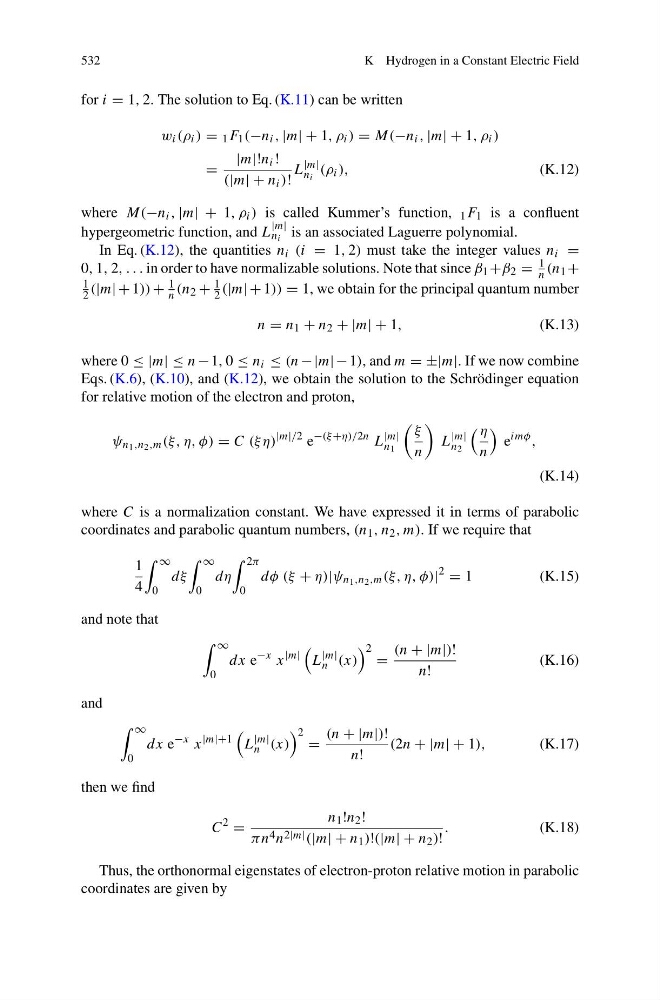
for i = 1, 2. The solution to Eq. (K.11) can be written
w i (ρ i ) = 1 F 1 (−n i , |m| + 1, ρ i ) = M(−n i , |m| + 1, ρ i )
=
|m|!n i !
(|m| + n i )!
L
|m|
n i
(ρ i ),
(K.12)
where M(−n i , |m| + 1, ρ i ) is called Kummer’s function, 1 F 1 is a confluent
hypergeometric function, and L
|m|
n i is an associated Laguerre polynomial.
In Eq. (K.12), the quantities n i (i = 1, 2) must take the integer values n i =
0, 1, 2, . . . in order to have normalizable solutions. Note that since β 1 +β 2 =
1
n (n 1 +
1
2 (|m| + 1)) +
1
n (n 2 +
1
2 (|m| + 1)) = 1, we obtain for the principal quantum number
n = n 1 + n 2 + |m| + 1,
(K.13)
where 0 ≤ |m| ≤ n − 1, 0 ≤ n i ≤ (n − |m| − 1), and m = ±|m|. If we now combine
Eqs. (K.6), (K.10), and (K.12), we obtain the solution to the Schrödinger equation
for relative motion of the electron and proton,
ψ n 1 ,n 2 ,m (ξ, η, φ) = C (ξη)
|m|/2 e
−(ξ +η)/2n L
|m|
n 1
ξ
n
L
|m|
n 2
η
n
e
imφ ,
(K.14)
where C is a normalization constant. We have expressed it in terms of parabolic
coordinates and parabolic quantum numbers, (n 1 , n 2 , m). If we require that
1
4
∞
0
dξ
∞
0
dη
2π
0
dφ (ξ + η)|ψ n 1 ,n 2 ,m (ξ, η, φ)|
2
= 1
(K.15)
and note that
∞
0
dx e
−x x
|m|
L
|m|
n (x)
2 =
(n + |m|)!
n!
(K.16)
and
∞
0
dx e
−x x
|m|+1
L
|m|
n (x)
2 =
(n + |m|)!
n!
(2n + |m| + 1),
(K.17)
then we find
C
2
=
n 1 !n 2 !
πn 4 n 2|m| (|m| + n 1 )!(|m| + n 2 )!
.
(K.18)
Thus, the orthonormal eigenstates of electron-proton relative motion in parabolic
coordinates are given by
K Hydrogen in a Constant Electric Field
for i = 1, 2. The solution to Eq. (K.11) can be written
w i (ρ i ) = 1 F 1 (−n i , |m| + 1, ρ i ) = M(−n i , |m| + 1, ρ i )
=
|m|!n i !
(|m| + n i )!
L
|m|
n i
(ρ i ),
(K.12)
where M(−n i , |m| + 1, ρ i ) is called Kummer’s function, 1 F 1 is a confluent
hypergeometric function, and L
|m|
n i is an associated Laguerre polynomial.
In Eq. (K.12), the quantities n i (i = 1, 2) must take the integer values n i =
0, 1, 2, . . . in order to have normalizable solutions. Note that since β 1 +β 2 =
1
n (n 1 +
1
2 (|m| + 1)) +
1
n (n 2 +
1
2 (|m| + 1)) = 1, we obtain for the principal quantum number
n = n 1 + n 2 + |m| + 1,
(K.13)
where 0 ≤ |m| ≤ n − 1, 0 ≤ n i ≤ (n − |m| − 1), and m = ±|m|. If we now combine
Eqs. (K.6), (K.10), and (K.12), we obtain the solution to the Schrödinger equation
for relative motion of the electron and proton,
ψ n 1 ,n 2 ,m (ξ, η, φ) = C (ξη)
|m|/2 e
−(ξ +η)/2n L
|m|
n 1
ξ
n
L
|m|
n 2
η
n
e
imφ ,
(K.14)
where C is a normalization constant. We have expressed it in terms of parabolic
coordinates and parabolic quantum numbers, (n 1 , n 2 , m). If we require that
1
4
∞
0
dξ
∞
0
dη
2π
0
dφ (ξ + η)|ψ n 1 ,n 2 ,m (ξ, η, φ)|
2
= 1
(K.15)
and note that
∞
0
dx e
−x x
|m|
L
|m|
n (x)
2 =
(n + |m|)!
n!
(K.16)
and
∞
0
dx e
−x x
|m|+1
L
|m|
n (x)
2 =
(n + |m|)!
n!
(2n + |m| + 1),
(K.17)
then we find
C
2
=
n 1 !n 2 !
πn 4 n 2|m| (|m| + n 1 )!(|m| + n 2 )!
.
(K.18)
Thus, the orthonormal eigenstates of electron-proton relative motion in parabolic
coordinates are given by