

530
K Hydrogen in a Constant Electric Field
K.1.1 Equation for Relative Motion
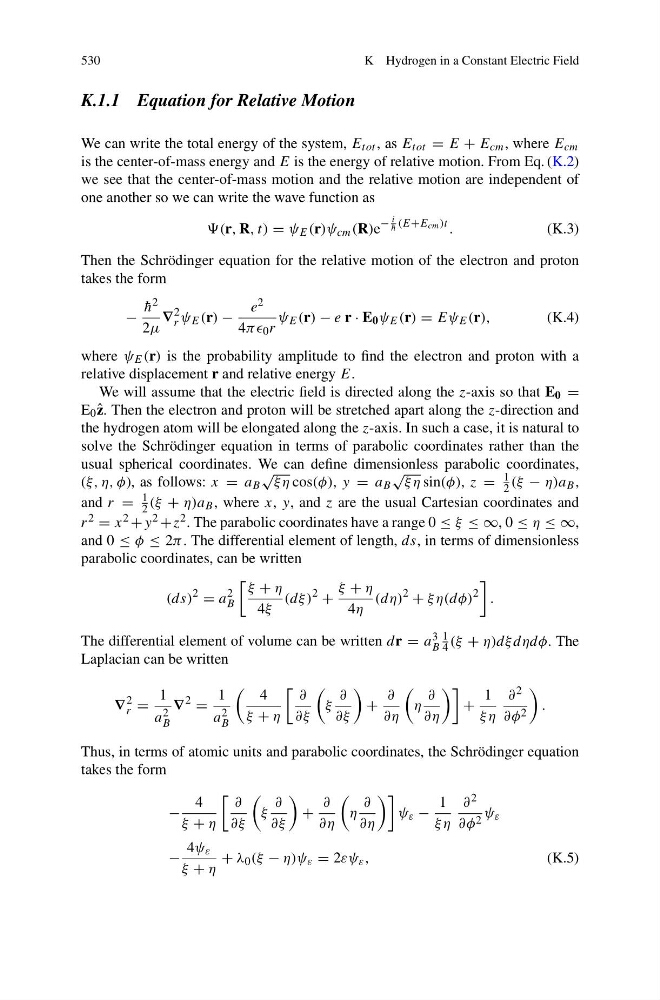
We can write the total energy of the system, E tot , as E tot = E + E cm , where E cm
is the center-of-mass energy and E is the energy of relative motion. From Eq. (K.2)
we see that the center-of-mass motion and the relative motion are independent of
one another so we can write the wave function as
(r, R, t) = ψ E (r)ψ cm (R)e
−
i
¯
h (E+E cm )t .
(K.3)
Then the Schrödinger equation for the relative motion of the electron and proton
takes the form
−
¯
h 2
2μ
∇
2
r ψ E (r) −
e 2
4ππ 0 r
ψ E (r) − e r · E 0 ψ E (r) = Eψ E (r),
(K.4)
where ψ E (r) is the probability amplitude to find the electron and proton with a
relative displacement r and relative energy E.
We will assume that the electric field is directed along the z-axis so that E 0 =
E 0 ˆ
z. Then the electron and proton will be stretched apart along the z-direction and
the hydrogen atom will be elongated along the z-axis. In such a case, it is natural to
solve the Schrödinger equation in terms of parabolic coordinates rather than the
usual spherical coordinates. We can define dimensionless parabolic coordinates,
(ξ, η, φ), as follows: x = a B
√
ξη cos(φ), y = a B
√
ξη sin(φ), z =
1
2 (ξ − η)a B ,
and r =
1
2 (ξ + η)a B , where x, y, and z are the usual Cartesian coordinates and
r 2 = x 2 +y 2 +z 2 . The parabolic coordinates have a range 0 ≤ ξ ≤ ∞, 0 ≤ η ≤ ∞,
and 0 ≤ φ ≤ 2π . The differential element of length, ds, in terms of dimensionless
parabolic coordinates, can be written
(ds)
2
= a
2
B
ξ + η
4ξ
(dξ )
2
+
ξ + η
4η
(dη)
2
+ ξη(dφ)
2
.
The differential element of volume can be written dr = a 3
B
1
4 (ξ + η)dξ dηdφ. The
Laplacian can be written
∇
2
r =
1
a 2
B
∇
2
=
1
a 2
B
4
ξ + η
∂
∂ξ
ξ
∂
∂ξ
+
∂
∂η
η
∂
∂η
+
1
ξη
∂ 2
∂φ 2
.
Thus, in terms of atomic units and parabolic coordinates, the Schrödinger equation
takes the form
−
4
ξ + η
∂
∂ξ
ξ
∂
∂ξ
+
∂
∂η
η
∂
∂η
ψ ε −
1
ξη
∂ 2
∂φ 2 ψ ε
−
4ψ ε
ξ + η
+ λ 0 (ξ − η)ψ ε = 2εψ ε ,
(K.5)
K Hydrogen in a Constant Electric Field
K.1.1 Equation for Relative Motion
We can write the total energy of the system, E tot , as E tot = E + E cm , where E cm
is the center-of-mass energy and E is the energy of relative motion. From Eq. (K.2)
we see that the center-of-mass motion and the relative motion are independent of
one another so we can write the wave function as
(r, R, t) = ψ E (r)ψ cm (R)e
−
i
¯
h (E+E cm )t .
(K.3)
Then the Schrödinger equation for the relative motion of the electron and proton
takes the form
−
¯
h 2
2μ
∇
2
r ψ E (r) −
e 2
4ππ 0 r
ψ E (r) − e r · E 0 ψ E (r) = Eψ E (r),
(K.4)
where ψ E (r) is the probability amplitude to find the electron and proton with a
relative displacement r and relative energy E.
We will assume that the electric field is directed along the z-axis so that E 0 =
E 0 ˆ
z. Then the electron and proton will be stretched apart along the z-direction and
the hydrogen atom will be elongated along the z-axis. In such a case, it is natural to
solve the Schrödinger equation in terms of parabolic coordinates rather than the
usual spherical coordinates. We can define dimensionless parabolic coordinates,
(ξ, η, φ), as follows: x = a B
√
ξη cos(φ), y = a B
√
ξη sin(φ), z =
1
2 (ξ − η)a B ,
and r =
1
2 (ξ + η)a B , where x, y, and z are the usual Cartesian coordinates and
r 2 = x 2 +y 2 +z 2 . The parabolic coordinates have a range 0 ≤ ξ ≤ ∞, 0 ≤ η ≤ ∞,
and 0 ≤ φ ≤ 2π . The differential element of length, ds, in terms of dimensionless
parabolic coordinates, can be written
(ds)
2
= a
2
B
ξ + η
4ξ
(dξ )
2
+
ξ + η
4η
(dη)
2
+ ξη(dφ)
2
.
The differential element of volume can be written dr = a 3
B
1
4 (ξ + η)dξ dηdφ. The
Laplacian can be written
∇
2
r =
1
a 2
B
∇
2
=
1
a 2
B
4
ξ + η
∂
∂ξ
ξ
∂
∂ξ
+
∂
∂η
η
∂
∂η
+
1
ξη
∂ 2
∂φ 2
.
Thus, in terms of atomic units and parabolic coordinates, the Schrödinger equation
takes the form
−
4
ξ + η
∂
∂ξ
ξ
∂
∂ξ
+
∂
∂η
η
∂
∂η
ψ ε −
1
ξη
∂ 2
∂φ 2 ψ ε
−
4ψ ε
ξ + η
+ λ 0 (ξ − η)ψ ε = 2εψ ε ,
(K.5)