

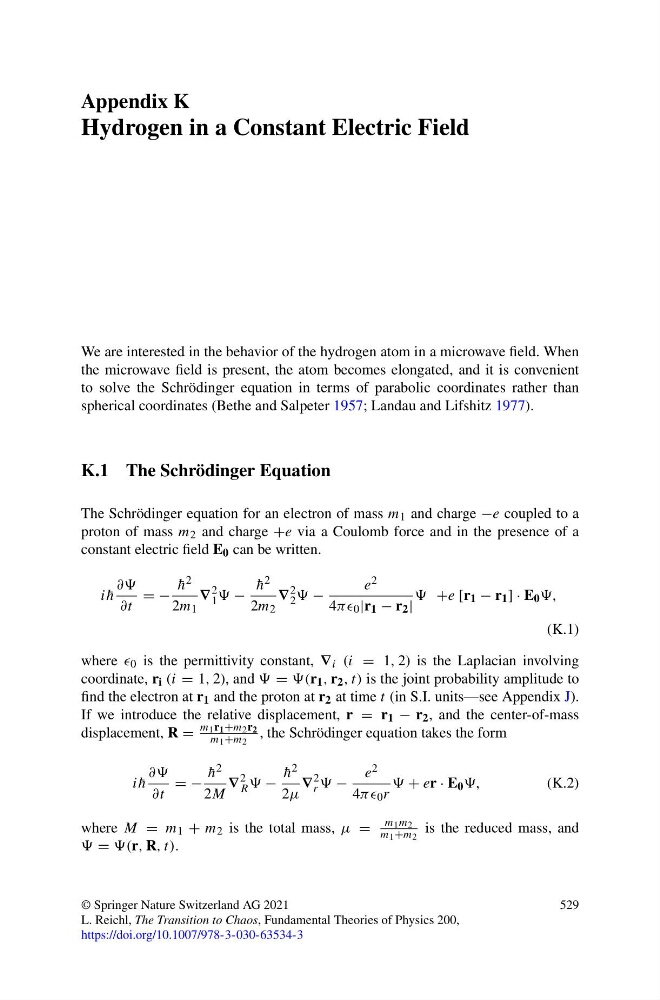
Appendix K
Hydrogen in a Constant Electric Field
We are interested in the behavior of the hydrogen atom in a microwave field. When
the microwave field is present, the atom becomes elongated, and it is convenient
to solve the Schrödinger equation in terms of parabolic coordinates rather than
spherical coordinates (Bethe and Salpeter 1957; Landau and Lifshitz 1977).
K.1 The Schrödinger Equation
The Schrödinger equation for an electron of mass m 1 and charge −e coupled to a
proton of mass m 2 and charge +e via a Coulomb force and in the presence of a
constant electric field E 0 can be written.
i ¯
h
∂∂
∂t
= −
¯
h 2
2m 1
∇
2
1 −
¯
h 2
2m 2
∇
2
2 −
e 2
4ππ 0 |r 1 − r 2 |
+e [r 1 − r 1 ] · E 0 ,
(K.1)
where 0 is the permittivity constant, ∇ i (i = 1, 2) is the Laplacian involving
coordinate, r i (i = 1, 2), and = (r 1 , r 2 , t) is the joint probability amplitude to
find the electron at r 1 and the proton at r 2 at time t (in S.I. units—see Appendix J).
If we introduce the relative displacement, r = r 1 − r 2 , and the center-of-mass
displacement, R =
m 1 r 1 +m 2 r 2
m 1 +m 2
, the Schrödinger equation takes the form
i ¯
h
∂∂
∂t
= −
¯
h 2
2M
∇
2
R −
¯
h 2
2μ
∇
2
r −
e 2
4ππ 0 r
+ er · E 0 ,
(K.2)
where M = m 1 + m 2 is the total mass, μ =
m 1 m 2
m 1 +m 2
is the reduced mass, and
= (r, R, t).
© Springer Nature Switzerland AG 2021
L. Reichl, The Transition to Chaos, Fundamental Theories of Physics 200,
https://doi.org/10.1007/978-3-030-63534-3
529
Hydrogen in a Constant Electric Field
We are interested in the behavior of the hydrogen atom in a microwave field. When
the microwave field is present, the atom becomes elongated, and it is convenient
to solve the Schrödinger equation in terms of parabolic coordinates rather than
spherical coordinates (Bethe and Salpeter 1957; Landau and Lifshitz 1977).
K.1 The Schrödinger Equation
The Schrödinger equation for an electron of mass m 1 and charge −e coupled to a
proton of mass m 2 and charge +e via a Coulomb force and in the presence of a
constant electric field E 0 can be written.
i ¯
h
∂∂
∂t
= −
¯
h 2
2m 1
∇
2
1 −
¯
h 2
2m 2
∇
2
2 −
e 2
4ππ 0 |r 1 − r 2 |
+e [r 1 − r 1 ] · E 0 ,
(K.1)
where 0 is the permittivity constant, ∇ i (i = 1, 2) is the Laplacian involving
coordinate, r i (i = 1, 2), and = (r 1 , r 2 , t) is the joint probability amplitude to
find the electron at r 1 and the proton at r 2 at time t (in S.I. units—see Appendix J).
If we introduce the relative displacement, r = r 1 − r 2 , and the center-of-mass
displacement, R =
m 1 r 1 +m 2 r 2
m 1 +m 2
, the Schrödinger equation takes the form
i ¯
h
∂∂
∂t
= −
¯
h 2
2M
∇
2
R −
¯
h 2
2μ
∇
2
r −
e 2
4ππ 0 r
+ er · E 0 ,
(K.2)
where M = m 1 + m 2 is the total mass, μ =
m 1 m 2
m 1 +m 2
is the reduced mass, and
= (r, R, t).
© Springer Nature Switzerland AG 2021
L. Reichl, The Transition to Chaos, Fundamental Theories of Physics 200,
https://doi.org/10.1007/978-3-030-63534-3
529