

G.4 Circular Symplectic Ensemble (COE)
505
so we have expressed the probability density in terms of the determinant of a
2N×2N matrix.
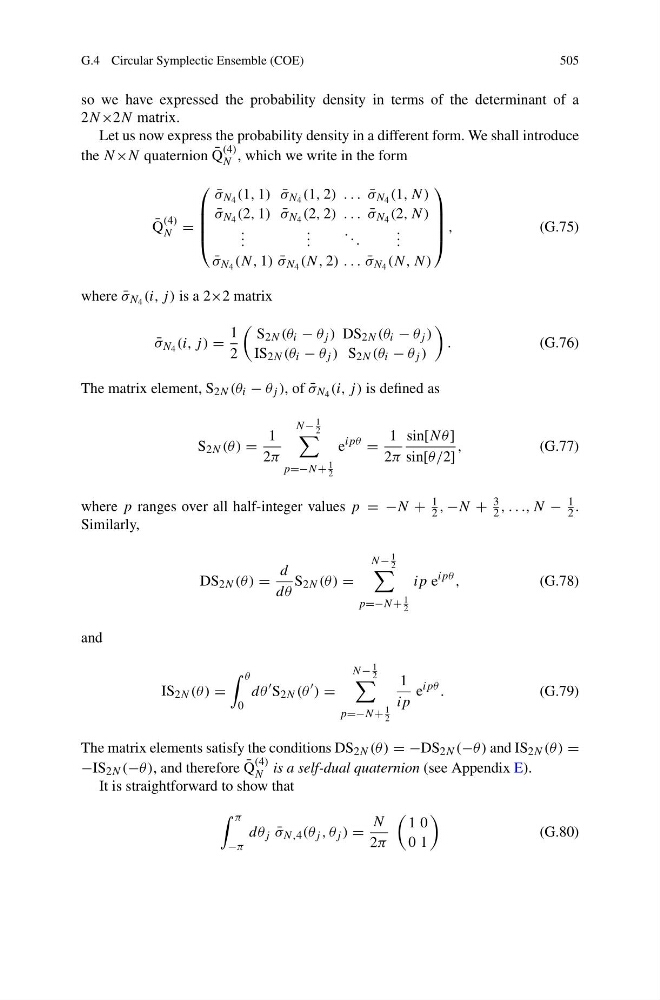
Let us now express the probability density in a different form. We shall introduce
the N ×N quaternion ¯
Q
(4)
N , which we write in the form
¯
Q
(4)
N =
⎛
⎜
⎜
⎜
⎝
¯
σ N 4 (1, 1) ¯
σ N 4 (1, 2) . . . ¯
σ N 4 (1, N)
¯
σ N 4 (2, 1) ¯
σ N 4 (2, 2) . . . ¯
σ N 4 (2, N)
. . .
. . .
. . .
. . .
¯
σ N 4 (N, 1) ¯
σ N 4 (N, 2) . . . ¯
σ N 4 (N, N)
⎞
⎟
⎟
⎟
⎠
,
(G.75)
where ¯
σ N 4 (i, j ) is a 2×2 matrix
¯
σ N 4 (i, j ) =
1
2
S 2N (θ i − θ j ) DS 2N (θ i − θ j )
IS 2N (θ i − θ j ) S 2N (θ i − θ j )
.
(G.76)
The matrix element, S 2N (θ i − θ j ), of ¯
σ N 4 (i, j ) is defined as
S 2N (θ ) =
1
2π
N −
1
2
p=−N +
1
2
e
ipθ
=
1
2π
sin[Nθ]
sin[θ/2]
,
(G.77)
where p ranges over all half-integer values p = −N +
1
2 , −N +
3
2 , . . ., N −
1
2 .
Similarly,
DS 2N (θ ) =
d
dθ
S 2N (θ ) =
N −
1
2
p=−N +
1
2
ip e
ipθ ,
(G.78)
and
IS 2N (θ ) =
θ
0
dθ
S 2N (θ
) =
N −
1
2
p=−N +
1
2
1
ip
e
ipθ .
(G.79)
The matrix elements satisfy the conditions DS 2N (θ ) = −DS 2N (−θ) and IS 2N (θ ) =
−IS 2N (−θ), and therefore ¯
Q
(4)
N is a self-dual quaternion (see Appendix E).
It is straightforward to show that
π
−π
dθ j ¯
σ N,4 (θ j , θ j ) =
N
2π
1 0
0 1
(G.80)
505
so we have expressed the probability density in terms of the determinant of a
2N×2N matrix.
Let us now express the probability density in a different form. We shall introduce
the N ×N quaternion ¯
Q
(4)
N , which we write in the form
¯
Q
(4)
N =
⎛
⎜
⎜
⎜
⎝
¯
σ N 4 (1, 1) ¯
σ N 4 (1, 2) . . . ¯
σ N 4 (1, N)
¯
σ N 4 (2, 1) ¯
σ N 4 (2, 2) . . . ¯
σ N 4 (2, N)
. . .
. . .
. . .
. . .
¯
σ N 4 (N, 1) ¯
σ N 4 (N, 2) . . . ¯
σ N 4 (N, N)
⎞
⎟
⎟
⎟
⎠
,
(G.75)
where ¯
σ N 4 (i, j ) is a 2×2 matrix
¯
σ N 4 (i, j ) =
1
2
S 2N (θ i − θ j ) DS 2N (θ i − θ j )
IS 2N (θ i − θ j ) S 2N (θ i − θ j )
.
(G.76)
The matrix element, S 2N (θ i − θ j ), of ¯
σ N 4 (i, j ) is defined as
S 2N (θ ) =
1
2π
N −
1
2
p=−N +
1
2
e
ipθ
=
1
2π
sin[Nθ]
sin[θ/2]
,
(G.77)
where p ranges over all half-integer values p = −N +
1
2 , −N +
3
2 , . . ., N −
1
2 .
Similarly,
DS 2N (θ ) =
d
dθ
S 2N (θ ) =
N −
1
2
p=−N +
1
2
ip e
ipθ ,
(G.78)
and
IS 2N (θ ) =
θ
0
dθ
S 2N (θ
) =
N −
1
2
p=−N +
1
2
1
ip
e
ipθ .
(G.79)
The matrix elements satisfy the conditions DS 2N (θ ) = −DS 2N (−θ) and IS 2N (θ ) =
−IS 2N (−θ), and therefore ¯
Q
(4)
N is a self-dual quaternion (see Appendix E).
It is straightforward to show that
π
−π
dθ j ¯
σ N,4 (θ j , θ j ) =
N
2π
1 0
0 1
(G.80)