

2.7 The Definition of Chaos
37
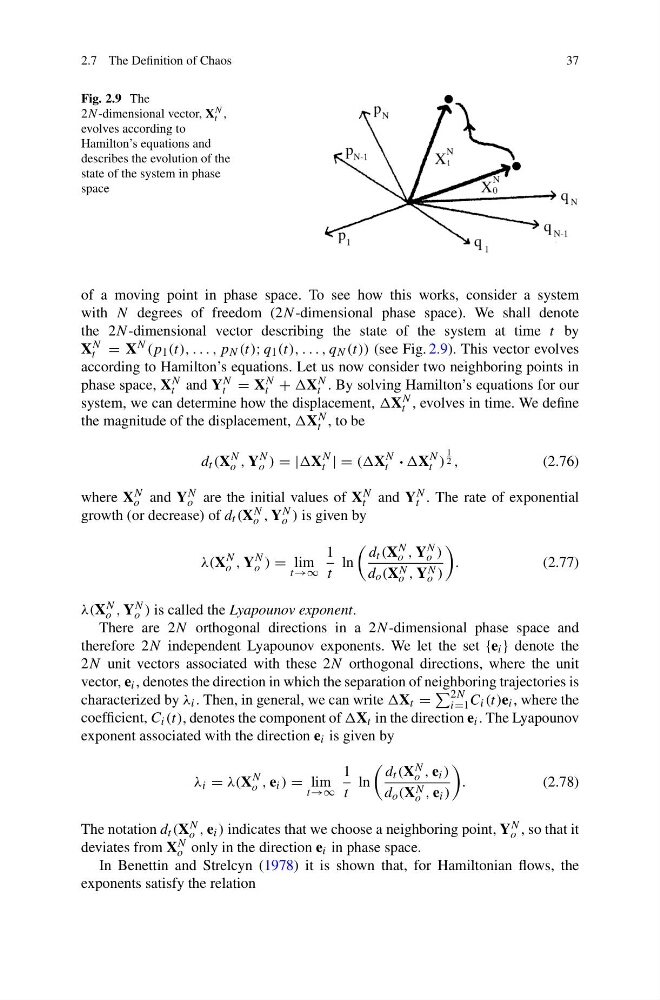
Fig. 2.9 The
2N -dimensional vector, X N
t ,
evolves according to
Hamilton’s equations and
describes the evolution of the
state of the system in phase
space
of a moving point in phase space. To see how this works, consider a system
with N degrees of freedom (2N-dimensional phase space). We shall denote
the 2N-dimensional vector describing the state of the system at time t by
X N
t = X N (p 1 (t), . . . , p N (t); q 1 (t), . . . , q N (t)) (see Fig. 2.9). This vector evolves
according to Hamilton’s equations. Let us now consider two neighboring points in
phase space, X N
t and Y N
t = X N
t + N
t . By solving Hamilton’s equations for our
system, we can determine how the displacement, N
t , evolves in time. We define
the magnitude of the displacement, N
t , to be
d t (X
N
o , Y
N
o ) = |
N
t | = ((X
N
t ·
N
t )
1
2 ,
(2.76)
where X N
o and Y N
o are the initial values of X N
t and Y N
t . The rate of exponential
growth (or decrease) of d t (X N
o , Y N
o ) is given by
λ(X
N
o , Y
N
o ) = lim
t→∞
1
t
ln
d t (X N
o , Y N
o )
d o (X N
o , Y N
o )
.
(2.77)
λ(X N
o , Y N
o ) is called the Lyapounov exponent.
There are 2N orthogonal directions in a 2N-dimensional phase space and
therefore 2N independent Lyapounov exponents. We let the set {e i } denote the
2N unit vectors associated with these 2N orthogonal directions, where the unit
vector, e i , denotes the direction in which the separation of neighboring trajectories is
characterized by λ i . Then, in general, we can write t =
2N
i=1 C i (t)e i , where the
coefficient, C i (t), denotes the component of t in the direction e i . The Lyapounov
exponent associated with the direction e i is given by
λ i = λ(X
N
o , e i ) = lim
t→∞
1
t
ln
d t (X N
o , e i )
d o (X N
o , e i )
.
(2.78)
The notation d t (X N
o , e i ) indicates that we choose a neighboring point, Y N
o , so that it
deviates from X N
o only in the direction e i in phase space.
In Benettin and Strelcyn (1978) it is shown that, for Hamiltonian flows, the
exponents satisfy the relation
37
Fig. 2.9 The
2N -dimensional vector, X N
t ,
evolves according to
Hamilton’s equations and
describes the evolution of the
state of the system in phase
space
of a moving point in phase space. To see how this works, consider a system
with N degrees of freedom (2N-dimensional phase space). We shall denote
the 2N-dimensional vector describing the state of the system at time t by
X N
t = X N (p 1 (t), . . . , p N (t); q 1 (t), . . . , q N (t)) (see Fig. 2.9). This vector evolves
according to Hamilton’s equations. Let us now consider two neighboring points in
phase space, X N
t and Y N
t = X N
t + N
t . By solving Hamilton’s equations for our
system, we can determine how the displacement, N
t , evolves in time. We define
the magnitude of the displacement, N
t , to be
d t (X
N
o , Y
N
o ) = |
N
t | = ((X
N
t ·
N
t )
1
2 ,
(2.76)
where X N
o and Y N
o are the initial values of X N
t and Y N
t . The rate of exponential
growth (or decrease) of d t (X N
o , Y N
o ) is given by
λ(X
N
o , Y
N
o ) = lim
t→∞
1
t
ln
d t (X N
o , Y N
o )
d o (X N
o , Y N
o )
.
(2.77)
λ(X N
o , Y N
o ) is called the Lyapounov exponent.
There are 2N orthogonal directions in a 2N-dimensional phase space and
therefore 2N independent Lyapounov exponents. We let the set {e i } denote the
2N unit vectors associated with these 2N orthogonal directions, where the unit
vector, e i , denotes the direction in which the separation of neighboring trajectories is
characterized by λ i . Then, in general, we can write t =
2N
i=1 C i (t)e i , where the
coefficient, C i (t), denotes the component of t in the direction e i . The Lyapounov
exponent associated with the direction e i is given by
λ i = λ(X
N
o , e i ) = lim
t→∞
1
t
ln
d t (X N
o , e i )
d o (X N
o , e i )
.
(2.78)
The notation d t (X N
o , e i ) indicates that we choose a neighboring point, Y N
o , so that it
deviates from X N
o only in the direction e i in phase space.
In Benettin and Strelcyn (1978) it is shown that, for Hamiltonian flows, the
exponents satisfy the relation