

G.1 Vandermonde Determinant
495
We will follow closely the derivation in Appendix F. As we shall show, the
probability densities for all three circular ensembles can be written in the form
P N β (θ 1 , . . ., θ N ) =
1
N!
det β [ ¯
Q
(β)
N ],
(G.12)
and the normalization constant C N,β in Eq. (G.10) is given by
C N,β =
1
(2π) N
(1 +
1
2 β)
N
(1 +
1
2 Nβ)
.
(G.13)
For the case β = 2, ¯
Q
(2)
N is an N×N matrix with scalar matrix elements and
det 2 [ ¯
Q
(2)
N ] ≡ Det[ ¯
Q
(2)
N ], where Det[ ¯
Q
(2)
N ] denotes the determinant of the N ×N
matrix, Q
(2)
N . For the cases β = 1 and β = 4, ¯
Q
(1)
N and ¯
Q
(4)
N are N ×N quaternions
(2N×2N matrices), and the determinants det 1 [ ¯
Q
(1)
N ] = Qdet[ ¯
Q
(1)
N ] and det 4 [ ¯
Q
(4)
N ] =
Qdet[ ¯
Q
(4)
N ] are quaternion determinants (see Appendix E).
The derivation of a unified formulation of the circular ensembles, in the form
given in Eq. (G.12), depends on the use of the Vandermonde determinant, which
was introduced in Appendix F. We first write down the Vandermonde determinant
for complex numbers and then use it to derive expressions for probability densities
for the circular unitary ensemble (β = 2), the circular orthogonal ensemble (β = 1),
and the circular symplectic ensemble (β = 4).
G.1 Vandermonde Determinant
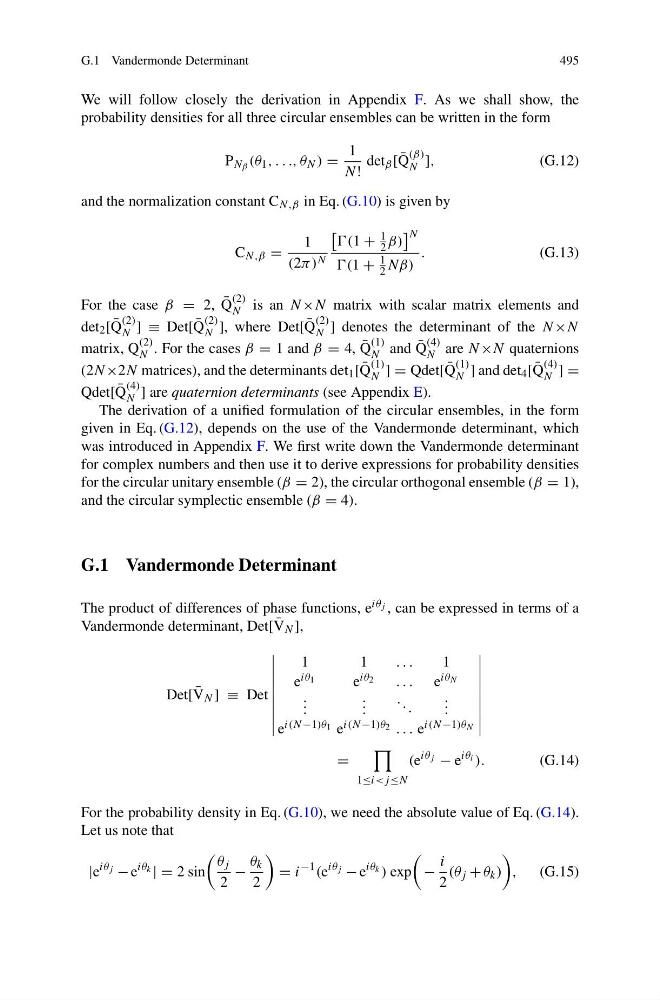
The product of differences of phase functions, e iθ j , can be expressed in terms of a
Vandermonde determinant, Det[ ¯
V N ],
Det[ ¯
V N ] ≡ Det
1
1
. . .
1
e iθ 1
e iθ 2 . . . e iθ N
. . .
. . .
. . .
. . .
e i(N−1)θ 1 e i(N−1)θ 2 . . . e i(N−1)θ N
=
1≤i
iθ j − e
iθ i ).
(G.14)
For the probability density in Eq. (G.10), we need the absolute value of Eq. (G.14).
Let us note that
|e
iθ j − e
iθ k | = 2 sin
θ j
2
−
θ k
2
= i
−1 (e
iθ j − e
iθ k ) exp
−
i
2
(θ j + θ k )
, (G.15)
495
We will follow closely the derivation in Appendix F. As we shall show, the
probability densities for all three circular ensembles can be written in the form
P N β (θ 1 , . . ., θ N ) =
1
N!
det β [ ¯
Q
(β)
N ],
(G.12)
and the normalization constant C N,β in Eq. (G.10) is given by
C N,β =
1
(2π) N
(1 +
1
2 β)
N
(1 +
1
2 Nβ)
.
(G.13)
For the case β = 2, ¯
Q
(2)
N is an N×N matrix with scalar matrix elements and
det 2 [ ¯
Q
(2)
N ] ≡ Det[ ¯
Q
(2)
N ], where Det[ ¯
Q
(2)
N ] denotes the determinant of the N ×N
matrix, Q
(2)
N . For the cases β = 1 and β = 4, ¯
Q
(1)
N and ¯
Q
(4)
N are N ×N quaternions
(2N×2N matrices), and the determinants det 1 [ ¯
Q
(1)
N ] = Qdet[ ¯
Q
(1)
N ] and det 4 [ ¯
Q
(4)
N ] =
Qdet[ ¯
Q
(4)
N ] are quaternion determinants (see Appendix E).
The derivation of a unified formulation of the circular ensembles, in the form
given in Eq. (G.12), depends on the use of the Vandermonde determinant, which
was introduced in Appendix F. We first write down the Vandermonde determinant
for complex numbers and then use it to derive expressions for probability densities
for the circular unitary ensemble (β = 2), the circular orthogonal ensemble (β = 1),
and the circular symplectic ensemble (β = 4).
G.1 Vandermonde Determinant
The product of differences of phase functions, e iθ j , can be expressed in terms of a
Vandermonde determinant, Det[ ¯
V N ],
Det[ ¯
V N ] ≡ Det
1
1
. . .
1
e iθ 1
e iθ 2 . . . e iθ N
. . .
. . .
. . .
. . .
e i(N−1)θ 1 e i(N−1)θ 2 . . . e i(N−1)θ N
=
1≤i
iθ j − e
iθ i ).
(G.14)
For the probability density in Eq. (G.10), we need the absolute value of Eq. (G.14).
Let us note that
|e
iθ j − e
iθ k | = 2 sin
θ j
2
−
θ k
2
= i
−1 (e
iθ j − e
iθ k ) exp
−
i
2
(θ j + θ k )
, (G.15)