

F.3 Gaussian Symplectic Ensemble (GSE)
489
The quaternion determinant of ¯
Q
(GSE)
N
has the property
∞
−∞
dx n+1 . . .
∞
−∞
dx N Qdet[ ¯
Q
(GSE)
N
] = (N − n)! Qdet[ ¯
Q
(GSE)
n
(N)], (F.126)
where ¯
Q
(GSE)
n
(N) is an n×n quaternion composed of matrix elements ¯
σ N,4 (x i , x j ),
and
∞
−∞
dx 1 . . .
∞
−∞
dx N Qdet[ ¯
Q
(GSE)
N
] = N!
1 0
0 1
.
(F.127)
F.3.4 Cluster Functions for GSE
Because of the probability density for the GSE is expressed in terms of self-dual
quaternion matrices, the process of obtaining the cluster functions is similar to those
used for GOE and GUE, although the results are different. We simply quote the
results here.
The two-body cluster function T N 4 (x 1 , x 2 ) for the Gaussian symplectic ensemble
can be obtained from the matrix equation
T N 4 (x 1 , x 2 )
0
0
T N 4 (x 1 , x 2 )
= − ¯
σ N,4 (x 1 , x 2 )· ¯
σ N,4 (x 2 , x 1 ).
(F.128)
Then, from Eq. (F.128), we obtain
T N 4 (x 1 , x 2 ) = −
1
2
[S 2N +1 (x 1
√
2, x 2
√
2)S 2N +1 (x 2
√
2, x 1
√
2)
−DS 2N +1 (x 1
√
2, x 2
√
2)I S 2N +1 (x 2
√
2, x 1
√
2)].
(F.129)
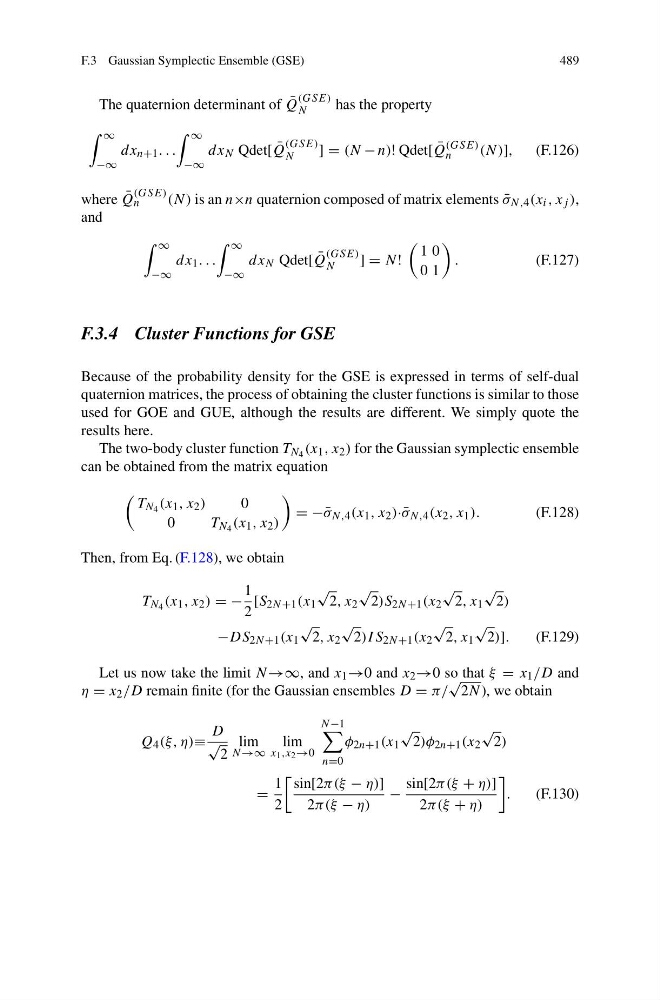
Let us now take the limit N→∞, and x 1 →0 and x 2 →0 so that ξ = x 1 /D and
η = x 2 /D remain finite (for the Gaussian ensembles D = π/
√
2N ), we obtain
Q 4 (ξ, η)≡
D
√
2
lim
N →∞
lim
x 1 ,x 2 →0
N −1
n=0
φ 2n+1 (x 1
√
2)φ 2n+1 (x 2
√
2)
=
1
2
sin[2π(ξ − η)]
2π(ξ − η)
−
sin[2π(ξ + η)]
2π(ξ + η)
.
(F.130)
489
The quaternion determinant of ¯
Q
(GSE)
N
has the property
∞
−∞
dx n+1 . . .
∞
−∞
dx N Qdet[ ¯
Q
(GSE)
N
] = (N − n)! Qdet[ ¯
Q
(GSE)
n
(N)], (F.126)
where ¯
Q
(GSE)
n
(N) is an n×n quaternion composed of matrix elements ¯
σ N,4 (x i , x j ),
and
∞
−∞
dx 1 . . .
∞
−∞
dx N Qdet[ ¯
Q
(GSE)
N
] = N!
1 0
0 1
.
(F.127)
F.3.4 Cluster Functions for GSE
Because of the probability density for the GSE is expressed in terms of self-dual
quaternion matrices, the process of obtaining the cluster functions is similar to those
used for GOE and GUE, although the results are different. We simply quote the
results here.
The two-body cluster function T N 4 (x 1 , x 2 ) for the Gaussian symplectic ensemble
can be obtained from the matrix equation
T N 4 (x 1 , x 2 )
0
0
T N 4 (x 1 , x 2 )
= − ¯
σ N,4 (x 1 , x 2 )· ¯
σ N,4 (x 2 , x 1 ).
(F.128)
Then, from Eq. (F.128), we obtain
T N 4 (x 1 , x 2 ) = −
1
2
[S 2N +1 (x 1
√
2, x 2
√
2)S 2N +1 (x 2
√
2, x 1
√
2)
−DS 2N +1 (x 1
√
2, x 2
√
2)I S 2N +1 (x 2
√
2, x 1
√
2)].
(F.129)
Let us now take the limit N→∞, and x 1 →0 and x 2 →0 so that ξ = x 1 /D and
η = x 2 /D remain finite (for the Gaussian ensembles D = π/
√
2N ), we obtain
Q 4 (ξ, η)≡
D
√
2
lim
N →∞
lim
x 1 ,x 2 →0
N −1
n=0
φ 2n+1 (x 1
√
2)φ 2n+1 (x 2
√
2)
=
1
2
sin[2π(ξ − η)]
2π(ξ − η)
−
sin[2π(ξ + η)]
2π(ξ + η)
.
(F.130)