

488
F Gaussian Ensembles
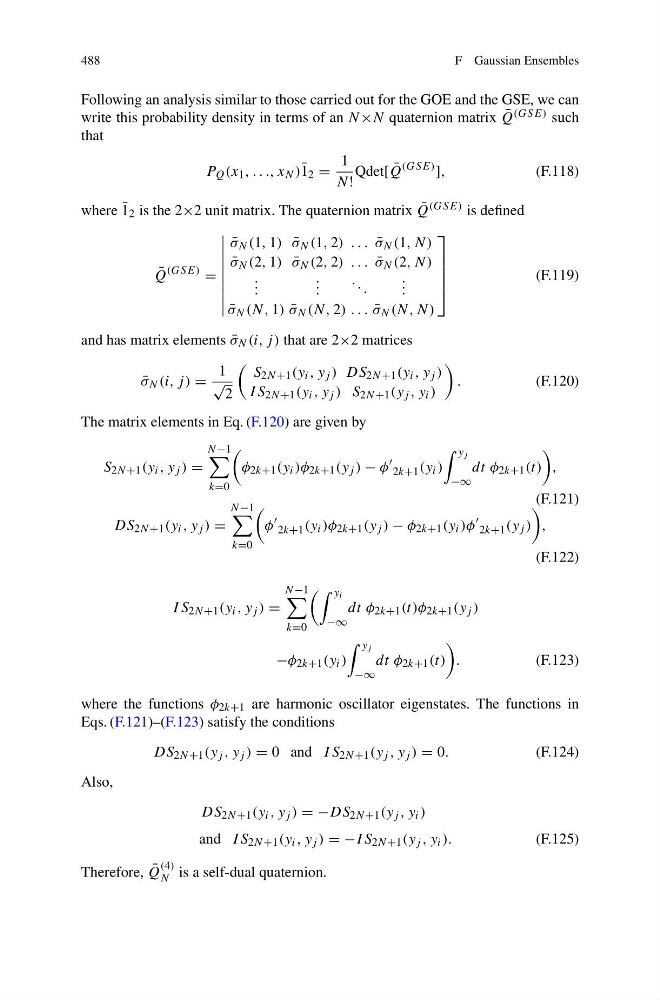
Following an analysis similar to those carried out for the GOE and the GSE, we can
write this probability density in terms of an N×N quaternion matrix ¯
Q (GSE) such
that
P Q (x 1 , . . ., x N ) ¯
1 2 =
1
N!
Qdet[ ¯
Q
(GSE)
],
(F.118)
where ¯
1 2 is the 2×2 unit matrix. The quaternion matrix ¯
Q (GSE) is defined
¯
Q
(GSE)
=
¯
σ N (1, 1) ¯
σ N (1, 2) . . . ¯
σ N (1, N)
¯
σ N (2, 1) ¯
σ N (2, 2) . . . ¯
σ N (2, N)
. . .
. . .
. . .
. . .
¯
σ N (N, 1) ¯
σ N (N, 2) . . . ¯
σ N (N, N)
⎤
⎥
⎥
⎥
⎦
(F.119)
and has matrix elements ¯
σ N (i, j ) that are 2×2 matrices
¯
σ N (i, j ) =
1
√
2
S 2N +1 (y i , y j ) DS 2N +1 (y i , y j )
I S 2N +1 (y i , y j ) S 2N +1 (y j , y i )
.
(F.120)
The matrix elements in Eq. (F.120) are given by
S 2N +1 (y i , y j ) =
N −1
k=0
φ 2k+1 (y i )φ 2k+1 (y j ) − φ
2k+1 (y i )
y j
−∞
dt φ 2k+1 (t)
,
(F.121)
DS 2N +1 (y i , y j ) =
N −1
k=0
φ
2k+1 (y i )φ 2k+1 (y j ) − φ 2k+1 (y i )φ
2k+1 (y j )
,
(F.122)
I S 2N +1 (y i , y j ) =
N −1
k=0
y i
−∞
dt φ 2k+1 (t)φ 2k+1 (y j )
−φ 2k+1 (y i )
y j
−∞
dt φ 2k+1 (t)
.
(F.123)
where the functions φ 2k+1 are harmonic oscillator eigenstates. The functions in
Eqs. (F.121)–(F.123) satisfy the conditions
DS 2N +1 (y j , y j ) = 0 and I S 2N +1 (y j , y j ) = 0.
(F.124)
Also,
DS 2N +1 (y i , y j ) = −DS 2N +1 (y j , y i )
and I S 2N +1 (y i , y j ) = −I S 2N +1 (y j , y i ).
(F.125)
Therefore, ¯
Q
(4)
N is a self-dual quaternion.
F Gaussian Ensembles
Following an analysis similar to those carried out for the GOE and the GSE, we can
write this probability density in terms of an N×N quaternion matrix ¯
Q (GSE) such
that
P Q (x 1 , . . ., x N ) ¯
1 2 =
1
N!
Qdet[ ¯
Q
(GSE)
],
(F.118)
where ¯
1 2 is the 2×2 unit matrix. The quaternion matrix ¯
Q (GSE) is defined
¯
Q
(GSE)
=
¯
σ N (1, 1) ¯
σ N (1, 2) . . . ¯
σ N (1, N)
¯
σ N (2, 1) ¯
σ N (2, 2) . . . ¯
σ N (2, N)
. . .
. . .
. . .
. . .
¯
σ N (N, 1) ¯
σ N (N, 2) . . . ¯
σ N (N, N)
⎤
⎥
⎥
⎥
⎦
(F.119)
and has matrix elements ¯
σ N (i, j ) that are 2×2 matrices
¯
σ N (i, j ) =
1
√
2
S 2N +1 (y i , y j ) DS 2N +1 (y i , y j )
I S 2N +1 (y i , y j ) S 2N +1 (y j , y i )
.
(F.120)
The matrix elements in Eq. (F.120) are given by
S 2N +1 (y i , y j ) =
N −1
k=0
φ 2k+1 (y i )φ 2k+1 (y j ) − φ
2k+1 (y i )
y j
−∞
dt φ 2k+1 (t)
,
(F.121)
DS 2N +1 (y i , y j ) =
N −1
k=0
φ
2k+1 (y i )φ 2k+1 (y j ) − φ 2k+1 (y i )φ
2k+1 (y j )
,
(F.122)
I S 2N +1 (y i , y j ) =
N −1
k=0
y i
−∞
dt φ 2k+1 (t)φ 2k+1 (y j )
−φ 2k+1 (y i )
y j
−∞
dt φ 2k+1 (t)
.
(F.123)
where the functions φ 2k+1 are harmonic oscillator eigenstates. The functions in
Eqs. (F.121)–(F.123) satisfy the conditions
DS 2N +1 (y j , y j ) = 0 and I S 2N +1 (y j , y j ) = 0.
(F.124)
Also,
DS 2N +1 (y i , y j ) = −DS 2N +1 (y j , y i )
and I S 2N +1 (y i , y j ) = −I S 2N +1 (y j , y i ).
(F.125)
Therefore, ¯
Q
(4)
N is a self-dual quaternion.