

460
E Quaternions
The quaternion determinant of the 3×3 quaternion ¯
Q 3 is
Qdet[ ¯
Q 3 ] =
1190 0
0 1190
.
(E.23)
.
E.2 Quaternions in the GOE
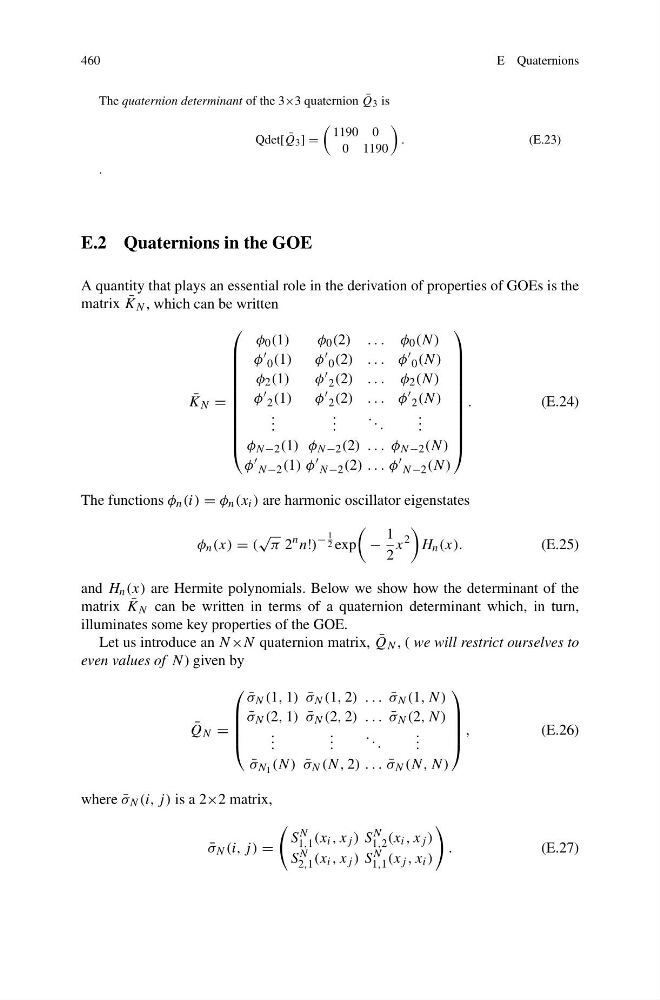
A quantity that plays an essential role in the derivation of properties of GOEs is the
matrix ¯
K N , which can be written
¯
K N =
⎛
⎜
⎜
⎜
⎜
⎜
⎜
⎜
⎜
⎜
⎜
⎝
φ 0 (1)
φ 0 (2) ... φ 0 (N)
φ
0 (1)
φ
0 (2) . . . φ
0 (N)
φ 2 (1)
φ
2 (2) . . . φ 2 (N)
φ
2 (1)
φ
2 (2) . . . φ
2 (N)
. . .
. . .
. . .
. . .
φ N −2 (1) φ N −2 (2) . . . φ N −2 (N)
φ
N −2 (1) φ
N −2 (2) . . . φ
N −2 (N)
⎞
⎟
⎟
⎟
⎟
⎟
⎟
⎟
⎟
⎟
⎟
⎠
.
(E.24)
The functions φ n (i) = φ n (x i ) are harmonic oscillator eigenstates
φ n (x) = (
√
π 2
n n!)
−
1
2 exp
−
1
2
x
2
H n (x).
(E.25)
and H n (x) are Hermite polynomials. Below we show how the determinant of the
matrix ¯
K N can be written in terms of a quaternion determinant which, in turn,
illuminates some key properties of the GOE.
Let us introduce an N×N quaternion matrix, ¯
Q N , ( we will restrict ourselves to
even values of N ) given by
¯
Q N =
⎛
⎜
⎜
⎜
⎝
¯
σ N (1, 1) ¯
σ N (1, 2) . . . ¯
σ N (1, N)
¯
σ N (2, 1) ¯
σ N (2, 2) . . . ¯
σ N (2, N)
. . .
. . .
. . .
. . .
¯
σ N 1 (N) ¯
σ N (N, 2) . . . ¯
σ N (N, N)
⎞
⎟
⎟
⎟
⎠
,
(E.26)
where ¯
σ N (i, j ) is a 2×2 matrix,
¯
σ N (i, j ) =
S N
1,1 (x i , x j ) S N
1,2 (x i , x j )
S N
2,1 (x i , x j ) S N
1,1 (x j , x i )
.
(E.27)
E Quaternions
The quaternion determinant of the 3×3 quaternion ¯
Q 3 is
Qdet[ ¯
Q 3 ] =
1190 0
0 1190
.
(E.23)
.
E.2 Quaternions in the GOE
A quantity that plays an essential role in the derivation of properties of GOEs is the
matrix ¯
K N , which can be written
¯
K N =
⎛
⎜
⎜
⎜
⎜
⎜
⎜
⎜
⎜
⎜
⎜
⎝
φ 0 (1)
φ 0 (2) ... φ 0 (N)
φ
0 (1)
φ
0 (2) . . . φ
0 (N)
φ 2 (1)
φ
2 (2) . . . φ 2 (N)
φ
2 (1)
φ
2 (2) . . . φ
2 (N)
. . .
. . .
. . .
. . .
φ N −2 (1) φ N −2 (2) . . . φ N −2 (N)
φ
N −2 (1) φ
N −2 (2) . . . φ
N −2 (N)
⎞
⎟
⎟
⎟
⎟
⎟
⎟
⎟
⎟
⎟
⎟
⎠
.
(E.24)
The functions φ n (i) = φ n (x i ) are harmonic oscillator eigenstates
φ n (x) = (
√
π 2
n n!)
−
1
2 exp
−
1
2
x
2
H n (x).
(E.25)
and H n (x) are Hermite polynomials. Below we show how the determinant of the
matrix ¯
K N can be written in terms of a quaternion determinant which, in turn,
illuminates some key properties of the GOE.
Let us introduce an N×N quaternion matrix, ¯
Q N , ( we will restrict ourselves to
even values of N ) given by
¯
Q N =
⎛
⎜
⎜
⎜
⎝
¯
σ N (1, 1) ¯
σ N (1, 2) . . . ¯
σ N (1, N)
¯
σ N (2, 1) ¯
σ N (2, 2) . . . ¯
σ N (2, N)
. . .
. . .
. . .
. . .
¯
σ N 1 (N) ¯
σ N (N, 2) . . . ¯
σ N (N, N)
⎞
⎟
⎟
⎟
⎠
,
(E.26)
where ¯
σ N (i, j ) is a 2×2 matrix,
¯
σ N (i, j ) =
S N
1,1 (x i , x j ) S N
1,2 (x i , x j )
S N
2,1 (x i , x j ) S N
1,1 (x j , x i )
.
(E.27)