

442
D Invariant Measures
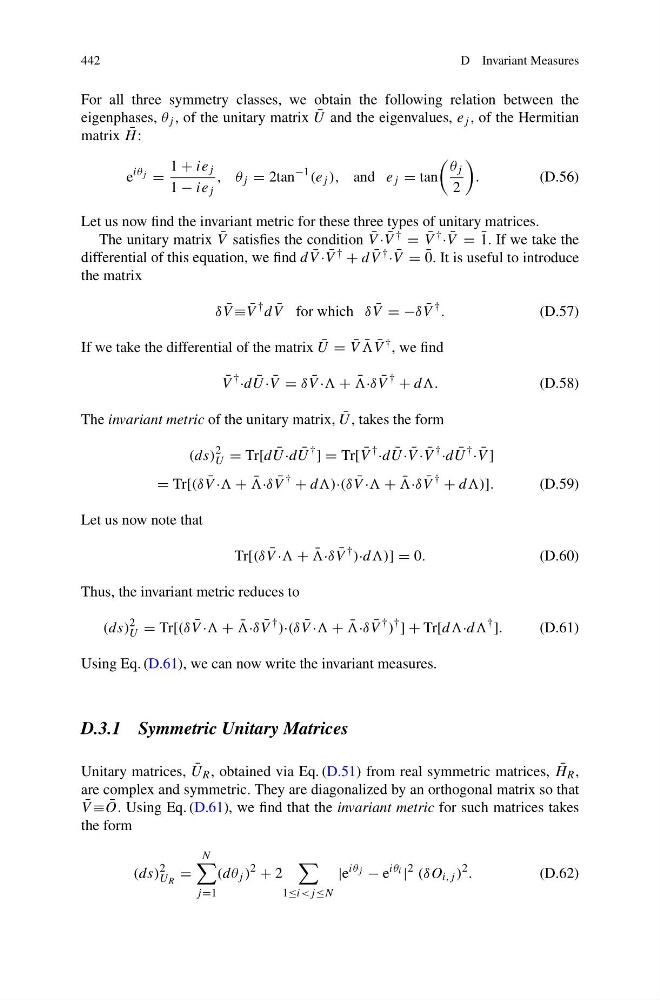
For all three symmetry classes, we obtain the following relation between the
eigenphases, θ j , of the unitary matrix ¯
U and the eigenvalues, e j , of the Hermitian
matrix ¯
H :
e
iθ j =
1 + ie j
1 − ie j
, θ j = 2tan
−1 (e j ), and e j = tan
θ j
2
.
(D.56)
Let us now find the invariant metric for these three types of unitary matrices.
The unitary matrix ¯
V satisfies the condition ¯
V · ¯
V † = ¯
V † · ¯
V = ¯
1. If we take the
differential of this equation, we find d ¯
V · ¯
V † + d ¯
V † · ¯
V = ¯
0. It is useful to introduce
the matrix
δ ¯
V ≡ ¯
V
† d ¯
V for which δ ¯
V = −δ ¯
V
† .
(D.57)
If we take the differential of the matrix ¯
U = ¯
V ¯
¯
V † , we find
¯
V
†
·d ¯
U · ¯
V = δ ¯
V · + ¯
·δ ¯
V
†
+ dd.
(D.58)
The invariant metric of the unitary matrix, ¯
U , takes the form
(ds)
2
U = Tr[d ¯
U ·d ¯
U
†
] = Tr[ ¯
V
†
·d ¯
U · ¯
V · ¯
V
†
·d ¯
U
†
· ¯
V ]
= Tr[(δ ¯
V · + ¯
·δ ¯
V
†
+ dd)·(δ ¯
V · + ¯
·δ ¯
V
†
+ dd)].
(D.59)
Let us now note that
Tr[(δ ¯
V · + ¯
·δ ¯
V
† )·dd)] = 0.
(D.60)
Thus, the invariant metric reduces to
(ds)
2
U = Tr[(δ ¯
V · + ¯
·δ ¯
V
† )·(δ ¯
V · + ¯
·δ ¯
V
† )
†
] + Tr[dd·dd
†
].
(D.61)
Using Eq. (D.61), we can now write the invariant measures.
D.3.1 Symmetric Unitary Matrices
Unitary matrices, ¯
U R , obtained via Eq. (D.51) from real symmetric matrices, ¯
H R ,
are complex and symmetric. They are diagonalized by an orthogonal matrix so that
¯
V ≡ ¯
O. Using Eq. (D.61), we find that the invariant metric for such matrices takes
the form
(ds)
2
U R
=
N
j =1
(dθ j )
2
+ 2
1≤i
iθ j − e
iθ i |
2 (δO i,j )
2 .
(D.62)
D Invariant Measures
For all three symmetry classes, we obtain the following relation between the
eigenphases, θ j , of the unitary matrix ¯
U and the eigenvalues, e j , of the Hermitian
matrix ¯
H :
e
iθ j =
1 + ie j
1 − ie j
, θ j = 2tan
−1 (e j ), and e j = tan
θ j
2
.
(D.56)
Let us now find the invariant metric for these three types of unitary matrices.
The unitary matrix ¯
V satisfies the condition ¯
V · ¯
V † = ¯
V † · ¯
V = ¯
1. If we take the
differential of this equation, we find d ¯
V · ¯
V † + d ¯
V † · ¯
V = ¯
0. It is useful to introduce
the matrix
δ ¯
V ≡ ¯
V
† d ¯
V for which δ ¯
V = −δ ¯
V
† .
(D.57)
If we take the differential of the matrix ¯
U = ¯
V ¯
¯
V † , we find
¯
V
†
·d ¯
U · ¯
V = δ ¯
V · + ¯
·δ ¯
V
†
+ dd.
(D.58)
The invariant metric of the unitary matrix, ¯
U , takes the form
(ds)
2
U = Tr[d ¯
U ·d ¯
U
†
] = Tr[ ¯
V
†
·d ¯
U · ¯
V · ¯
V
†
·d ¯
U
†
· ¯
V ]
= Tr[(δ ¯
V · + ¯
·δ ¯
V
†
+ dd)·(δ ¯
V · + ¯
·δ ¯
V
†
+ dd)].
(D.59)
Let us now note that
Tr[(δ ¯
V · + ¯
·δ ¯
V
† )·dd)] = 0.
(D.60)
Thus, the invariant metric reduces to
(ds)
2
U = Tr[(δ ¯
V · + ¯
·δ ¯
V
† )·(δ ¯
V · + ¯
·δ ¯
V
† )
†
] + Tr[dd·dd
†
].
(D.61)
Using Eq. (D.61), we can now write the invariant measures.
D.3.1 Symmetric Unitary Matrices
Unitary matrices, ¯
U R , obtained via Eq. (D.51) from real symmetric matrices, ¯
H R ,
are complex and symmetric. They are diagonalized by an orthogonal matrix so that
¯
V ≡ ¯
O. Using Eq. (D.61), we find that the invariant metric for such matrices takes
the form
(ds)
2
U R
=
N
j =1
(dθ j )
2
+ 2
1≤i
iθ j − e
iθ i |
2 (δO i,j )
2 .
(D.62)