

438
D Invariant Measures
Using the equation ¯
H C = ¯
V C ¯
E C ¯
V
†
C , matrix elements of ¯
H C can be written
h 11 = e 1 cos
2 (φ) + e 2 sin
2 (φ), h 12 = i(e 2 − e 1 )cos(φ)sin(φ)e
iψ ,
and h 22 = e 1 sin
2 (φ) + e 2 cos
2 (φ).
(D.34)
Equations (D.34) relate the four variables h 11 , h 22 , h R
12 , and h I
12 to the four variables e 1 , e 2 ,
φ, and ψ. Using these equations, the Jacobian of the transformation between these two sets
of variables is
J
h 11 h 22 h R
12 h I
12
e 1 e 2 φ ψ
= |e 2 − e 1 |
2 cos(φ)sin(φ).
(D.35)
Thus, the invariant measure is
dd H C = 2dh 11 dh 22 dh
R
12 dh
I
12 = 2|e 2 − e 1 |
2 cos(φ)sin(φ)de 1 de 2 dφdψ.
(D.36)
Note the important weighting factor |e 2 − e 1 | 2 .
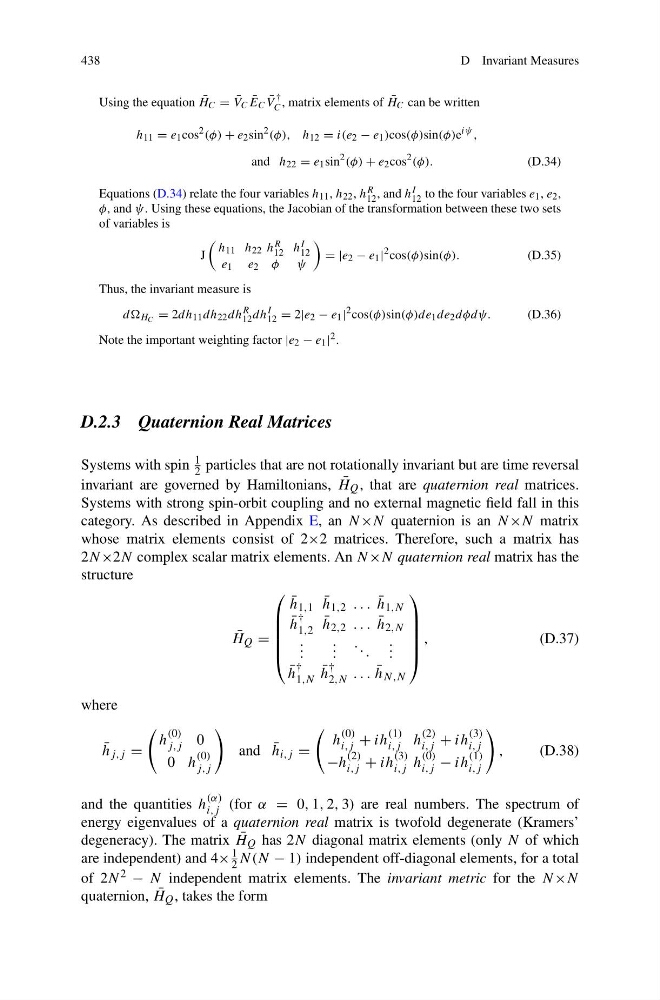
D.2.3 Quaternion Real Matrices
Systems with spin
1
2 particles that are not rotationally invariant but are time reversal
invariant are governed by Hamiltonians, ¯
H Q , that are quaternion real matrices.
Systems with strong spin-orbit coupling and no external magnetic field fall in this
category. As described in Appendix E, an N×N quaternion is an N×N matrix
whose matrix elements consist of 2×2 matrices. Therefore, such a matrix has
2N×2N complex scalar matrix elements. An N×N quaternion real matrix has the
structure
¯
H Q =
⎛
⎜
⎜
⎜
⎜
⎝
¯
h 1,1 ¯
h 1,2 . . . ¯
h 1,N
¯
h
†
1,2
¯
h 2,2 . . . ¯
h 2,N
. . .
. . .
. . .
. . .
¯
h
†
1,N
¯
h
†
2,N . . . ¯
h N,N
⎞
⎟
⎟
⎟
⎟
⎠
,
(D.37)
where
¯
h j,j =
h
(0)
j,j 0
0 h
(0)
j,j
and ¯
h i,j =
h
(0)
i,j + ih
(1)
i,j h
(2)
i,j + ih
(3)
i,j
−h
(2)
i,j + ih
(3)
i,j h
(0)
i,j − ih
(1)
i,j
,
(D.38)
and the quantities h
(α)
i,j (for α = 0, 1, 2, 3) are real numbers. The spectrum of
energy eigenvalues of a quaternion real matrix is twofold degenerate (Kramers’
degeneracy). The matrix ¯
H Q has 2N diagonal matrix elements (only N of which
are independent) and 4×
1
2 N(N − 1) independent off-diagonal elements, for a total
of 2N 2 − N independent matrix elements. The invariant metric for the N ×N
quaternion, ¯
H Q , takes the form
D Invariant Measures
Using the equation ¯
H C = ¯
V C ¯
E C ¯
V
†
C , matrix elements of ¯
H C can be written
h 11 = e 1 cos
2 (φ) + e 2 sin
2 (φ), h 12 = i(e 2 − e 1 )cos(φ)sin(φ)e
iψ ,
and h 22 = e 1 sin
2 (φ) + e 2 cos
2 (φ).
(D.34)
Equations (D.34) relate the four variables h 11 , h 22 , h R
12 , and h I
12 to the four variables e 1 , e 2 ,
φ, and ψ. Using these equations, the Jacobian of the transformation between these two sets
of variables is
J
h 11 h 22 h R
12 h I
12
e 1 e 2 φ ψ
= |e 2 − e 1 |
2 cos(φ)sin(φ).
(D.35)
Thus, the invariant measure is
dd H C = 2dh 11 dh 22 dh
R
12 dh
I
12 = 2|e 2 − e 1 |
2 cos(φ)sin(φ)de 1 de 2 dφdψ.
(D.36)
Note the important weighting factor |e 2 − e 1 | 2 .
D.2.3 Quaternion Real Matrices
Systems with spin
1
2 particles that are not rotationally invariant but are time reversal
invariant are governed by Hamiltonians, ¯
H Q , that are quaternion real matrices.
Systems with strong spin-orbit coupling and no external magnetic field fall in this
category. As described in Appendix E, an N×N quaternion is an N×N matrix
whose matrix elements consist of 2×2 matrices. Therefore, such a matrix has
2N×2N complex scalar matrix elements. An N×N quaternion real matrix has the
structure
¯
H Q =
⎛
⎜
⎜
⎜
⎜
⎝
¯
h 1,1 ¯
h 1,2 . . . ¯
h 1,N
¯
h
†
1,2
¯
h 2,2 . . . ¯
h 2,N
. . .
. . .
. . .
. . .
¯
h
†
1,N
¯
h
†
2,N . . . ¯
h N,N
⎞
⎟
⎟
⎟
⎟
⎠
,
(D.37)
where
¯
h j,j =
h
(0)
j,j 0
0 h
(0)
j,j
and ¯
h i,j =
h
(0)
i,j + ih
(1)
i,j h
(2)
i,j + ih
(3)
i,j
−h
(2)
i,j + ih
(3)
i,j h
(0)
i,j − ih
(1)
i,j
,
(D.38)
and the quantities h
(α)
i,j (for α = 0, 1, 2, 3) are real numbers. The spectrum of
energy eigenvalues of a quaternion real matrix is twofold degenerate (Kramers’
degeneracy). The matrix ¯
H Q has 2N diagonal matrix elements (only N of which
are independent) and 4×
1
2 N(N − 1) independent off-diagonal elements, for a total
of 2N 2 − N independent matrix elements. The invariant metric for the N ×N
quaternion, ¯
H Q , takes the form