

D.2 Hermitian Matrices
437
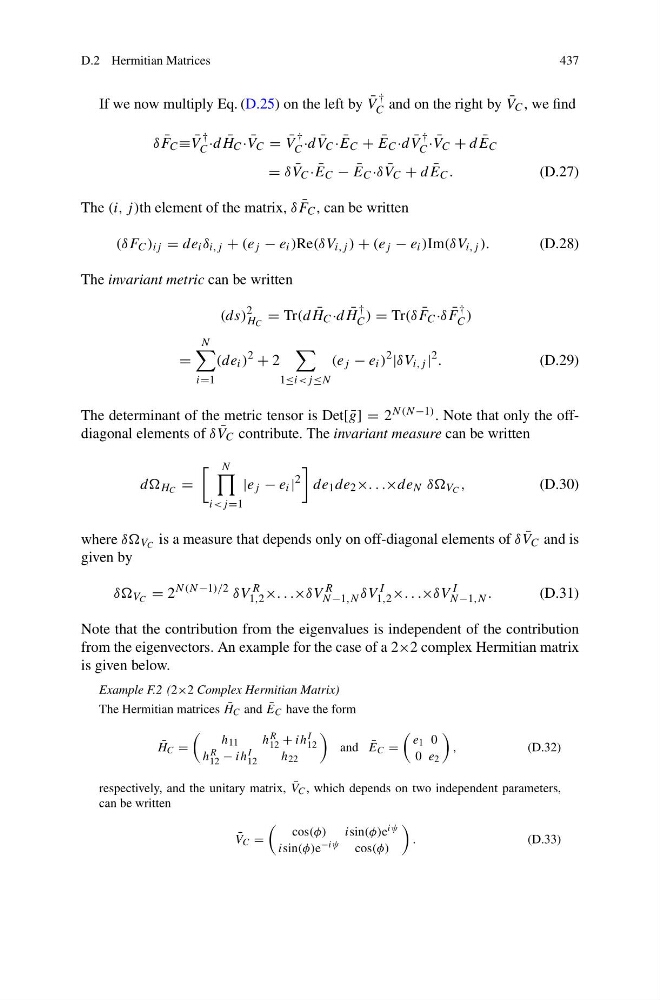
If we now multiply Eq. (D.25) on the left by ¯
V
†
C and on the right by ¯
V C , we find
δ ¯
F C ≡ ¯
V
†
C ·d ¯
H C · ¯
V C = ¯
V
†
C ·d ¯
V C · ¯
E C + ¯
E C ·d ¯
V
†
C · ¯
V C + d ¯
E C
= δ ¯
V C · ¯
E C − ¯
E C ·δ ¯
V C + d ¯
E C .
(D.27)
The (i, j )th element of the matrix, δ ¯
F C , can be written
(δF C ) ij = de i δ i,j + (e j − e i )Re(δV i,j ) + (e j − e i )Im(δV i,j ).
(D.28)
The invariant metric can be written
(ds)
2
H C
= Tr(d ¯
H C ·d ¯
H
†
C ) = Tr(δ ¯
F C ·δ ¯
F
†
C )
=
N
i=1
(de i )
2
+ 2
1≤i
2
|δV i,j |
2 .
(D.29)
The determinant of the metric tensor is Det[ ¯
g] = 2 N(N−1) . Note that only the offdiagonal elements of δ ¯
V C contribute. The invariant measure can be written
dd H C =
N
i
2
de 1 de 2 ×. . .×de N δδ V C ,
(D.30)
where δδ V C is a measure that depends only on off-diagonal elements of δ ¯
V C and is
given by
δδ V C = 2
N(N−1)/2 δV
R
1,2 ×. . .×δV
R
N −1,N δV
I
1,2 ×. . .×δV
I
N −1,N .
(D.31)
Note that the contribution from the eigenvalues is independent of the contribution
from the eigenvectors. An example for the case of a 2×2 complex Hermitian matrix
is given below.
Example F.2 (2×2 Complex Hermitian Matrix)
The Hermitian matrices ¯
H C and ¯
E C have the form
¯
H C =
h 11
h R
12 + ih I
12
h R
12 − ih I
12
h 22
and ¯
E C =
e 1 0
0 e 2
,
(D.32)
respectively, and the unitary matrix, ¯
V C , which depends on two independent parameters,
can be written
¯
V C =
cos(φ) isin(φ)e iψ
isin(φ)e −iψ cos(φ)
.
(D.33)
437
If we now multiply Eq. (D.25) on the left by ¯
V
†
C and on the right by ¯
V C , we find
δ ¯
F C ≡ ¯
V
†
C ·d ¯
H C · ¯
V C = ¯
V
†
C ·d ¯
V C · ¯
E C + ¯
E C ·d ¯
V
†
C · ¯
V C + d ¯
E C
= δ ¯
V C · ¯
E C − ¯
E C ·δ ¯
V C + d ¯
E C .
(D.27)
The (i, j )th element of the matrix, δ ¯
F C , can be written
(δF C ) ij = de i δ i,j + (e j − e i )Re(δV i,j ) + (e j − e i )Im(δV i,j ).
(D.28)
The invariant metric can be written
(ds)
2
H C
= Tr(d ¯
H C ·d ¯
H
†
C ) = Tr(δ ¯
F C ·δ ¯
F
†
C )
=
N
i=1
(de i )
2
+ 2
1≤i
2
|δV i,j |
2 .
(D.29)
The determinant of the metric tensor is Det[ ¯
g] = 2 N(N−1) . Note that only the offdiagonal elements of δ ¯
V C contribute. The invariant measure can be written
dd H C =
N
i
2
de 1 de 2 ×. . .×de N δδ V C ,
(D.30)
where δδ V C is a measure that depends only on off-diagonal elements of δ ¯
V C and is
given by
δδ V C = 2
N(N−1)/2 δV
R
1,2 ×. . .×δV
R
N −1,N δV
I
1,2 ×. . .×δV
I
N −1,N .
(D.31)
Note that the contribution from the eigenvalues is independent of the contribution
from the eigenvectors. An example for the case of a 2×2 complex Hermitian matrix
is given below.
Example F.2 (2×2 Complex Hermitian Matrix)
The Hermitian matrices ¯
H C and ¯
E C have the form
¯
H C =
h 11
h R
12 + ih I
12
h R
12 − ih I
12
h 22
and ¯
E C =
e 1 0
0 e 2
,
(D.32)
respectively, and the unitary matrix, ¯
V C , which depends on two independent parameters,
can be written
¯
V C =
cos(φ) isin(φ)e iψ
isin(φ)e −iψ cos(φ)
.
(D.33)