

D.2 Hermitian Matrices
435
(ds)
2
H R
= Tr(d ¯
H R ·d ¯
H
T
R ) = Tr(δ ¯
F ·δ ¯
F
T )
=
N
i=1
(de i )
2
+ 2
1≤i
2 (δ ¯
O i,j )
2 ,
(D.16)
so Det[ ¯
g] = 2 N(N−1)/2
1≤i
dd H R =
1≤i
de 1 de 2 ×. . .×de N δδ δO ,
(D.17)
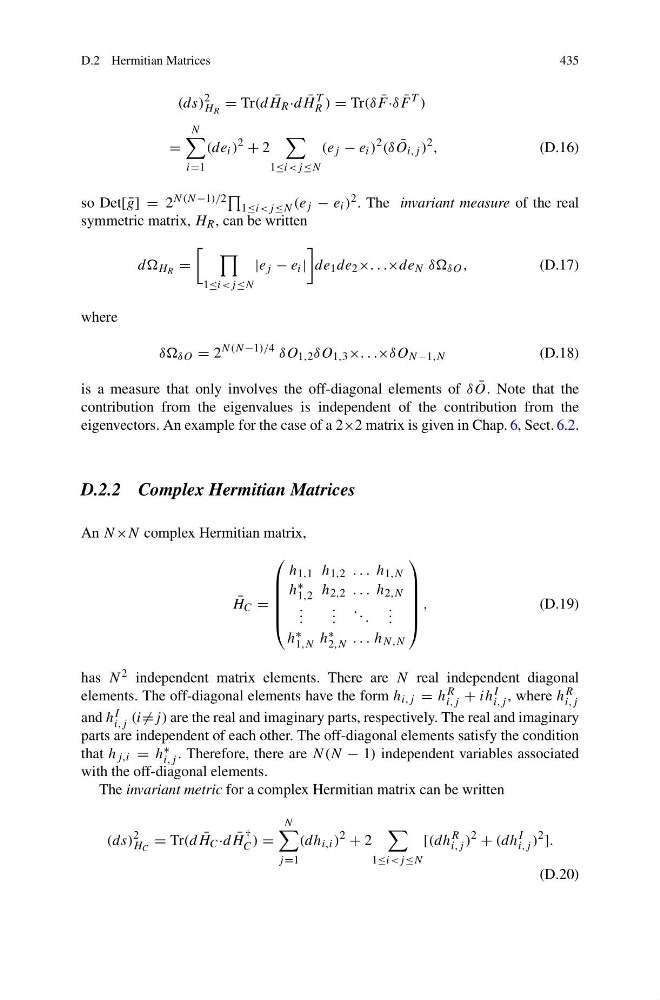
where
δδ δO = 2
N(N−1)/4 δO 1,2 δO 1,3 ×. . .×δO N −1,N
(D.18)
is a measure that only involves the off-diagonal elements of δ ¯
O. Note that the
contribution from the eigenvalues is independent of the contribution from the
eigenvectors. An example for the case of a 2×2 matrix is given in Chap. 6, Sect. 6.2.
D.2.2 Complex Hermitian Matrices
An N ×N complex Hermitian matrix,
¯
H C =
⎛
⎜
⎜
⎜
⎜
⎝
h 1,1 h 1,2 . . . h 1,N
h ∗
1,2 h 2,2 . . . h 2,N
. . .
. . .
. . .
. . .
h ∗
1,N h ∗
2,N . . . h N,N
⎞
⎟
⎟
⎟
⎟
⎠
,
(D.19)
has N 2 independent matrix elements. There are N real independent diagonal
elements. The off-diagonal elements have the form h i,j = h R
i,j + ih I
i,j , where h R
i,j
and h I
i,j (i =j ) are the real and imaginary parts, respectively. The real and imaginary
parts are independent of each other. The off-diagonal elements satisfy the condition
that h j,i = h ∗
i,j . Therefore, there are N(N − 1) independent variables associated
with the off-diagonal elements.
The invariant metric for a complex Hermitian matrix can be written
(ds)
2
H C
= Tr(d ¯
H C ·d ¯
H
†
C ) =
N
j =1
(dh i,i )
2
+ 2
1≤i
R
i,j )
2
+ (dh
I
i,j )
2
].
(D.20)
435
(ds)
2
H R
= Tr(d ¯
H R ·d ¯
H
T
R ) = Tr(δ ¯
F ·δ ¯
F
T )
=
N
i=1
(de i )
2
+ 2
1≤i
2 (δ ¯
O i,j )
2 ,
(D.16)
so Det[ ¯
g] = 2 N(N−1)/2
1≤i
dd H R =
1≤i
de 1 de 2 ×. . .×de N δδ δO ,
(D.17)
where
δδ δO = 2
N(N−1)/4 δO 1,2 δO 1,3 ×. . .×δO N −1,N
(D.18)
is a measure that only involves the off-diagonal elements of δ ¯
O. Note that the
contribution from the eigenvalues is independent of the contribution from the
eigenvectors. An example for the case of a 2×2 matrix is given in Chap. 6, Sect. 6.2.
D.2.2 Complex Hermitian Matrices
An N ×N complex Hermitian matrix,
¯
H C =
⎛
⎜
⎜
⎜
⎜
⎝
h 1,1 h 1,2 . . . h 1,N
h ∗
1,2 h 2,2 . . . h 2,N
. . .
. . .
. . .
. . .
h ∗
1,N h ∗
2,N . . . h N,N
⎞
⎟
⎟
⎟
⎟
⎠
,
(D.19)
has N 2 independent matrix elements. There are N real independent diagonal
elements. The off-diagonal elements have the form h i,j = h R
i,j + ih I
i,j , where h R
i,j
and h I
i,j (i =j ) are the real and imaginary parts, respectively. The real and imaginary
parts are independent of each other. The off-diagonal elements satisfy the condition
that h j,i = h ∗
i,j . Therefore, there are N(N − 1) independent variables associated
with the off-diagonal elements.
The invariant metric for a complex Hermitian matrix can be written
(ds)
2
H C
= Tr(d ¯
H C ·d ¯
H
†
C ) =
N
j =1
(dh i,i )
2
+ 2
1≤i
R
i,j )
2
+ (dh
I
i,j )
2
].
(D.20)