

432
D Invariant Measures
d ¯
W =
⎛
⎜
⎜
⎜
⎝
dw 1,1 dw 1,2 . . . dw 1,N
dw 2,1 dw 2,2 . . . dw 2,N
. . .
. . .
. . .
. . .
dw N,1 dw N,2 . . . dw N,N
⎞
⎟
⎟
⎟
⎠
,
(D.2)
where dw ij = dw R
ij +dw I
ij is the (i, j )th matrix element of d ¯
W , and dw R
ij and dw I
ij
are its real and imaginary parts.
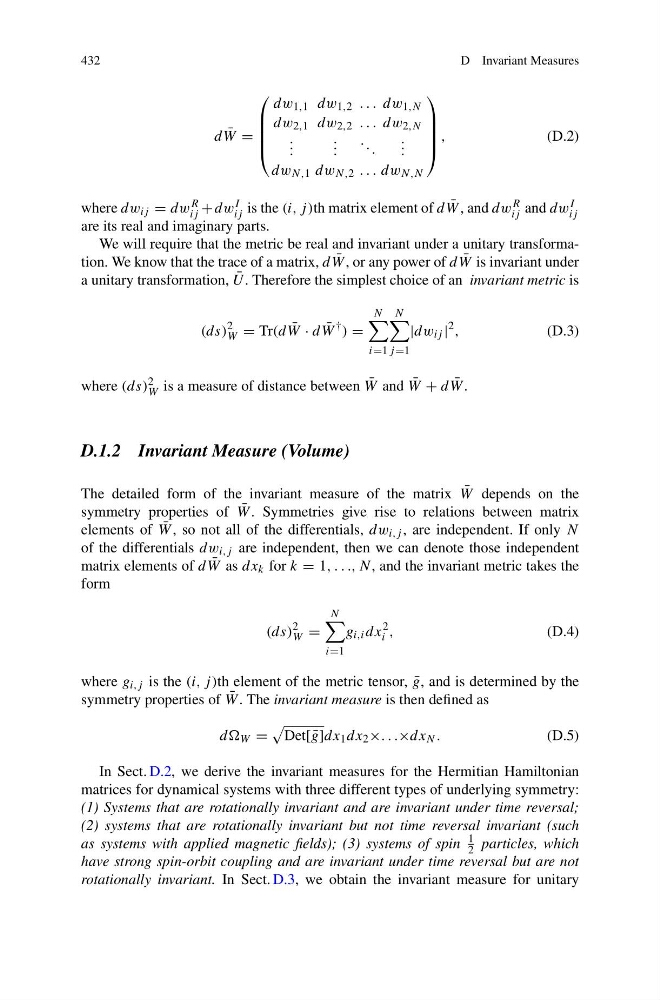
We will require that the metric be real and invariant under a unitary transformation. We know that the trace of a matrix, d ¯
W , or any power of d ¯
W is invariant under
a unitary transformation, ¯
U . Therefore the simplest choice of an invariant metric is
(ds)
2
W = Tr(d ¯
W · d ¯
W
† ) =
N
i=1
N
j =1
|dw ij |
2 ,
(D.3)
where (ds) 2
W is a measure of distance between ¯
W and ¯
W + d ¯
W .
D.1.2 Invariant Measure (Volume)
The detailed form of the invariant measure of the matrix ¯
W depends on the
symmetry properties of ¯
W . Symmetries give rise to relations between matrix
elements of ¯
W , so not all of the differentials, dw i,j , are independent. If only N
of the differentials dw i,j are independent, then we can denote those independent
matrix elements of d ¯
W as dx k for k = 1, . . ., N, and the invariant metric takes the
form
(ds)
2
W =
N
i=1
g i,i dx
2
i ,
(D.4)
where g i,j is the (i, j )th element of the metric tensor, ¯
g, and is determined by the
symmetry properties of ¯
W . The invariant measure is then defined as
dd W =
Det[ ¯
g]dx 1 dx 2 ×. . .×dx N .
(D.5)
In Sect. D.2, we derive the invariant measures for the Hermitian Hamiltonian
matrices for dynamical systems with three different types of underlying symmetry:
(1) Systems that are rotationally invariant and are invariant under time reversal;
(2) systems that are rotationally invariant but not time reversal invariant (such
as systems with applied magnetic fields); (3) systems of spin
1
2 particles, which
have strong spin-orbit coupling and are invariant under time reversal but are not
rotationally invariant. In Sect. D.3, we obtain the invariant measure for unitary
D Invariant Measures
d ¯
W =
⎛
⎜
⎜
⎜
⎝
dw 1,1 dw 1,2 . . . dw 1,N
dw 2,1 dw 2,2 . . . dw 2,N
. . .
. . .
. . .
. . .
dw N,1 dw N,2 . . . dw N,N
⎞
⎟
⎟
⎟
⎠
,
(D.2)
where dw ij = dw R
ij +dw I
ij is the (i, j )th matrix element of d ¯
W , and dw R
ij and dw I
ij
are its real and imaginary parts.
We will require that the metric be real and invariant under a unitary transformation. We know that the trace of a matrix, d ¯
W , or any power of d ¯
W is invariant under
a unitary transformation, ¯
U . Therefore the simplest choice of an invariant metric is
(ds)
2
W = Tr(d ¯
W · d ¯
W
† ) =
N
i=1
N
j =1
|dw ij |
2 ,
(D.3)
where (ds) 2
W is a measure of distance between ¯
W and ¯
W + d ¯
W .
D.1.2 Invariant Measure (Volume)
The detailed form of the invariant measure of the matrix ¯
W depends on the
symmetry properties of ¯
W . Symmetries give rise to relations between matrix
elements of ¯
W , so not all of the differentials, dw i,j , are independent. If only N
of the differentials dw i,j are independent, then we can denote those independent
matrix elements of d ¯
W as dx k for k = 1, . . ., N, and the invariant metric takes the
form
(ds)
2
W =
N
i=1
g i,i dx
2
i ,
(D.4)
where g i,j is the (i, j )th element of the metric tensor, ¯
g, and is determined by the
symmetry properties of ¯
W . The invariant measure is then defined as
dd W =
Det[ ¯
g]dx 1 dx 2 ×. . .×dx N .
(D.5)
In Sect. D.2, we derive the invariant measures for the Hermitian Hamiltonian
matrices for dynamical systems with three different types of underlying symmetry:
(1) Systems that are rotationally invariant and are invariant under time reversal;
(2) systems that are rotationally invariant but not time reversal invariant (such
as systems with applied magnetic fields); (3) systems of spin
1
2 particles, which
have strong spin-orbit coupling and are invariant under time reversal but are not
rotationally invariant. In Sect. D.3, we obtain the invariant measure for unitary