

B.1 The Pendulum
407
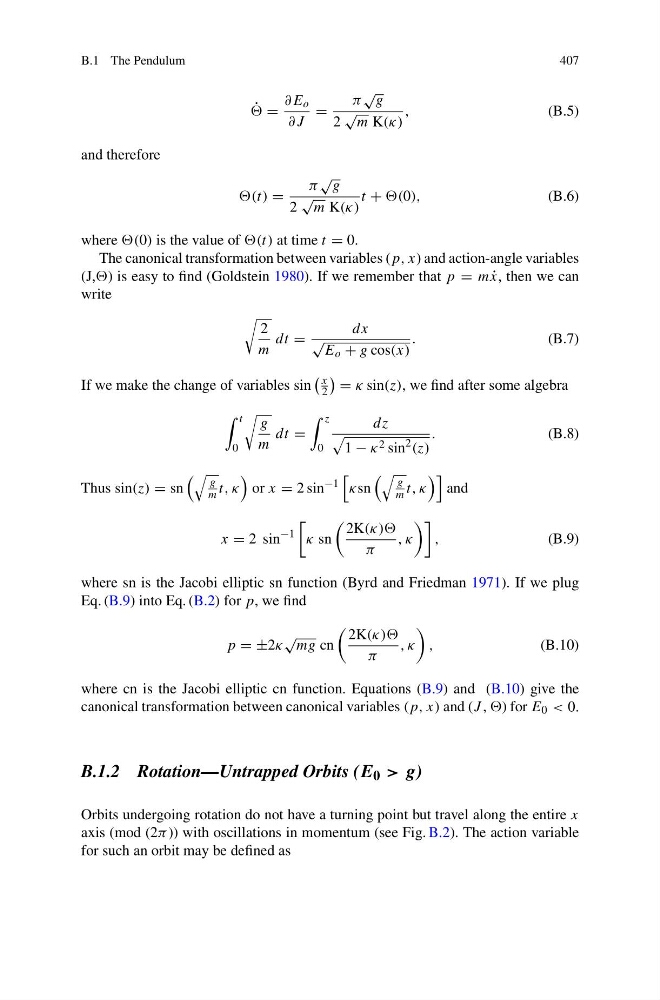
˙
=
∂E o
∂J
=
π
√ g
2
√
m K(κ)
,
(B.5)
and therefore
(t) =
π
√ g
2
√
m K(κ)
t + (0),
(B.6)
where (0) is the value of at time t = 0.
The canonical transformation between variables (p, x) and action-angle variables
(J,) is easy to find (Goldstein 1980). If we remember that p = m ˙
x, then we can
write
2
m
dt =
dx
√
E o + g cos(x)
.
(B.7)
If we make the change of variables sin
x
2
= κ sin(z), we find after some algebra
t
0
g
m
dt =
z
0
dz
1 − κ 2 sin
2 (z)
.
(B.8)
Thus sin(z) = sn
g
m t, κ
or x = 2 sin
−1
κsn
g
m t, κ
and
x = 2 sin
−1
κ sn
2K(κ))
π
, κ
,
(B.9)
where sn is the Jacobi elliptic sn function (Byrd and Friedman 1971). If we plug
Eq. (B.9) into Eq. (B.2) for p, we find
p = ±2κ
√ mg cn
2K(κ))
π
, κ
,
(B.10)
where cn is the Jacobi elliptic cn function. Equations (B.9) and (B.10) give the
canonical transformation between canonical variables (p, x) and (J , ) for E 0 < 0.
B.1.2 Rotation—Untrapped Orbits (E 0 > g)
Orbits undergoing rotation do not have a turning point but travel along the entire x
axis (mod (2π )) with oscillations in momentum (see Fig. B.2). The action variable
for such an orbit may be defined as
407
˙
=
∂E o
∂J
=
π
√ g
2
√
m K(κ)
,
(B.5)
and therefore
(t) =
π
√ g
2
√
m K(κ)
t + (0),
(B.6)
where (0) is the value of at time t = 0.
The canonical transformation between variables (p, x) and action-angle variables
(J,) is easy to find (Goldstein 1980). If we remember that p = m ˙
x, then we can
write
2
m
dt =
dx
√
E o + g cos(x)
.
(B.7)
If we make the change of variables sin
x
2
= κ sin(z), we find after some algebra
t
0
g
m
dt =
z
0
dz
1 − κ 2 sin
2 (z)
.
(B.8)
Thus sin(z) = sn
g
m t, κ
or x = 2 sin
−1
κsn
g
m t, κ
and
x = 2 sin
−1
κ sn
2K(κ))
π
, κ
,
(B.9)
where sn is the Jacobi elliptic sn function (Byrd and Friedman 1971). If we plug
Eq. (B.9) into Eq. (B.2) for p, we find
p = ±2κ
√ mg cn
2K(κ))
π
, κ
,
(B.10)
where cn is the Jacobi elliptic cn function. Equations (B.9) and (B.10) give the
canonical transformation between canonical variables (p, x) and (J , ) for E 0 < 0.
B.1.2 Rotation—Untrapped Orbits (E 0 > g)
Orbits undergoing rotation do not have a turning point but travel along the entire x
axis (mod (2π )) with oscillations in momentum (see Fig. B.2). The action variable
for such an orbit may be defined as