

References
403
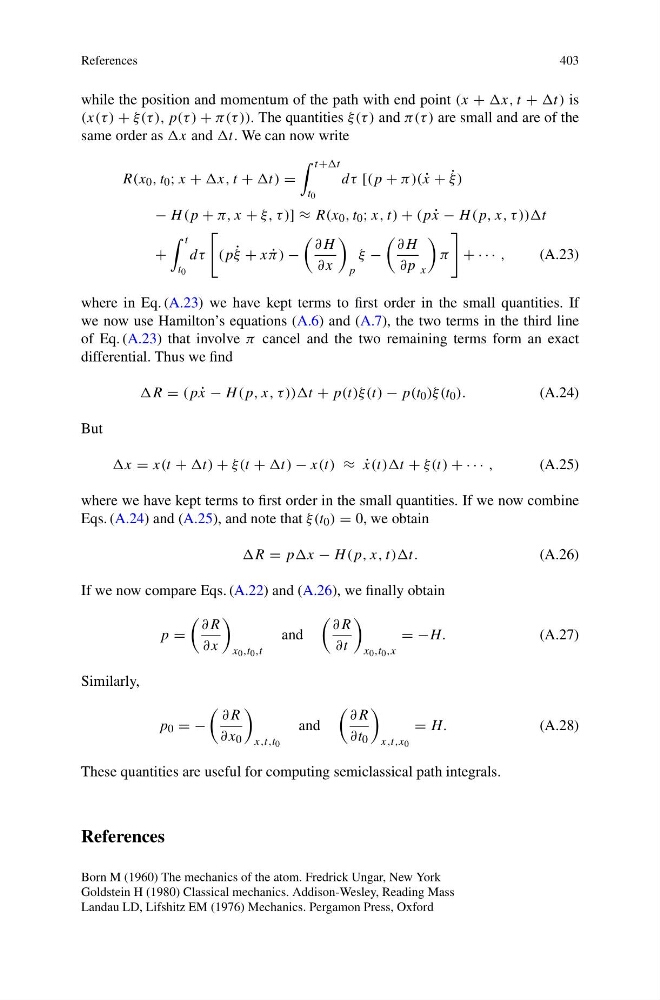
while the position and momentum of the path with end point (x + t + is
(x(τ ) + ξ(τ ), p(τ ) + π(τ )). The quantities ξ(τ ) and π(τ ) are small and are of the
same order as x and t. We can now write
R(x 0 , t 0 ; x + t + =
t+t
t 0
dτ [(p + π)( ˙
x + ˙
ξ)
− H (p + π, x + ξ, τ )] ≈ R(x 0 , t 0 ; x, t) + (p ˙
x − H (p, x, τ )))t
+
t
t 0
dτ
(p ˙
ξ + x ˙
π) −
∂H
∂x
p
ξ −
∂H
∂p x
π
+ · · · ,
(A.23)
where in Eq. (A.23) we have kept terms to first order in the small quantities. If
we now use Hamilton’s equations (A.6) and (A.7), the two terms in the third line
of Eq. (A.23) that involve π cancel and the two remaining terms form an exact
differential. Thus we find
R = (p ˙
x − H (p, x, τ )))t + p(t)ξ(t) − p(t 0 )ξ(t 0 ).
(A.24)
But
x = x(t + t) + ξ(t + t) − x(t) ≈ ˙
x(t))t + ξ(t) + · · · ,
(A.25)
where we have kept terms to first order in the small quantities. If we now combine
Eqs. (A.24) and (A.25), and note that ξ(t 0 ) = 0, we obtain
R = ppx − H (p, x, t))t.
(A.26)
If we now compare Eqs. (A.22) and (A.26), we finally obtain
p =
∂R
∂x
x 0 ,t 0 ,t
and
∂R
∂t
x 0 ,t 0 ,x
= −H.
(A.27)
Similarly,
p 0 = −
∂R
∂x 0
x,t,t 0
and
∂R
∂t 0
x,t,x 0
= H.
(A.28)
These quantities are useful for computing semiclassical path integrals.
References
Born M (1960) The mechanics of the atom. Fredrick Ungar, New York
Goldstein H (1980) Classical mechanics. Addison-Wesley, Reading Mass
Landau LD, Lifshitz EM (1976) Mechanics. Pergamon Press, Oxford
403
while the position and momentum of the path with end point (x + t + is
(x(τ ) + ξ(τ ), p(τ ) + π(τ )). The quantities ξ(τ ) and π(τ ) are small and are of the
same order as x and t. We can now write
R(x 0 , t 0 ; x + t + =
t+t
t 0
dτ [(p + π)( ˙
x + ˙
ξ)
− H (p + π, x + ξ, τ )] ≈ R(x 0 , t 0 ; x, t) + (p ˙
x − H (p, x, τ )))t
+
t
t 0
dτ
(p ˙
ξ + x ˙
π) −
∂H
∂x
p
ξ −
∂H
∂p x
π
+ · · · ,
(A.23)
where in Eq. (A.23) we have kept terms to first order in the small quantities. If
we now use Hamilton’s equations (A.6) and (A.7), the two terms in the third line
of Eq. (A.23) that involve π cancel and the two remaining terms form an exact
differential. Thus we find
R = (p ˙
x − H (p, x, τ )))t + p(t)ξ(t) − p(t 0 )ξ(t 0 ).
(A.24)
But
x = x(t + t) + ξ(t + t) − x(t) ≈ ˙
x(t))t + ξ(t) + · · · ,
(A.25)
where we have kept terms to first order in the small quantities. If we now combine
Eqs. (A.24) and (A.25), and note that ξ(t 0 ) = 0, we obtain
R = ppx − H (p, x, t))t.
(A.26)
If we now compare Eqs. (A.22) and (A.26), we finally obtain
p =
∂R
∂x
x 0 ,t 0 ,t
and
∂R
∂t
x 0 ,t 0 ,x
= −H.
(A.27)
Similarly,
p 0 = −
∂R
∂x 0
x,t,t 0
and
∂R
∂t 0
x,t,x 0
= H.
(A.28)
These quantities are useful for computing semiclassical path integrals.
References
Born M (1960) The mechanics of the atom. Fredrick Ungar, New York
Goldstein H (1980) Classical mechanics. Addison-Wesley, Reading Mass
Landau LD, Lifshitz EM (1976) Mechanics. Pergamon Press, Oxford