

402
A Classical Mechanics Concepts
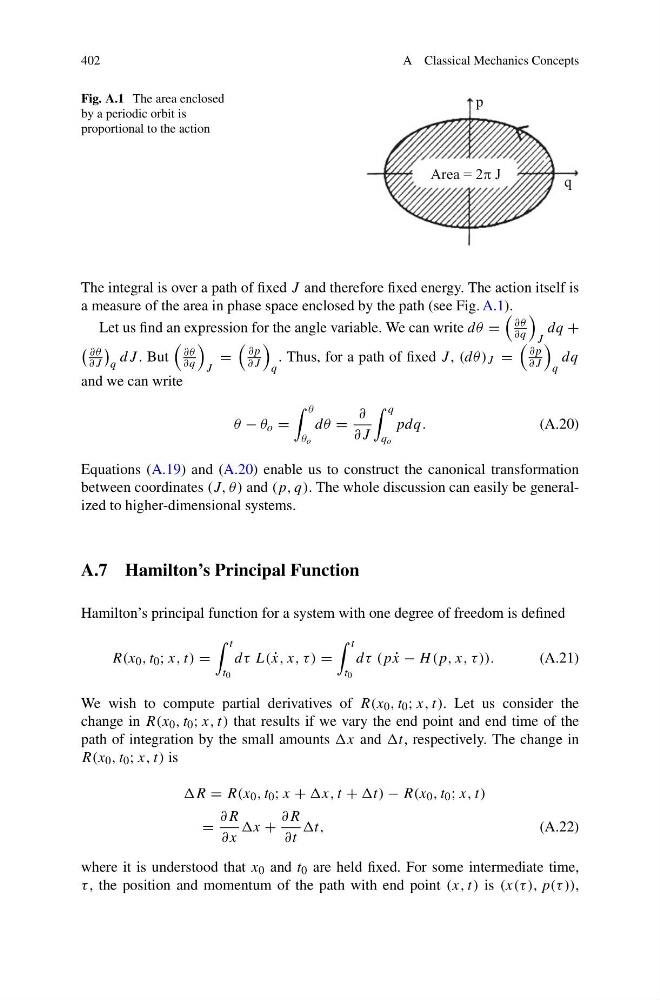
Fig. A.1 The area enclosed
by a periodic orbit is
proportional to the action
p
q
Area = 2S J
The integral is over a path of fixed J and therefore fixed energy. The action itself is
a measure of the area in phase space enclosed by the path (see Fig. A.1).
Let us find an expression for the angle variable. We can write dθ =
∂θ
∂q
J
dq +
∂θ
∂J
q
dJ . But
∂θ
∂q
J
=
∂p
∂J
q
. Thus, for a path of fixed J , (dθ ) J =
∂p
∂J
q
dq
and we can write
θ − θ o =
θ
θ o
dθ =
∂
∂J
q
q o
pdq.
(A.20)
Equations (A.19) and (A.20) enable us to construct the canonical transformation
between coordinates (J, θ ) and (p, q). The whole discussion can easily be generalized to higher-dimensional systems.
A.7 Hamilton’s Principal Function
Hamilton’s principal function for a system with one degree of freedom is defined
R(x 0 , t 0 ; x, t) =
t
t 0
dτ L( ˙
x, x, τ ) =
t
t 0
dτ (p ˙
x − H (p, x, τ )).
(A.21)
We wish to compute partial derivatives of R(x 0 , t 0 ; x, t). Let us consider the
change in R(x 0 , t 0 ; x, t) that results if we vary the end point and end time of the
path of integration by the small amounts x and t, respectively. The change in
R(x 0 , t 0 ; x, t) is
R = R(x 0 , t 0 ; x + x, t + − R(x 0 , t 0 ; x, t)
=
∂R
∂x
x +
∂R
∂t
(A.22)
where it is understood that x 0 and t 0 are held fixed. For some intermediate time,
τ , the position and momentum of the path with end point (x, t) is (x(τ ), p(τ )),
A Classical Mechanics Concepts
Fig. A.1 The area enclosed
by a periodic orbit is
proportional to the action
p
q
Area = 2S J
The integral is over a path of fixed J and therefore fixed energy. The action itself is
a measure of the area in phase space enclosed by the path (see Fig. A.1).
Let us find an expression for the angle variable. We can write dθ =
∂θ
∂q
J
dq +
∂θ
∂J
q
dJ . But
∂θ
∂q
J
=
∂p
∂J
q
. Thus, for a path of fixed J , (dθ ) J =
∂p
∂J
q
dq
and we can write
θ − θ o =
θ
θ o
dθ =
∂
∂J
q
q o
pdq.
(A.20)
Equations (A.19) and (A.20) enable us to construct the canonical transformation
between coordinates (J, θ ) and (p, q). The whole discussion can easily be generalized to higher-dimensional systems.
A.7 Hamilton’s Principal Function
Hamilton’s principal function for a system with one degree of freedom is defined
R(x 0 , t 0 ; x, t) =
t
t 0
dτ L( ˙
x, x, τ ) =
t
t 0
dτ (p ˙
x − H (p, x, τ )).
(A.21)
We wish to compute partial derivatives of R(x 0 , t 0 ; x, t). Let us consider the
change in R(x 0 , t 0 ; x, t) that results if we vary the end point and end time of the
path of integration by the small amounts x and t, respectively. The change in
R(x 0 , t 0 ; x, t) is
R = R(x 0 , t 0 ; x + x, t + − R(x 0 , t 0 ; x, t)
=
∂R
∂x
x +
∂R
∂t
(A.22)
where it is understood that x 0 and t 0 are held fixed. For some intermediate time,
τ , the position and momentum of the path with end point (x, t) is (x(τ ), p(τ )),