

392
10 Time-Periodic Quantum Systems
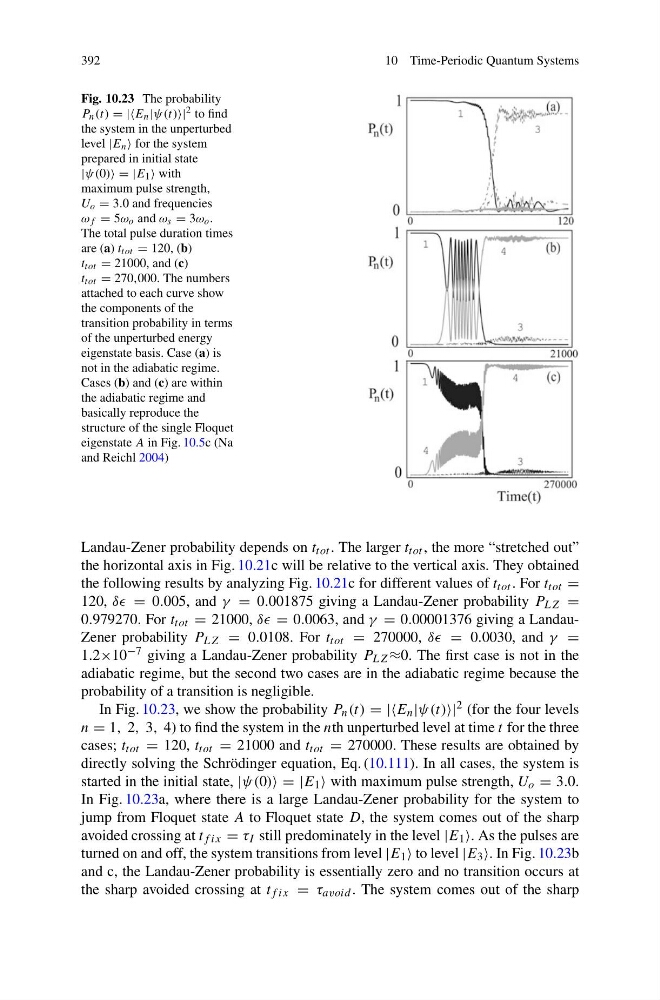
Fig. 10.23 The probability
P n (t) = ||E n |ψ(t) 2 to find
the system in the unperturbed
level |E n for the system
prepared in initial state
|ψ(0) = |E 1 with
maximum pulse strength,
U o = 3.0 and frequencies
ω f = 5ω o and ω s = 3ω o .
The total pulse duration times
are (a) t tot = 120, (b)
t tot = 21000, and (c)
t tot = 270,000. The numbers
attached to each curve show
the components of the
transition probability in terms
of the unperturbed energy
eigenstate basis. Case (a) is
not in the adiabatic regime.
Cases (b) and (c) are within
the adiabatic regime and
basically reproduce the
structure of the single Floquet
eigenstate A in Fig. 10.5c (Na
and Reichl 2004)
Landau-Zener probability depends on t tot . The larger t tot , the more “stretched out”
the horizontal axis in Fig. 10.21c will be relative to the vertical axis. They obtained
the following results by analyzing Fig. 10.21c for different values of t tot . For t tot =
120, δδ = 0.005, and γ = 0.001875 giving a Landau-Zener probability P LZ =
0.979270. For t tot = 21000, δδ = 0.0063, and γ = 0.00001376 giving a LandauZener probability P LZ = 0.0108. For t tot = 270000, δδ = 0.0030, and γ =
1.2×10 −7 giving a Landau-Zener probability P LZ ≈0. The first case is not in the
adiabatic regime, but the second two cases are in the adiabatic regime because the
probability of a transition is negligible.
In Fig. 10.23, we show the probability P n (t) = ||E n |ψ(t) 2 (for the four levels
n = 1, 2, 3, 4) to find the system in the nth unperturbed level at time t for the three
cases; t tot = 120, t tot = 21000 and t tot = 270000. These results are obtained by
directly solving the Schrödinger equation, Eq. (10.111). In all cases, the system is
started in the initial state, |ψ(0) = |E 1 with maximum pulse strength, U o = 3.0.
In Fig. 10.23a, where there is a large Landau-Zener probability for the system to
jump from Floquet state A to Floquet state D, the system comes out of the sharp
avoided crossing at t f ix = τ I still predominately in the level |E 1 . As the pulses are
turned on and off, the system transitions from level |E 1 to level |E 3 . In Fig. 10.23b
and c, the Landau-Zener probability is essentially zero and no transition occurs at
the sharp avoided crossing at t f ix = τ avoid . The system comes out of the sharp
10 Time-Periodic Quantum Systems
Fig. 10.23 The probability
P n (t) = ||E n |ψ(t) 2 to find
the system in the unperturbed
level |E n for the system
prepared in initial state
|ψ(0) = |E 1 with
maximum pulse strength,
U o = 3.0 and frequencies
ω f = 5ω o and ω s = 3ω o .
The total pulse duration times
are (a) t tot = 120, (b)
t tot = 21000, and (c)
t tot = 270,000. The numbers
attached to each curve show
the components of the
transition probability in terms
of the unperturbed energy
eigenstate basis. Case (a) is
not in the adiabatic regime.
Cases (b) and (c) are within
the adiabatic regime and
basically reproduce the
structure of the single Floquet
eigenstate A in Fig. 10.5c (Na
and Reichl 2004)
Landau-Zener probability depends on t tot . The larger t tot , the more “stretched out”
the horizontal axis in Fig. 10.21c will be relative to the vertical axis. They obtained
the following results by analyzing Fig. 10.21c for different values of t tot . For t tot =
120, δδ = 0.005, and γ = 0.001875 giving a Landau-Zener probability P LZ =
0.979270. For t tot = 21000, δδ = 0.0063, and γ = 0.00001376 giving a LandauZener probability P LZ = 0.0108. For t tot = 270000, δδ = 0.0030, and γ =
1.2×10 −7 giving a Landau-Zener probability P LZ ≈0. The first case is not in the
adiabatic regime, but the second two cases are in the adiabatic regime because the
probability of a transition is negligible.
In Fig. 10.23, we show the probability P n (t) = ||E n |ψ(t) 2 (for the four levels
n = 1, 2, 3, 4) to find the system in the nth unperturbed level at time t for the three
cases; t tot = 120, t tot = 21000 and t tot = 270000. These results are obtained by
directly solving the Schrödinger equation, Eq. (10.111). In all cases, the system is
started in the initial state, |ψ(0) = |E 1 with maximum pulse strength, U o = 3.0.
In Fig. 10.23a, where there is a large Landau-Zener probability for the system to
jump from Floquet state A to Floquet state D, the system comes out of the sharp
avoided crossing at t f ix = τ I still predominately in the level |E 1 . As the pulses are
turned on and off, the system transitions from level |E 1 to level |E 3 . In Fig. 10.23b
and c, the Landau-Zener probability is essentially zero and no transition occurs at
the sharp avoided crossing at t f ix = τ avoid . The system comes out of the sharp