

378
10 Time-Periodic Quantum Systems
10.8.1 Arnol’d Diffusion in the Driven Optical Lattice
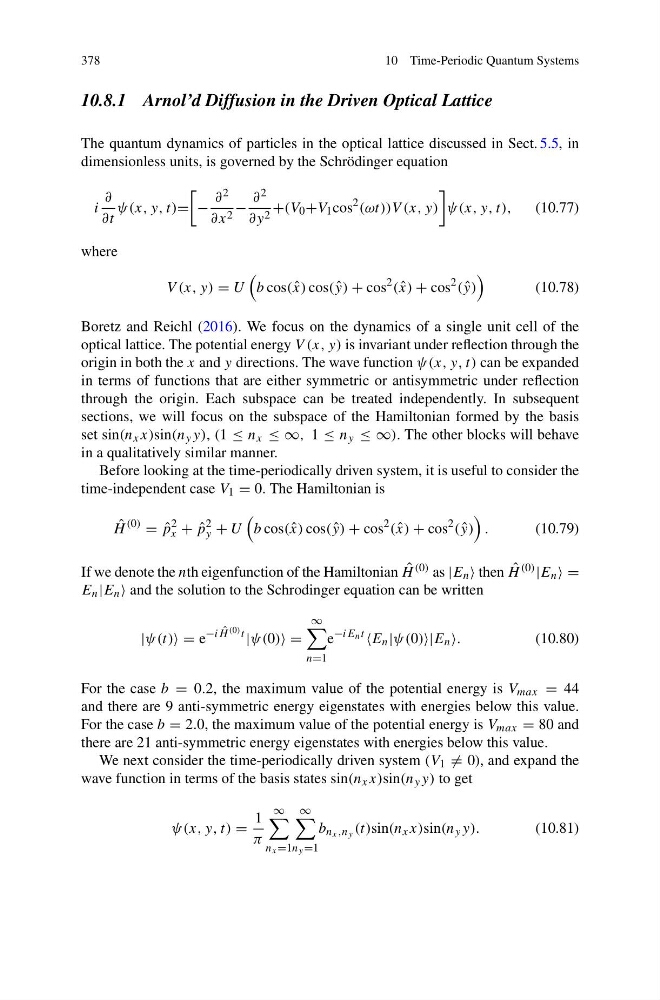
The quantum dynamics of particles in the optical lattice discussed in Sect. 5.5, in
dimensionless units, is governed by the Schrödinger equation
i
∂
∂t
ψ(x, y, t)=
−
∂ 2
∂x 2 −
∂ 2
∂y 2 +(V 0 +V 1 cos
2 (ωt))V (x, y)
ψ(x, y, t),
(10.77)
where
V (x, y) = U
b cos( ˆ
x) cos( ˆ
y) + cos
2 ( ˆ
x) + cos
2 ( ˆ
y)
(10.78)
Boretz and Reichl (2016). We focus on the dynamics of a single unit cell of the
optical lattice. The potential energy V (x, y) is invariant under reflection through the
origin in both the x and y directions. The wave function ψ(x, y, t) can be expanded
in terms of functions that are either symmetric or antisymmetric under reflection
through the origin. Each subspace can be treated independently. In subsequent
sections, we will focus on the subspace of the Hamiltonian formed by the basis
set sin(n x x)sin(n y y), (1 ≤ n x ≤ ∞, 1 ≤ n y ≤ ∞). The other blocks will behave
in a qualitatively similar manner.
Before looking at the time-periodically driven system, it is useful to consider the
time-independent case V 1 = 0. The Hamiltonian is
ˆ
H
(0)
= ˆ
p
2
x + ˆ
p
2
y + U
b cos( ˆ
x) cos( ˆ
y) + cos
2 ( ˆ
x) + cos
2 ( ˆ
y)
.
(10.79)
If we denote the nth eigenfunction of the Hamiltonian ˆ
H (0) as |E n then ˆ
H (0) |E n =
E n |E n and the solution to the Schrodinger equation can be written
|ψ(t) = e
−i ˆ
H (0) t
|ψ(0) =
∞
n=1
e
−iE n t
E n |ψ(0)|E n .
(10.80)
For the case b = 0.2, the maximum value of the potential energy is V max = 44
and there are 9 anti-symmetric energy eigenstates with energies below this value.
For the case b = 2.0, the maximum value of the potential energy is V max = 80 and
there are 21 anti-symmetric energy eigenstates with energies below this value.
We next consider the time-periodically driven system (V 1 = 0), and expand the
wave function in terms of the basis states sin(n x x)sin(n y y) to get
ψ(x, y, t) =
1
π
∞
n x =1
∞
n y =1
b n x ,n y (t)sin(n x x)sin(n y y).
(10.81)
10 Time-Periodic Quantum Systems
10.8.1 Arnol’d Diffusion in the Driven Optical Lattice
The quantum dynamics of particles in the optical lattice discussed in Sect. 5.5, in
dimensionless units, is governed by the Schrödinger equation
i
∂
∂t
ψ(x, y, t)=
−
∂ 2
∂x 2 −
∂ 2
∂y 2 +(V 0 +V 1 cos
2 (ωt))V (x, y)
ψ(x, y, t),
(10.77)
where
V (x, y) = U
b cos( ˆ
x) cos( ˆ
y) + cos
2 ( ˆ
x) + cos
2 ( ˆ
y)
(10.78)
Boretz and Reichl (2016). We focus on the dynamics of a single unit cell of the
optical lattice. The potential energy V (x, y) is invariant under reflection through the
origin in both the x and y directions. The wave function ψ(x, y, t) can be expanded
in terms of functions that are either symmetric or antisymmetric under reflection
through the origin. Each subspace can be treated independently. In subsequent
sections, we will focus on the subspace of the Hamiltonian formed by the basis
set sin(n x x)sin(n y y), (1 ≤ n x ≤ ∞, 1 ≤ n y ≤ ∞). The other blocks will behave
in a qualitatively similar manner.
Before looking at the time-periodically driven system, it is useful to consider the
time-independent case V 1 = 0. The Hamiltonian is
ˆ
H
(0)
= ˆ
p
2
x + ˆ
p
2
y + U
b cos( ˆ
x) cos( ˆ
y) + cos
2 ( ˆ
x) + cos
2 ( ˆ
y)
.
(10.79)
If we denote the nth eigenfunction of the Hamiltonian ˆ
H (0) as |E n then ˆ
H (0) |E n =
E n |E n and the solution to the Schrodinger equation can be written
|ψ(t) = e
−i ˆ
H (0) t
|ψ(0) =
∞
n=1
e
−iE n t
E n |ψ(0)|E n .
(10.80)
For the case b = 0.2, the maximum value of the potential energy is V max = 44
and there are 9 anti-symmetric energy eigenstates with energies below this value.
For the case b = 2.0, the maximum value of the potential energy is V max = 80 and
there are 21 anti-symmetric energy eigenstates with energies below this value.
We next consider the time-periodically driven system (V 1 = 0), and expand the
wave function in terms of the basis states sin(n x x)sin(n y y) to get
ψ(x, y, t) =
1
π
∞
n x =1
∞
n y =1
b n x ,n y (t)sin(n x x)sin(n y y).
(10.81)